Thursday, December 8, 2016

Getting Loopy


Took a ride on the loop-d-loop...
That's when I fell in love
Down at Palisades Park
      -Freddy Cannon

Run, run,run
Runaway
    -Dell Shannon


Greetings

     Its true that our political situation is now expressing it's essential loopiness, (Climate denier to head EPA) and there is some loopiness in the weather  the jet stream is getting wobbly, and the poles are too hot. -Artcic air to hit 35-55F above normal

.   But the loops I am thinking of now are the loop in the climate models - the feedback loops.   Some of the are negative loops, which tend to reduce to CO2, but most seem to be "positive" loops which despite their name, tend to make things worse.

      A recent study has brought put a degree of precision on one of the loops - carbon releases from land and sea and the fact that  the ocean and land tend to hold less carbon as they get warmer.   So co2 in the air causes heat on land and sea, and heat causes more co2 releaases from the land and sea to the air.     Robert Scribbler has a useful article  that explains the study in more detail.  Its worth taking a look at, because the implications are pretty astounding.   

Here are a two quotes

"Sadly, soil respiration is just one potential feedback mechanism that can produce added greenhouse gasses as the Earth warms. Warming oceans take in less carbon and are capable of producing their own carbon sources as they acidify and as methane seeps proliferate. Forests that burn due to heat and drought produce their own carbon sources. But increasing soil respiration, which has also been called the compost bomb, represents what is probably one of the most immediate and likely large sources of carbon feedback."

.......

What this means is that the stakes for cutting human carbon emissions to zero as swiftly as possible just got a whole hell of a lot higher. If we fail to do this, we will easily be on track for 5-7 C or worse warming by the end of this Century. And this level of warming happening so soon and over so short a timeframe is an event that few, if any, current human civilizations are likely to survive. Furthermore, if we are to avoid terribly harmful warming over longer periods, we must not only rapidly transition to renewable energy sources. We must also somehow learn to pull carbon, on net, out of the atmosphere in rather high volumes.

    As Robert points out, thanks to natural gas and renewable power, the amount of carbon the world puts into the air has actually begun to stop rising, and begun to reach a plateau.   Unfortunately the actual concentration of CO2 in the air has not stopped rising. .  it continues to rise at a record breaking pace.   Which naturally leads to the question :  Where is this extra carbon coming from?"    It appears that some of the additional CO2 is a result of that the carbon feedback from the ocean and land.  

        As the feedback increases, the warming increases, at an accelerating rate.   The study shows a fairly wide range of outcomes,  but it may be useful to consider the worst case scenario.  Because as our information has gotten better, it seems that the scientific studies are generally conservative.  


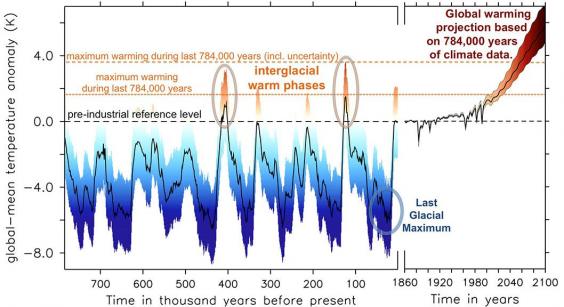
      With that in mind, take look at the graph from the study,   As I read it, the worst case is 4 degrees by 2040.
globaltemperature.jpg

From The Independent

   
And Robert points out that the study itself is conservative. 
"And it is also worth noting that the study categorizes its own findings as conservative estimates. That the world could, as an outside risk, see as much as four times the amount of carbon feedback (or as much as 2.7 ppm of CO2 per year) coming from soil if respiration is more efficient and wide-ranging than expected. If a larger portion of the surface soil carbon in newly warmed regions becomes a part of the climate system as microbes activate."
Is the study legit?  Apparently so.
"Professor Michael Mann, of Penn State University in the US, who led research that produced the famous “hockey stick” graph showing how humans were dramatically increasing the Earth’s temperature, told The Independent the new paper appeared "sound and the conclusions quite defensible".

It is pretty well accepted that 4 degrees is bad .  (!)
"The thing is, if 2 degrees C is extremely dangerous, 4 degrees C is absolutely catastrophic. In fact, according to the latest science, says Anderson, “a 4 degrees C future is incompatible with an organized global community, is likely to be beyond ‘adaptation’, is devastating to the majority of ecosystems, and has a high probability of not being stable.”
From here and here   
Professor Kevin Anderson, director of the Tyndall Centre for Climate Change in Britain, was quoted in The Scotsman  ahead of the 2009 Copenhagen conference saying the consequences were ‘‘terrifying’’.
‘‘For humanity it’s a matter of life or death ... we will not make all human beings extinct, as a few people with the right sort of resources may put themselves in the right parts of the world and survive. But I think it’s extremely unlikely that we wouldn’t have mass death at 4 degrees.
‘‘If you have got a population of 9 billion by 2050 and you hit 4 degrees, 5 degrees or 6 degrees, you might have half a billion people surviving.’’

      OK, this is pretty bad. And of course well before 2040, other odd things will occur.   As this article points out
"...the climate crisis will not appear as a climate crisis, at least not to most people in the U.S.  Rather, it will appear as a political crisis, often precipitated by economic upheaval.  It will come in the form of migration, of course, but also in the form of poverty and a growing underclass of people uprooted from their old livelihoods, with little support from a government and society stretched too thin by mounting crises.  Very likely it will have racist component, which doesn’t mean that there will all of a sudden be more horrible and bad people.  Rather, it means that when ecological and thus economic crises squeeze people, trust horizons shrink, fault lines widen, and people (good enlightened urban liberals, we are seeing, as well) become more tribal.  As Trump so clearly shows, these shrinking trust horizons are exceedingly easy to manipulate."
   However, it would be mistake to try to blame these crises on Trump or conservatives.  The author notes           
"I am repeatedly struck with how ignorant the average well-educated, politically-involved, often graduate-educated membr of the liberal elite is about issues having to do with the climate and the magnitude of the crisis that awaits our inaction.  ...... For these liberals, the climate remains an abstraction, one that “we” are “better on” (“we don’t deny climate change, they do!”), which is apparently enough for now. 

But the facts speak well enough for themselves, the problem is almost no one bothers to learn them, nor has the university or powerful centers of journalism taken a lead in mainstreaming ecological awareness.  So, for the sake of review, here are just a few (or many) basics.  Even the best case scenario has us on a path to warm the globe by around two degrees centigrade, though our actions and expectations are aiming at a place much warmer than that.   The damage that this alone will cause—never mind all the other ecological disasters occurring simultaneously—will ravage our way of life.  There is little reason to expect our current world order to survive the climate crisis unless we make drastic changes, especially in our consumption.  For climate change is not only about it getting hotter, it is about unravelling the web of ecological connections that maintain life as we know it.  To this end, I think most liberals remain oblivious to the delicate nature of ecological equilibriums and to the extent to which nature provides us with irreplaceable “services,” like clean(ish) water, soil, pollination, air, relative weather predictability, a balance among species (including pests and pestilence), a check on the spread of disease, and the list could go on

And yet anyone who tries too hard to assert the importance of climate issues or suggest that ecological destruction has to do with real human beings and their suffering is accused of being insufficiently concerned about other pressing issues that are already on the table.  Anyone who forefronts climate destruction, I have heard it said multiple times, is simply writing from a race, class, and gender subject-position that makes him or her insufficiently aware about the real problems affecting real people.  Unaware of the also basic fact that Americans (6% of the world population) consume about a quarter of all natural resources and create about a quarter of all emissions, these same “informed liberals” still cheer-on a rising U.S. GDP, while preparing to participate enthusiastically in this year’s “healthy retail season.”  This is not a blind-spot; this is an eclipse.  Liberal America, at least the part of it that makes a “decent” income, it bears mentioning, is also a greater squanderer of nature than less affluent rural America, the latter’s transfixion with NASCAR and ATV’s, and our membership in the Sierra Club, notwithstanding.  A couple of airplane flights, not to mention a second home in the country, is all it takes to send your own carbon footprint into orbit.  But such entitlements remain a third-rail of political discussion today.


Using  easy labels will not be helpful in understanding each other, and harder still understanding ourselves

"We are just doing what we were taught, following the expectations that we received from our formal education and informal socialization.  We certainly are not trying to make the planet uninhabitable, in fact many of strive to do just the opposite.  But the numbers do not lie and as history will someday be told, Americans led the charge towards the climate-cliff, cheering themselves on with great enthusiasm and little self-doubt.  It is far easier to put your own consumption and expectations about it into an accurate global perspective if you are not in the habit of dividing the world into good vs. evil."

We are heading into some really hard times.  We will be tempted to frame the problems in terms of good guys and bad guys  (and of course we will always be the "good" guys)  , of us and them.   And that will probably not be useful.  We will need to accept that we all created this mess, and will need to cooperate  to get through it.

"The whole system thinking that obliges one to admit our own complicity, and requires one to understand, to try to engage with the feelings and beliefs that people very different from oneself might have, to have sympathy for other’s with whom we may appear to have irreconcilable differences, puts us very close to the teachings of most religions. "


Labels: , , , ,

Monday, April 20, 2015

Red sun in the morning


Wheels on fire
Rolling down the road
    - the Band
I have only one burning desire
Let me stand next to your fire
       -Jimi Hendrix
Greetings
       You've probably noticed that the smoke from Siberia has given us some pretty spectacular sun rises and sunsets.  Here's some pretty amazing shots of the burning..   From here  

“The Dry Land Burned Like Grass” — Siberia’s Road to a Permaburn Hell

(Residents of the Trans Baikal region of Russia flee through a raging permafrost fire on April 13 of 2015. Video Source: The Road to Hell Recorded by: Vladislav Igorevich.)
The script reads like a scene from some post-apocalyptic disaster film.
Frigid Siberia begins an epic thaw — a thaw set off by an unstoppable dumping of heat-trapping gasses into the atmosphere by human fossil fuel industry. Finally, after years of warming, the thawing land itself becomes fuel for fires. A thick layer of peat-like organic material that serves as kindling to the heat-dried trees and grasses atop it.
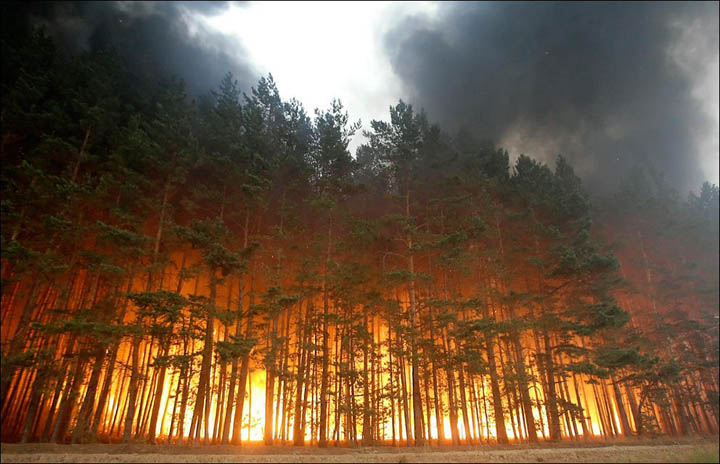
Immense blazes ignite in April — fully 100 days before the usual fire season in late July. The fires explode to enormous size, doubling in area in less than a day, covering scores to hundreds of square miles. Residents flee or face off against walls of raging flame in bucket and hose brigades. Military units descend on the regions affected to fight blazes and prevent looting. The fires are freakish, starting from nowhere at a moment’s notice. Eyewitnesses at the scene of one fire describe the surreal situation saying: “… the dry land burned like grass.”
inside_chita_fores
(A wall of fire confronts residents of Chita, Russia this week as local townsfolk prepared to defend their homes and livelihoods from the inferno. Image source: The Siberian Times.)
But for two regions of Russia, that’s exactly what happened this week.
In Khakassia, a region of southern Siberia bordering Kazakhstan and Mongolia, massive blazes ripped through a broad permafrost thaw zone, impacting 39 villages, killing 29 people and leaving thousands homeless. By Thursday, many of these massive fires were finally extinguished — leaving miles wide scars over a smoldering and blackened land.
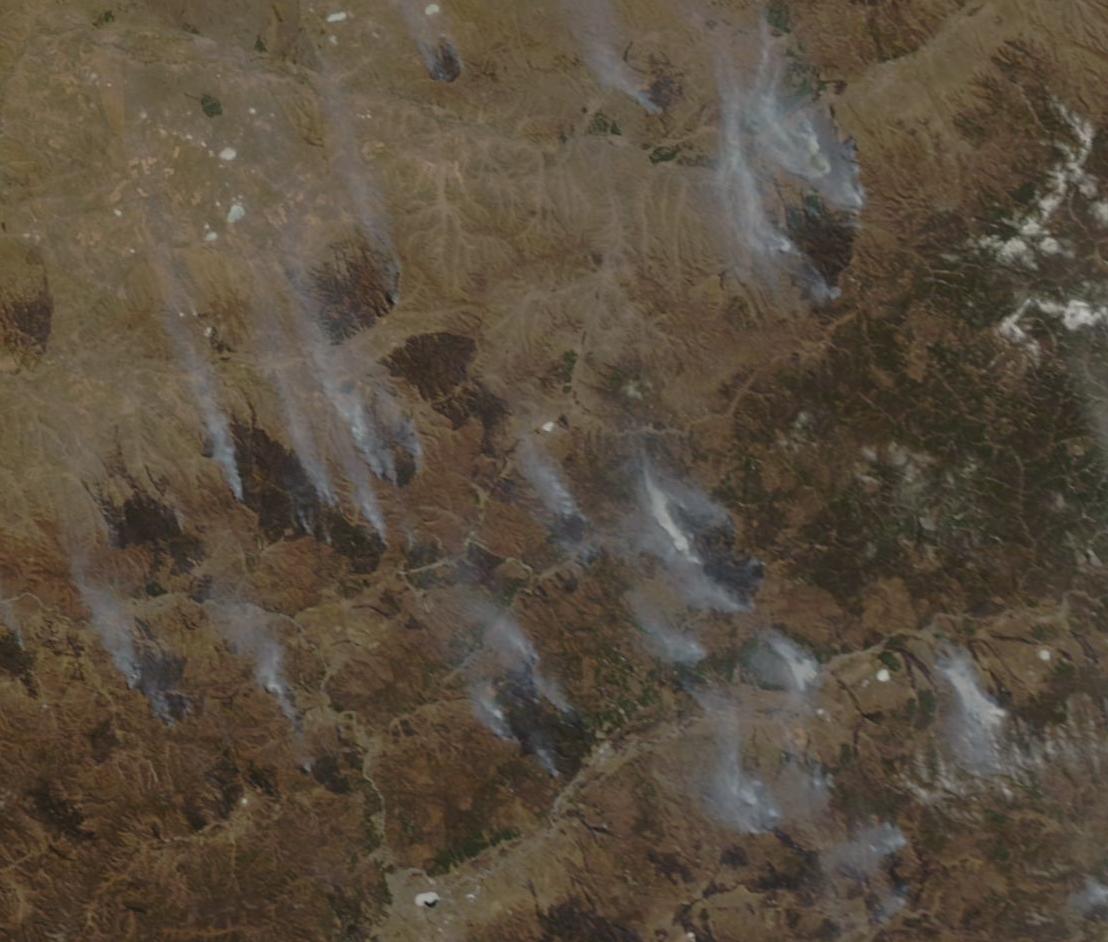
Hundreds of miles away in Trans Baikal, the story was also one of hellish inferno. There, wildfires erupted from the thawing permafrost zone — engulfing forests, burning dry land, destroying hundreds of homes in more than 9 villages, and killing four people. One wildfire alone surged to nearly 400 square miles in size and threatened numerous settlements near the city of Chita. There, locals are still fighting the blaze in a desperate effort to preserve life and property.
Chita Fires April 17 2015
(Satellite image of fires and large burn scars in Chita, Russia on April 17 of 2015. For reference, bottom edge of frame is 120 miles. Note that some of the burn scars in this satellite shot stretch for 20 miles at their widest point. Image source: LANCE MODIS.)
In total, nearly 50 villages and towns have now been affected, 33 lives have been lost, four more have gone missing, nearly 7,000 people are now homeless, and more than 6,000 domestic animals have been lost to the fires. These are the first, early casualties in a fire season stoked by climate change that will flare off and on for at least the next five months. A fire season that will likely see immense plumes of smoke covering broad sections of the Northern Hemisphere, involve Canadian and Alaskan permafrost zones, and see wildfires burning all the way through Siberia to the shores of the Arctic Ocean.
And so we are just at the start of a long road through another hellish Arctic fire season, one enabled and made far, far worse by a current and very rapid rate of human-forced warming.
Links:
Hat tip to Alexander Ac

Labels: , , , ,

Monday, May 26, 2014

NASA: Melt of Antarctic Glacier Unstoppable


Ice, ice, baby
  -Vanilla Ice

He feels the piston scraping --
Steam breaking on his brow --
Thank God, he stole the handle and
The train won't stop going --
No way to slow down.
   -Jethro Tull

Greetings

    I've been re-reading "Thinking In Systems"  by Donella Meadows.  It;s great stuff,  but hard on my linear thinking brain.  So, of course one of the features is self reinforcing feedback loops.    Regardless of the inputs from outside the system, they continue.    Apparently the Antarctic glaciers have sucha feedback. 

  The result ?  15 foot sea level rise.

NASA glaciologist Eric Rignot  put it this way:
“The collapse of this sector of West Antarctica appears to be unstoppable. The fact that the retreat is happening simultaneously over a large sector suggests it was triggered by a common cause, such as an increase in the amount of ocean heat beneath the floating sections of the glaciers. At this point, the end of this sector appears to be inevitable.”
   Portions of the NASA news conference are provided  courtesy of Radio Eco shock.    (see below)   Very interesting to listen to the news conference.  Several times, questioners asked something like :  "You don't really mean "unstoppable" , do you?"    And severa;l times the scientists said "Yes, We can't stop it, but we can speed it up!"


------------

Grim News From NASA: West Antarctica’s Entire Flank Collapsing Toward Southern Ocean, At Least 15 Feet of Sea Level Rise Already Locked-in Worldwide

(Must-watch NASA presentation finding six Antarctic Glaciers in irreversible collapse.)
Human-caused heat forcing. From the top of the atmosphere to the bottom of the world’s oceans, there’s no safe place to put it. For where-ever it goes it sets in place conditions with the potential to unleash gargantuan forces.
481. Minus aerosols, that’s the equivalent CO2 heat forcing humans have now built up in the atmosphere due to a constant and rapidly rising greenhouse gas emission. By itself, this heat forcing, were it to remain in the world’s atmosphere and ocean system, is enough to melt all of West Antarctica, all of Greenland, and part of East Antarctica pushing sea levels higher by between 30 and 120 feet or more.
Inertia. Namely, the massive inertia in the Earth climate system creating a perceived ability to resist rapid destabilization due to the human insult. It’s the one hope scientists and policy-makers alike pinned on the possibility of bringing human greenhouse gas emissions down in time to prevent radical and damaging change.
Rapid glacier and ice sheet destabilization. What, by 2014, became understood as the new reality, as an ever-increasing number of the world’s glaciers displayed far less resilience than previously anticipated and were set in motion to an unstoppable and catastrophic reunion with the world’s oceans by human warming.
Now, a new NASA study finds that six of West Antarctica’s largest glaciers are in a state of irreversible collapse. These add to a growing tally of destabilized glaciers from Greenland to Svalbard to Baffin Island to Antarctica and beyond which, all together, show that at least a 15 foot sea level rise from human-spurred glacial release is now inevitable.
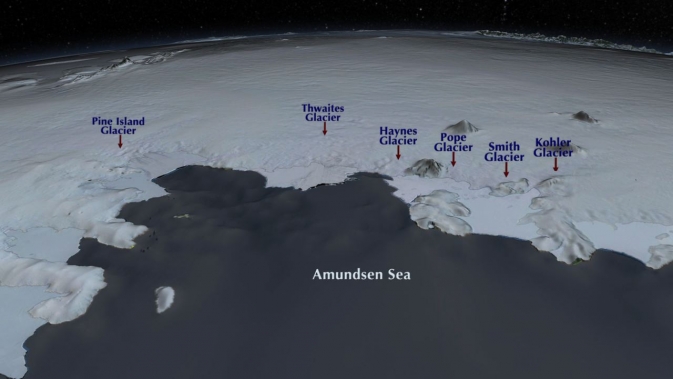
Their names were Pine Island, Thwaites, Haynes, Pope, Smith and Kohler
antarctica_screen_grab1_2
(The locations of West Antarctica’s ‘butcher board’ glaciers — those that are doomed to an inevitable embrace with the Amundsen Sea. Image source: NASA.)
At issue are six massive glaciers representing more than 1/3 of total the ice mass of West Antarctica and what could well be called its entire weak flank.
As early as 1968, this massive section of West Antarctica was listed as unstable. Since that time, human heat forcing has pumped higher and higher volumes of warmth deep into the Pacific Ocean. The warmth pooled in the depths, building, even as it rose up beneath Antarctica. Ocean circulation and Ekman pumping along the coast of Antarctica brought this warm water up from the depths where it traveled along the continental shelf zone to encounter Antarctica’s mile-high glaciers. The warm water did its work, unseen, for a time. Eating away at the bottoms of these glaciers and speeding their slide to the sea. The increased glacial melt and related fresh water outflow put a kind of cold water cap on the Southern Ocean around Antarctica. This cold cap gave the ever-warming bottom waters no outlet to the surface and so the heat concentrated where it was needed least — at the bases of massive ocean-fronting glaciers.
One section of West Antarctica, composed of the six glaciers now listed as undergoing irreversible collapse, was particularly vulnerable to this basalt melt and ocean upwelling heat forcing. For the glaciers there rested on a section of continental shelf well below sea level — extending scores of miles beneath the ice and on into interior Antarctica. As a result, newly undercut glaciers are flooded until they float, creating lift, reducing friction and rapidly speeding the glacier’s plunge seaward. Even worse, few sub-glacier ridges — speed bumps that glaciologists call grounding points — interrupt the more rapid flow of these glaciers once initiated.
(NASA slide-show illustrating the process of basal melt and grounding line retreat)
By earlier this year, a separate NASA study found that the Pine Island Glacier (PIG), one of the world’s largest glaciers and the most vulnerable ice sheet in West Antarctica, had entered a state of irreversible collapse. Now, the most recent study, led by glaciologist Eric Rignot at NASA’s Jet Propulsion Laboratory, finds that five of its fellows — Thwaites, Haynes, Pope, Smith, and Kohler — are following PIG’s lead.
Rignot’s findings could not be more stark:
“The collapse of this sector of West Antarctica appears to be unstoppable. The fact that the retreat is happening simultaneously over a large sector suggests it was triggered by a common cause, such as an increase in the amount of ocean heat beneath the floating sections of the glaciers. At this point, the end of this sector appears to be inevitable.”
In other words, over the course of decades-to-centuries, these glaciers will disintegrate and slide into the sea until they are no more. Years from now, their names will be a distant memory, reminders of a faded and far better time.
At Least 15 Feet of Sea Level Rise From Glacial Melt Now Locked-in
This year, the pace of new announcements for massive glaciers undergoing destabilization or irreversible collapse could best be described as terrifying and unprecedented. And each new announcement brings with it starker implications for both the ultimate pace and scope of global sea level rise.
Global sea level rise
(Current pace of global sea level rise at 3.26 mm per year is likely now set to rapidly accelerate coincident with the rapid acceleration and melt of an ever-increasing number of the world’s glaciers. Image source: AVISO.)
The amount of sea level rise to result from just the loss of the disintegrating section of West Antarctica described in the most recent NASA study amounts to at least four feet. But looking around the world we also find rapid destabilization of more than 13 glaciers encircling all of Greenland with one, the Zacharie Glacier, featuring an ice flow that stretches all the way to the center of the Greenland ice mass. Recent studies also find that the massive glaciers of Baffin Island and the world’s largest ice cap — the Austfonna glacier on Svalbard’s island of Nordaustlandet — are all locked in an inevitable seaward rush.
The total water composed in the moving and destabilized glaciers worldwide is now at least enough to raise world ocean levels by a total of 15 feet. But the inevitable loss of these glaciers tells a darker tale, one that hints that the 23 feet worth of sea level rise in all of Greenland’s ice and the 11-13 feet of sea level rise in all of West Antarctica’s ice may well be locked in to what is a growing daisy chain of explosive destabilization if human greenhouse gas levels aren’t radically drawn down.
In continuing to emit greenhouse gasses, we make the situation ever worse by imposing a heightening heat pressure on glacial systems that will both speed their release and ensure that an ever growing portion of the Earth’s ice ultimately melts. The current forcing though both extreme and dangerous is small compared to the potential forcing should we not rapidly reign in the human emission.
Links:
Hat tip to Peter Sinclair and Colorado Bob

-------


ANTARCTICA IS MELTING!

SUMMARY: Gasp! Antarctica is melting. Coastal cities at risk. New science direct from NASA. Plus eminent climate scientist Kevin Trenberth predicts strong El Nino impacts on world weather. Radio Ecoshock 140521

Welcome to Radio Ecoshock, I'm Alex Smith - but you won't hear much from me in this program. There is huge news from the Antarctic. Scientists fears that those glaciers will melt, lifting global sea levels above the streets of many world coastal cities - have been verified by two studies.

Later in the program, you will hear an excellent interview of top climate scientists Kevin Trenberth, conducted by Peter Sinclair.


Download this Radio Ecoshock show in CD Quality (56 MB) or Lo-Fi (14 MB)

FREE CLIMATE AUDIO QUOTES

At the bottom of this blog you can also find out about our new climate music contest, and links to download key climate quotes from Radio Ecoshock interviews. You can use these quotes for music, or in your podcast, radio show, or as audio for your web page or blog. Help yourself, help the world.

THE BIGGEST CLIMATE NEWS THIS YEAR - ANTARCTICA IS MELTING

But right now we're going to bypass the mainstream media machine to hear from the NASA scientists who say the melt of one Antarctic glacier set is now "unstoppable". We don't often get such certainty from science, or large government agencies.

This is a moment to gasp, just like the record Arctic sea ice melt of 2007. The planet has undeniably and unmistakably been altered. It's a major tipping point crossed. Even without the Greenland Ice melt, the Antarctic glaciers will reshape the geography of land for all conceivable generations to come. Redraw the maps, and realize humans will eventually withdraw from mega-cities ranging from New York to China, a retreat from the sea by millions of people, from trillions of dollars in assets. That's what this is about.

I play you an edited-for-radio replay of the NASA press conference held May 12th for the media.

Scientists have long feared that human-made climate change would trigger melting of Antarctic glaciers, especially in the fragile West Antarctic Peninsula. Now the bad news is upon us: Antarctica is melting. The process NASA scientists say, is unstoppable. The inevitable result will be massive sea level rise over the next several centuries. Some scientists suggest 7 meters, or 22 feet of sea level rise is even possible this century, but the NASA study is more conservative, as you will hear.

Keep in mind when the study authors talk about 3 meters, or 10 feet of global sea level rise, they are discussing only the potential from a small part of the West Antarctic Peninsula they have studied, not the totals from elsewhere among the South Pole glaciers, or melt waters from Greenland.


Eric Rignot

We begin with the voice of Thomas Wagner, NASA's Program Scientist for the cryosphere and Director of the agency's polar studies. He is introducing the lead scientist for this Antarctic study, Eric Rignot. Eric is Professor of Earth System Science at the University of California, Irvine. You will hear his entire presentation for the NASA teleconference, held May 12th, 2014.


Sridhar Anandakrishnan

Our next speaker at the NASA teleconference is Sridhar Anandakrishnan, Professor of Geosciences at Pennsylvania State University.

I then play you key questions from major media to these scientists and their replies. It's also an exercise in seeing what TV networks and top tier newspapers ask. You can then compare how that filters through to the public. For example, while these NASA scientists say the Antarctic glacier melt they studied IS unstoppable, the New York Times reported it MAY be unstoppable. The certainty of science did not make it to the public.

You can watch the NASA teleconference in full here.

The fact that Antarctica is committed to melting, or at least parts of the West Antarctic Peninsula are, is one of the biggest stories in years. Joe Romm, the respected energy expert and blogger at Climate Progress, says this means coastal cities in many parts of the world will ultimately be abandoned.

You can see what the United States will look like with just ten feet (3 meters) of sea level rise here.

I also recommend this short video by Peter Sinclair - "This Is Not Cool". He interviews scientists, with a couple of news clips, about huge sea level rise coming.

Mother Jones has this key article about the West Antarctic ice sheet collapse.

You can get more essential facts from this Washington Post article.

EAST ANTARCTICA ALSO AT RISK OF MELTING

But it's not just the West Antarctic peninsula, although that will go first. New science finds East Antarctica, long thought impervious to near-term climate change, is also at risk of melting.

TWENTY TWO FEET OF SEA LEVEL RISE BY 2070?

The most extreme prediction comes when University of Ottawa climate scientist Paul Beckwith asks whether we could see 7 meters of sea level rise (22 feet!) by 2070. Find that in this You tube video. Paul also points out that moving massive amounts of water from land-based glaciers to the oceans could destabilize weak spots in the Earth's crust, leading to more seismic activity (read deadly earthquakes and tsunamis).

You can read Peter Sinclair's blog article about important New York Times coverage of this Antarctic melting news, plus references to the original science, here.

Unfortunately, one of the original scientific papers is behind a pay wall. Here is the linkanyway.

Labels: , , , ,