Monday, April 20, 2015

Red sun in the morning


Wheels on fire
Rolling down the road
    - the Band
I have only one burning desire
Let me stand next to your fire
       -Jimi Hendrix
Greetings
       You've probably noticed that the smoke from Siberia has given us some pretty spectacular sun rises and sunsets.  Here's some pretty amazing shots of the burning..   From here  

“The Dry Land Burned Like Grass” — Siberia’s Road to a Permaburn Hell

(Residents of the Trans Baikal region of Russia flee through a raging permafrost fire on April 13 of 2015. Video Source: The Road to Hell Recorded by: Vladislav Igorevich.)
The script reads like a scene from some post-apocalyptic disaster film.
Frigid Siberia begins an epic thaw — a thaw set off by an unstoppable dumping of heat-trapping gasses into the atmosphere by human fossil fuel industry. Finally, after years of warming, the thawing land itself becomes fuel for fires. A thick layer of peat-like organic material that serves as kindling to the heat-dried trees and grasses atop it.
Immense blazes ignite in April — fully 100 days before the usual fire season in late July. The fires explode to enormous size, doubling in area in less than a day, covering scores to hundreds of square miles. Residents flee or face off against walls of raging flame in bucket and hose brigades. Military units descend on the regions affected to fight blazes and prevent looting. The fires are freakish, starting from nowhere at a moment’s notice. Eyewitnesses at the scene of one fire describe the surreal situation saying: “… the dry land burned like grass.”
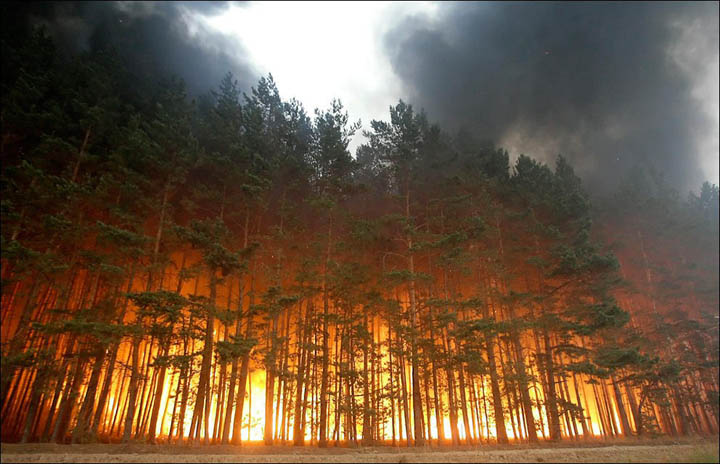
inside_chita_fores
(A wall of fire confronts residents of Chita, Russia this week as local townsfolk prepared to defend their homes and livelihoods from the inferno. Image source: The Siberian Times.)
But for two regions of Russia, that’s exactly what happened this week.
In Khakassia, a region of southern Siberia bordering Kazakhstan and Mongolia, massive blazes ripped through a broad permafrost thaw zone, impacting 39 villages, killing 29 people and leaving thousands homeless. By Thursday, many of these massive fires were finally extinguished — leaving miles wide scars over a smoldering and blackened land.
Hundreds of miles away in Trans Baikal, the story was also one of hellish inferno. There, wildfires erupted from the thawing permafrost zone — engulfing forests, burning dry land, destroying hundreds of homes in more than 9 villages, and killing four people. One wildfire alone surged to nearly 400 square miles in size and threatened numerous settlements near the city of Chita. There, locals are still fighting the blaze in a desperate effort to preserve life and property.
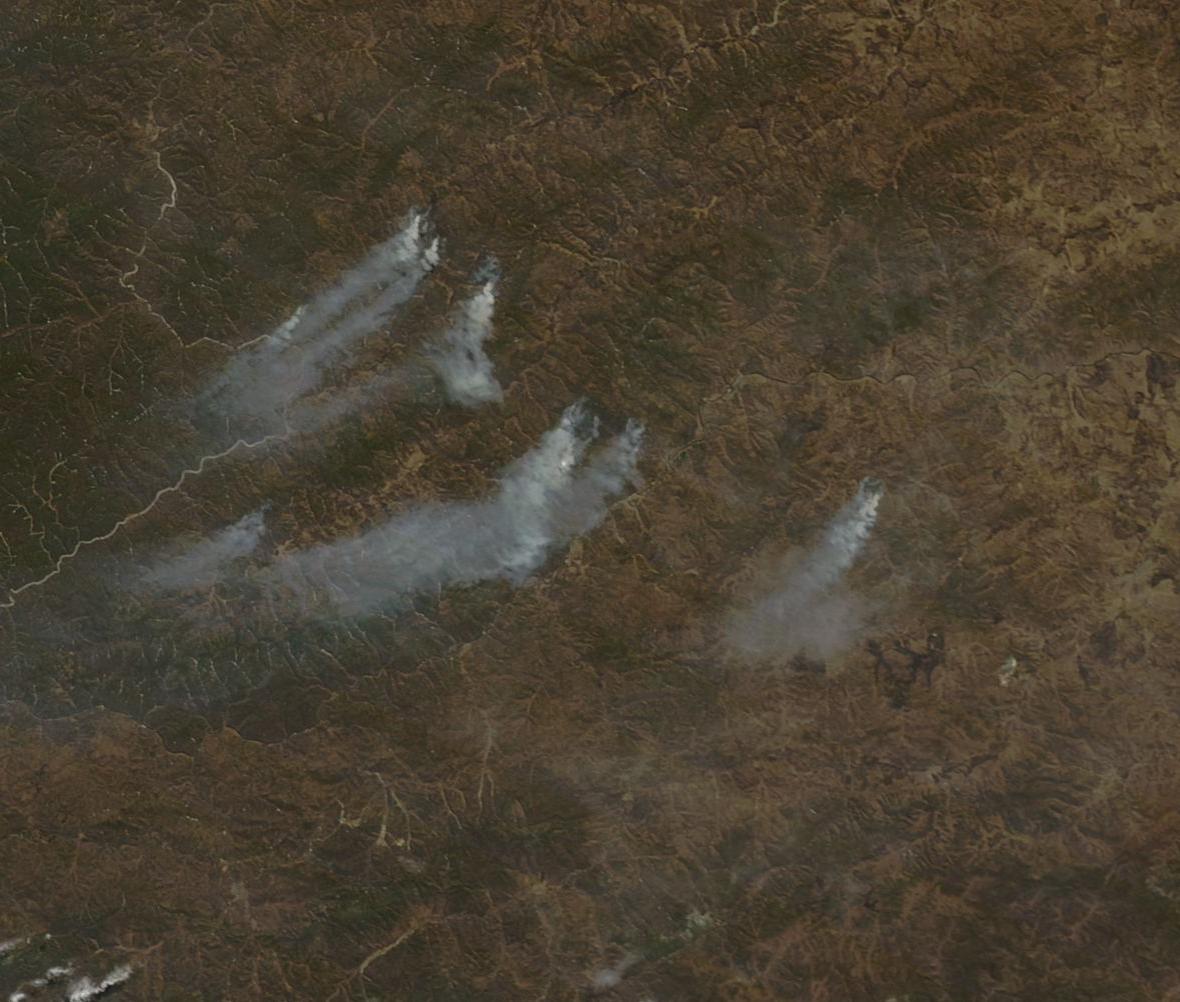
Chita Fires April 17 2015
(Satellite image of fires and large burn scars in Chita, Russia on April 17 of 2015. For reference, bottom edge of frame is 120 miles. Note that some of the burn scars in this satellite shot stretch for 20 miles at their widest point. Image source: LANCE MODIS.)
In total, nearly 50 villages and towns have now been affected, 33 lives have been lost, four more have gone missing, nearly 7,000 people are now homeless, and more than 6,000 domestic animals have been lost to the fires. These are the first, early casualties in a fire season stoked by climate change that will flare off and on for at least the next five months. A fire season that will likely see immense plumes of smoke covering broad sections of the Northern Hemisphere, involve Canadian and Alaskan permafrost zones, and see wildfires burning all the way through Siberia to the shores of the Arctic Ocean.
And so we are just at the start of a long road through another hellish Arctic fire season, one enabled and made far, far worse by a current and very rapid rate of human-forced warming.
Links:
Hat tip to Alexander Ac

Labels: , , , ,

Thursday, April 24, 2014

Fire and Ice


Some say the world will end in fire
some say ice
- Robert Frost

I saw new history of time...
New history of time!!!

Through Siberian woods
Breaking up their neck
  -Gogol Bordello


Greetings

Here's something new from RobertScribbler, a good site for climate science explained.   Also interesting comments like this:

Watch ice berg 8 times the size of Manhatten break off 

http://www.livescience.com/44958-ice-island-b31-antarctica.html

---
Odds of storm waters overflowing Manhattan seawall up 20-fold
The newly recognized storm-tide increase means that New York is at risk of more frequent and extensive flooding than was expected due to sea-level rise alone, said Stefan Talke, an assistant professor of civil and environmental engineering at Portland State University in Portland, Ore. He is lead author of the new study accepted for publication in Geophysical Research Letters, a journal of the American Geophysical Union. The research also confirms that the New York harbor storm tide produced by Hurricane Sandy was the largest since at least 1821.
Tide gauge data analyzed in the study show that a major, “10-year” storm hitting New York City today causes bigger storm tides and potentially more damage than the identical storm would have in the mid-1800s. Specifically, Talke explained, there’s a 10 percent chance today that, in any given year, a storm tide in New York harbor will reach a maximum height of nearly two meters (about six and a half feet), the so-called “10-year storm.” In the mid-19th century, however, that maximum height was about 1.7 meters (about 5.6 feet), or nearly a foot lower than it is today, according to tide gauge data going back to 1844, he noted.
“What we are finding is that the 10-year storm tide of your great-, great-grandparents is not the same as the 10-year storm tide of today,” Talke said.


-----


A Dangerous Dance of Frost and Flame: More Than 100 Wildfires Now Raging Along Siberian Melt-Freeze Line

Anomalous, global-warming-enhanced, fires continued to erupt across Eastern Russia this week, chasing a rapidly receding freeze line north and into zones still frozen, but starting to shake off ice cover far too soon for comfort.
According to reports from Radio Free Europe, more than 5,000 pieces of heavy equipment and many more firefighters are now battling blazes throughout Siberia this week. As of April 20th, more than 100 blazes were reported in numerous regions including: the Orenburg area around Lake Baikal, the Amur region, the Birobidzhan Autonomous Oblast, the Primorsky Krai, and the Far Eastern region of Russia.
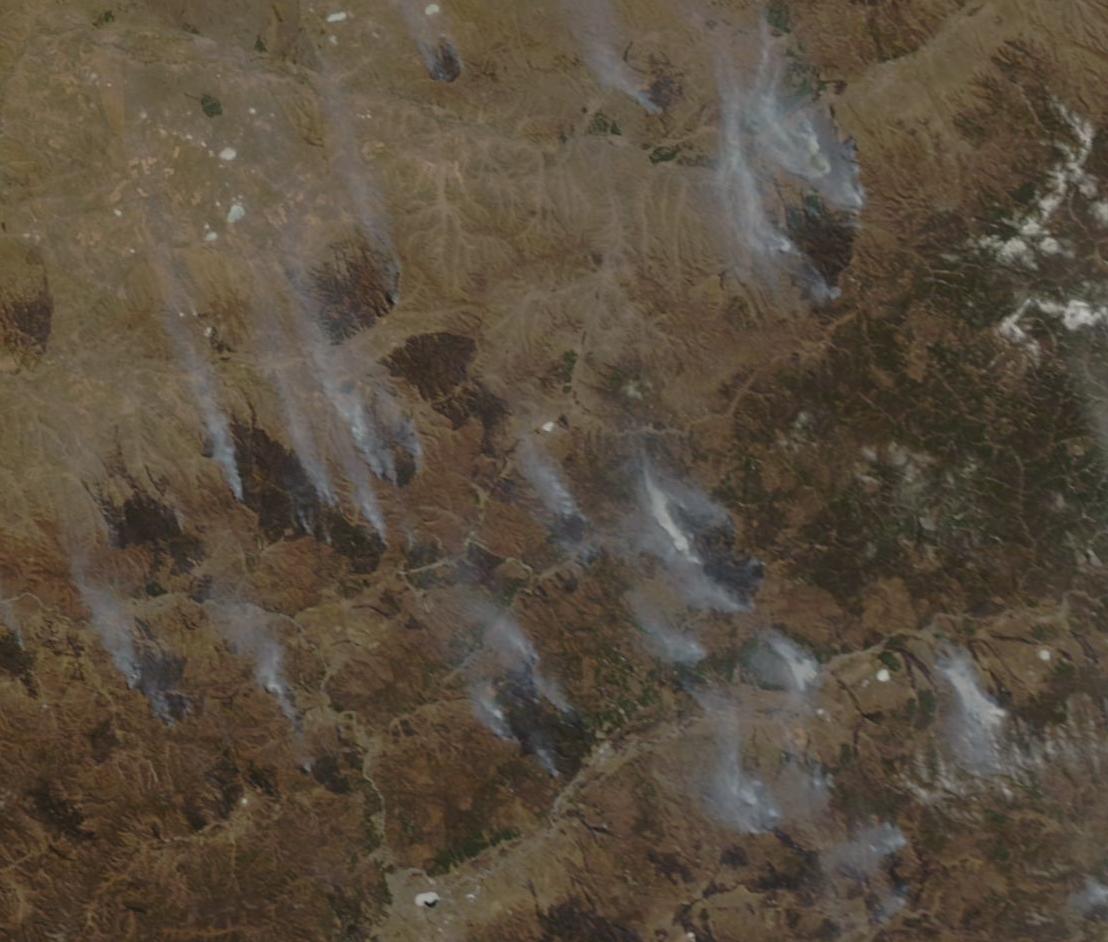
Multiple Wildfires Raging in the Amur Region of Russia
(Multiple wildfires raging in the Amur region of Russia on April 23, 2014. Image source:LANCE-MODIS.)
The fires come as temperatures ranging from 5-18 C above average continued throughout a region that has experienced hotter than normal temperatures all winter and on into spring of 2014.
For example, the average April high temperature for the region of Lake Baikal is typically a frigid 28 F, while this week is expected to see highs in the lower to middle 40s. Further east, the temperature extremes are more radical. In Amur Blagoveshchensk, the average low is about 27 degrees F for this time of year, the average high, about 50. But today the low was 52 and the high is forecast to be 78 — 25 and 28 degrees above average respectively.
All across Eastern Russia, the story is the same: above average warmth, early thaw, summer-like temperatures in spring time. It has been this way day after day, month after month. Since 2010, the story has mostly been the same: early thaw, record or near record heat, amazing fire hazard. Even more concerning, the situation is steadily growing worse.
How Global Warming is Turning the Siberian Tundra into a Firetrap
Winters during cold regions are typically comparatively dry events. Though snows may pile up, the water content of the snows amount to much less moisture than it would seem. During spring, a gradual thaw ensures this moisture keeps the thin, top layer of soil above the permafrost (called the active layer) from drying out too rapidly. Typically only inches to a few feet in depth, this layer is far more susceptible to drying than a deeper layer with access to greater moisture sources at depth. But only frozen or melting permafrost currently rest below the active layer, creating a moisture barrier or worse — adding a potential fuel source for wildfires.
Eastern Russia in a Hot Zone
(Eastern Russia in a hot zone. Hot atmospheric ridge and coincident extreme temperature anomalies stretching from Southeast Asia, up through China and Eastern Russia and on up through the polar region. Information Source: NOAA Global Forecast Systems Model. Image source: University of Maine.)
In years of warmer than usual temperatures, as has happened more and more often under the current regime of human-caused warming, the thaw occurs rapidly and the active layer quickly dries out. This loss of moisture amplifies into a kind of tundra drought that can block atmospheric moisture flows and prevent rainfall, compounding the drying problem until the more energetic storms of summer arrive.
In addition, expanding zones of thawing permafrost provide two added fuel sources for wildfires. Tundra melt in high water content areas forms into wet thermokarsts, mires or melt ponds that vent methane gas in high enough concentration to burn. Tundra melt that rapidly dries after thaw forms into a peat-like basement layer that can burn and smolder for long periods once ignited.
On average, temperatures have been rising by about .4 C per decade throughout Siberia. So almost every spring now falls into what would typically be called a hot year. In addition, amplification of Jet Stream wave patterns deliver proportionately more heat to regions in the up-slope of these high amplitude atmospheric pulses, forming hot, high pressure ridges. And this year, the heat ridge has consistently formed over China, Mongolia and Eastern Siberia — the region of the current large fire outbreaks.
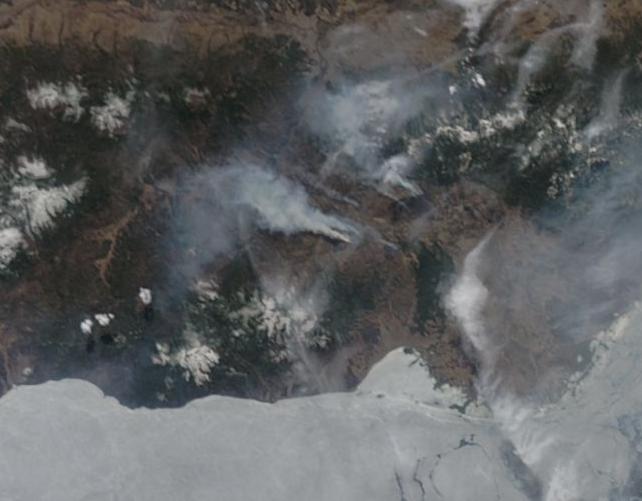
Russian wildfire burning on the shores of still frozen Lake Baikal April 23 2014
(Siberian wildfires burning on the shores of still-frozen Lake Baikal in southern Siberia on April 23, 2014. Image source: LANCE-MODIS.)
As a result, what we are seeing is an extraordinary outbreak of intense wildfires directly adjacent to still melting snow and frozen lakes. A surreal event that reminds one of the ever-at-war frost and fire giants of ancient Viking legend. But these giants, the fire giants at least, are a direct result of an ongoing and ever increasing human-caused heating of our world.
Links:
Labels: , , ,