Wednesday, July 26, 2017

Send in the clowns


Fools rush in
Where wise men fear to tread 
    -Elvis

Idiot wind
Blowing every time you move your mouth
    Bob Dylan


Greetings 

What can I say?  A bit heavy handed but fairly typical of this administration .       See also Glacier Park Ranger can't talk to Zuckberg about the future of glaciers. here.     The market place is at least slowing Trump's efforts to re-carbonized the economy.  As long as natural gas is cheaper than coal, less coal plants will be running.  Similarly Rick Perry's attempt to prove the fossil fuels are better than renewables seems to have hit a snag..

       As this op ed points out ,Trump trying to lobotomizing America, introducing The Golden Age of Stupidity
“The opposite of knowledge is ignorance. But the willful disregard of knowledge — regardless of motive — is stupidity. That is because those who battle facts are at war with reality. It is an unwinnable proposition. Furthermore, specialized knowledge, particularly that of scientists, is essential if we are to do what leaders must, anticipate change, understand its consequences and harness the opportunities it presents. Trump, in waging a systematic campaign to rid the government of the experts and ideas he sees as threats to his agenda, has done more than just usher in a Golden Age of Stupidity.  He is unwittingly asking a question it doesn't take an expert to figure out: "What happens when you lobotomize the world's leading power?"

        LOokingat th e bigger picture, it seems to me that the "big question "seems to have shifted from "Can we avoid "dangerous"climate change ( 1.5 or 2 degrees)"   To something like "Can we slow things down at bit, maybe decarbonize before we hit 4 degrees?"  

      Four degrees does look a little spooky:  Here's one description.  From here 


 "But according to one of the world’s most influential climate scientists, John Schellnhuber, ‘the difference between two and four degrees is human civilisation.’ Thanks to the global paralysis since 1992, the ‘window of opportunity’ for reducing emissions fast enough to avoid this scenario is starting to look more like a crack in the plaster.
Four degrees of warming, Marshall tells us, is likely to bring heatwaves of magnitudes never experienced before, and temperatures not seen on Earth in the last five million years. Forty per cent of plant and animal species would be at risk of extinction, a third of Asian rainforests would be under threat and most of the Amazon would be at high risk of burning down. Crop yields would collapse, possibly by a third in Africa. US production of corn, soy beans and cotton would fall by up to 82 per cent. Four degrees guarantees the total melting of the Greenland ice sheet and probably the Western Antarctic ice sheet, which would raise sea levels by more than thirty feet. Two-thirds of the world’s major cities would end up underwater. And we aren’t looking at a multigenerational timescale: we may see a four-degree rise over the next sixty years. ‘The science around four degrees keeps moving,’ Marshall notes, ‘usually in the direction of greater pessimism.’
       Trump and his fossil fueled friends seem happy to push ahead burn what there is, and deal with 4 when that comes. 

          I've been reading an interesting book called Defiant Earth, by Clive Hamilton.  He explores some ideas about what it means to be in the Anthropocene.  Stuff like :  In the post anthropocene - what is "nature", what is  "progress", and what is humanity's role?  Its pretty dry, but  worth a look,  One quote sticks with me:

"What kind of creature interfered with the Earths functioning and would not desist when the facts became known?"

           So, Trump's "plan" is pedal to the metal.  What about the rest of the world?   Plan B seems to be green growth,  as growth is apparently non negotiable .  For instance see here.


'There seems to be a complete inability for senior policy makers to even countenance the possibility that a period of economic contraction may be required to reduce greenhouse gas emissions at the rate required to forestall dangerous climate change. This inability was on display in an interview given by Christiana Figueres, the former UN Climate Chief, to Radio New Zealand[1]. She went out of her way to state that the decarbonization of the global economy was not inconsistent with continued economic growth. The desperation to not question the growth paradigm, and the many misleading tactics used to keep questions of growth at bay, were fully on display in the Figueres interview and the recent paper she published with others[2]:


       Arguably  both Plan Trump, and Plan B are both versions of what has been called "the politics of unsustainability ".   Consciously, or unconsciously, the unsustainability of our life style is accepted.  Therefore the only real strategy is how to adapt to its effects  -  rising tides, drowning cities, burning forests, climate refugees.  These are all just facts of life in the Athropocene.  Expressing ourselves through consumption,  travel,  and other high status displays are the highest good.  Maintenance of nature, the biosphere get lip service only.    We are in a post e ogical era    This is described in a somewhat academic way as follows:


'Whatever its declared commitments, this politics of unsustainability is no longer powered by the ecologist attempt to change individual lifestyles and societal structures in such a way that environmental integrity may be sustained and ecologist visions of authentic social well-being achieved. Instead, its primary concern is to manage the inevitable consequences, social and ecological, of the resolve to sustain the established order. Rather than tryingto suspend or even reverse the prevailing logic of unsustainability, its main preoccupation is to promote societal adaptation and resilience to sustained unsustainability.


The mechanism is described below.   This may seem a little cynical, but consider this little factoid from the head of the IEA.
"Fossil fuels accounted for 81% of the world's energy consumption in 1987. Thirty years later it's still 81%."  (Kyoto was in 1997, ever since CO2 concentrations have been accelerating)


"For their politics of unsustainability, so the theory of post-ecologist politics suggests, advanced post-industrial societies are relying, in particular, on strategies of simulation. These strategies entail the production and maintenance of societal self-descriptions in which modern societies portray themselves as having fully recognised the seriousness and urgency of the sustainability crisis, as having a clear understanding of what remedial action is required and as commanding the political will and ability to implement it. These societal self descriptions provide reassurance that the problem is taken seriously, that it is being researched and addressed with all available expertise, and that appropriate counter-strategies are being pursued with undivided determination. They create discursive spaces in which individuals, collective actors and society at large can present and experience themselves as ecologically virtuous and committed without compromising the post-ecologist value preferences which condition their thinking and behaviour otherwise. These narratives of reassurance include, for example, the above-mentioned stories of ecological modernisation and the Green New Deal, the story that a ‘science of sustainability’ can ‘provide the rock-solid foundations upon which the structures of sustainable development’ can then be raised...


         What would the politics of sustainability look like?   Here's  a critique of green growth and decoupling.   Here;s a possible  Plan C  Avoiding Collapse, An agenda for sustainable degrowth  

Labels: , , , ,

Thursday, February 2, 2017

Alternative Facts

Its all part 
of my rock and roll fantasy
Its all part 
of my rock and roll dream
     -Bad Company

This is not my beautiful house
       -Talking Heads

Greetings

      Well, we apparently have moved into the "truth free" area.    Here is a funny ( I think)  take on how the founding fathers might react to our current way of doing things.


"Two hundred years ago no one would have thought sheer volume of available facts in the digital information age would fail to produce informed Americans. Founders of the republic, steeped in the Enlightenment as they were, and believers in an informed citizenry being vital to freedom and democracy, would be delirious with joy at the prospect. Imagine Jefferson and Franklin high on Google. 
The fatal assumption was that Americans would choose to think and learn, instead of cherry picking the blogs and TV channels to reinforce their particular branded choice cultural ignorance, consumer, scientific or political, but especially political. Tom and Ben could never have guessed we would chase prepackaged spectacle, junk science, and titillating rumor such as death panels, Obama as a socialist Muslim and Biblical proof that Adam and Eve rode dinosaurs around Eden. "  (from here)
      So, where am I going with this?    As far as energy and the environment are concerned, we are caught between two visions of the future, neither of which seem to be particularity likely to occur.  On the one hand we have the views of the current administration.  This used to be called "Drill Baby Drill" ,but is now known as   "The "America First Energy Plan", .  

    This plan has three desired goals,  all of which were met in the 1950's, but unfortunately in today's energy world, only two could be realized at the same time. 


Two out of three
To close, let’s look again at the three goals of Trump’s America First Energy Plan:
• Abundant fossil fuel
• Profitable fossil fuel
• Cheap fossil fuel
With remaining resources increasingly represented by unconventional oil such as that in the Permian basin of Texas, there is indeed abundant fossil fuel – but it’s very expensive to get. Therefore if oil companies are to remain profitable, oil has to be more expensive – that is, there can be abundant fossil fuel and profitable fossil fuel, but then the fuel cannot be cheap (and the economy will hit the skids). Or there can be abundant fossil fuel at low prices, but oil companies will lose money hand-over-fist (a situation which cannot last long).
It’s a bit harder to imagine, but there can also be fossil fuel which is both profitable to extract and cheap enough for economies to afford – it just won’t be abundant. That would require scaling back production/consumption to the remaining easy-to-extract conventional fossil fuels, and a reduction in overall demand so that those limited supplies aren’t immediately bid out of a comfortable price range. For that reduction in demand to occur, there would have to be some combination of dramatic reduction in energy use per capita and a rapid increase in deployment of renewable energies.   (for more details see  here.)


           On the other side we have our shiny new renewable plan which also has three goals. - cheap abundant energy, universal prosperity, and no significant environmental impact.

     Once again we find these goals to be internally inconsistent, as illustrated by Professor  William Reese, the creator of the ecological footprint analysis.  In In a nice review of the situation , Chapter 4 of the  Worldwatch Institutes,  "State of the World" 2013 , Professor Reese explains  how thoroughly unsustainable our current situation is, and that on average we are using the "ecological income " from  1.5 planets, each year.   Carbon emissions are of course, a major part of the unsustainable situation, but other population dependent factors such top soil loss,  over fishing and forestry also continue the increase..
  
        But, of course, the  current lavish, energy rich lifestyles of the "developed nation" , exists overwhelmingly as a result of the use of fossil fuels.   Reese provides a  recipe for sustainability for the west.,  First he punctures the "sustainability through efficiency " meme noting that ..". total resource and energy demand in most of the world’s industrial countries has increased in absolute terms over the past 40 years despite efficiency gains of 50 percent in materials and 30 percent in energy use".

       He then explains what it would take:

Clearly, lifestyle choices have a significant impact on our Ecological Footprint. However, even if average Vancouverites followed a vegan diet; avoided driving or flying and only walked, cycled, or used public transit;lived in a passive solar house that used almost no fossil-based energy; and cut their personal consumption by half, they could only reduce their per 
capita Ecological Footprint by 44 percent (from 4.96 to 2.8 gha per capita).That seems like an impossible challenge already—and yet it is still a full global hectare beyond the one-planet threshold.


       In case you skipped that quote, here is the takeaway,  in order to return to sustainability, , we  in the "west" need to do the following things :No driving, no flying, and  little buying.  Oh,yeah, and become a vegan.   And even then, its pretty iffy. 
       
       But that's not picture we get from our leaders, or environmental activists.  They assume, we can have more of the same, with no major changes. How can we have such irrationality on both sides.?  It seems that both on the right and left are able to forget facts when they conflict with dreams.   Here's an interesting article on the appeal of "fake news" to both sides of the political spectrum.  One study found  that both sides were happy not to question or analyze,  and that liberals, were only " slightly more predisposed to think critically than conservatives ."
"Daniel Kahan, a Yale professor of law and psychology, says his research has found that people on the right are no more vulnerable to political bias than those on the left.

""Bottom line," Kahan said in an email, "there's ample evidence of politically biased information processing across the entire ideological spectrum."


         So, one might argue that humans are often  basically irrational, and believe what makes them feel good.  see here  When confronted by opposing facts, they will often, not change their minds , but will even hold their original position more strongly See e.g. The Back fire effect.

         OK, so, how is this likely to play out?

         For one possible future, lets look at John Micheal Greer, who recently wrote,


The Earth’s economically accessible reserves of fossil carbon dwindle day by day; with each year that passes, on average, the amount of coal, oil, and natural gas burnt exceeds the amount that’s discovered by a wider margin  (ed  see above); the current temporary glut in the oil markets is waning so fast that analysts are predicting the next price spike as soon as 2018.  (ed. see here) Talk of transitioning away from fossil fuels to renewable energy, on the one hand, or nuclear power on the other, remains talk—I encourage anyone who doubts this to look up the amount of fossil fuels burnt each year over the last two decades and see if they can find a noticeable decrease in global fossil fuel consumption to match the much-ballyhooed buildout of solar and wind power.

The industrial world remains shackled to fossil fuels for most of its energy and all of its transportation fuel, for the simple reason that no other energy source in this end of the known universe provides the abundant, concentrated, and fungible energy supply that’s needed to keep our current lifestyles going. There was always an alternative—deliberately downshifting out of the embarrassing extravagance that counts for normal lifestyles in the industrial world these days, accepting more restricted ways of living in order to leave a better world for our descendants—but not enough people were willing to accept that alternative to make a difference while there was still a chance.

Meanwhile the other jaw of the vise that’s tightening around the future is becoming increasingly visible just now. In the Arctic, freak weather systems has sucked warm air up from lower latitudes and brought the normal process of winter ice formation to a standstill. In the Antarctic, the Larsen C ice shelf, until a few years ago considered immovable by most glaciologists, is in the process of loosing an ice sheet the size of Delaware into the Antarctic Ocean. (ed. see here I look out my window and see warm rain falling; here in the north central Appalachians, in January, it’s been most of a month since the thermometer last dipped below freezing. The new administration has committed itself to do nothing about anthropogenic climate change, but then, despite plenty of talk, the Obama administration didn’t do anything about it either.

There’s good reason for that, too. The only way to stop anthropogenic climate change in its tracks is to stop putting greenhouse gases into the atmosphere, and doing that would require the world to ground its airlines, turn its highways over to bicycles and oxcarts, and shut down every other technology that won’t be economically viable if it has to depend on the diffuse intermittent energy available from renewable sources.  (ed.  see above).  Does the political will to embrace such changes exist? Since I know of precisely three climate change scientists, out of thousands, who take their own data seriously enough to cut their carbon footprint by giving up air travel, it’s safe to say that the answer is “no.”

So, basically, we’re in for it.


 "In for it" is a short hand way of saying that the feedbacks will eventually make it impossible for the industrial system to continue.   Some people might say "It's about time!   Now perhaps we can give the biosphere a chance to heal itself.!  Maybe we can pick up the pieces and start again on a sustainable basis" .  See e.g  Surviving The Future    But what about between now and when we "pick up the pieces"?   Greer's prognosis for that era is not all that appealing 


" From the early days of the peak oil movement in the late 1990s on, a remarkably large number of the people who talked eagerly about the looming crisis of our age seemed to think that its consequences would leave them and the people and things they cared about more or less intact. That wasn’t universal by any means; there were always some people who grappled with the hard realities that the end of the fossil fuel age was going to impose on their own lives; but all things considered, there weren’t that many, in comparison to all those who chattered amiably about how comfortable they’d be in their rural doomsteads, lifeboat communities, Transition Towns, et al.

Now, as discussed earlier in this post, we’ve gotten a very modest helping of decline and fall, and people who were enthusiastically discussing the end of the industrial age not that long ago are freaking out six ways from Sunday. If a relatively tame event like the election of an unpopular president can send people into this kind of tailspin, what are they going to do the day their paychecks suddenly turn out to be worth only half as much in terms of goods and services as before—a kind of event that’s already become tolerably common elsewhere, and could quite easily happen in this country as the dollar loses its reserve currency status?

What kinds of meltdowns are we going to get when internet service or modern health care get priced out of reach, or become unavailable at any price?  How are they going to cope if the accelerating crisis of legitimacy in this country causes the federal government to implode, the way the government of the Soviet Union did, and suddenly they’re living under cobbled-together regional governments that don’t have the money to pay for basic services? What sort of reaction are we going to see if the US blunders into a sustained domestic insurgency—suicide bombs going off in public places, firefights between insurgent forces and government troops, death squads from both sides rounding up potential opponents and leaving them in unmarked mass graves—or, heaven help us, all-out civil war?

This is what the decline and fall of a civilization looks like. It’s not about sitting in a cozy earth-sheltered home under a roof loaded with solar panels, living some close approximation of a modern industrial lifestyle, while the rest of the world slides meekly down the chute toward history’s compost bin, leaving you and yours untouched. It’s about political chaos—meaning that you won’t get the leaders you want, and you may not be able to count on the rule of law or even the most basic civil liberties. It’s about economic implosion—meaning that your salary will probably go away, your savings almost certainly won’t keep its value, and if you have gold bars hidden in your home, you’d better hope to Hannah that nobody ever finds out, or it’ll be a race between the local government and the local bandits to see which one gets to tie your family up and torture them to death, starting with the children, until somebody breaks and tells them where your stash is located.

It’s about environmental chaos—meaning that you and the people you care about may have many hungry days ahead as crazy weather messes with the harvests, and it’s by no means certain you won’t die early from some tropical microbe that’s been jarred loose from its native habitat to find a new and tasty home in you. It’s about rapid demographic contraction—meaning that you get to have the experience a lot of people in the Rust Belt have already, of walking past one abandoned house after another and remembering the people who used to live there, until they didn’t any more.

More than anything else, it’s about loss. Things that you value—things you think of as important, meaningful, even necessary—are going to go away forever in the years immediately ahead of us, and there will be nothing you can do about it.  It really is as simple as that. People who live in an age of decline and fall can’t afford to cultivate a sense of entitlement. Unfortunately, for reasons discussed at some length in one of last month’s posts, the notion that the universe is somehow obliged to give people what they think they deserve is very deeply engrained in American popular culture these days. That’s a very unwise notion to believe right now, and as we slide further down the slope, it could very readily become fatal—and no, by the way, I don’t mean that last adjective in a metaphorical sense.

That gives the "transition"  a different perspective.  And when might this happen?  Well, Greer suggest that in some sense it is happening; i.e. social and political conflicts are coming to the fore.  I'd suggest that we wont really notice until the next "Great Recession", which at least one pundit , Dr. Nafeez Mosaddeq Ahmed, suggests that it's around the next corner.  See  here.     Who knows?

Labels: , , , , , ,

Thursday, December 8, 2016

Getting Loopy


Took a ride on the loop-d-loop...
That's when I fell in love
Down at Palisades Park
      -Freddy Cannon

Run, run,run
Runaway
    -Dell Shannon


Greetings

     Its true that our political situation is now expressing it's essential loopiness, (Climate denier to head EPA) and there is some loopiness in the weather  the jet stream is getting wobbly, and the poles are too hot. -Artcic air to hit 35-55F above normal

.   But the loops I am thinking of now are the loop in the climate models - the feedback loops.   Some of the are negative loops, which tend to reduce to CO2, but most seem to be "positive" loops which despite their name, tend to make things worse.

      A recent study has brought put a degree of precision on one of the loops - carbon releases from land and sea and the fact that  the ocean and land tend to hold less carbon as they get warmer.   So co2 in the air causes heat on land and sea, and heat causes more co2 releaases from the land and sea to the air.     Robert Scribbler has a useful article  that explains the study in more detail.  Its worth taking a look at, because the implications are pretty astounding.   

Here are a two quotes

"Sadly, soil respiration is just one potential feedback mechanism that can produce added greenhouse gasses as the Earth warms. Warming oceans take in less carbon and are capable of producing their own carbon sources as they acidify and as methane seeps proliferate. Forests that burn due to heat and drought produce their own carbon sources. But increasing soil respiration, which has also been called the compost bomb, represents what is probably one of the most immediate and likely large sources of carbon feedback."

.......

What this means is that the stakes for cutting human carbon emissions to zero as swiftly as possible just got a whole hell of a lot higher. If we fail to do this, we will easily be on track for 5-7 C or worse warming by the end of this Century. And this level of warming happening so soon and over so short a timeframe is an event that few, if any, current human civilizations are likely to survive. Furthermore, if we are to avoid terribly harmful warming over longer periods, we must not only rapidly transition to renewable energy sources. We must also somehow learn to pull carbon, on net, out of the atmosphere in rather high volumes.

    As Robert points out, thanks to natural gas and renewable power, the amount of carbon the world puts into the air has actually begun to stop rising, and begun to reach a plateau.   Unfortunately the actual concentration of CO2 in the air has not stopped rising. .  it continues to rise at a record breaking pace.   Which naturally leads to the question :  Where is this extra carbon coming from?"    It appears that some of the additional CO2 is a result of that the carbon feedback from the ocean and land.  

        As the feedback increases, the warming increases, at an accelerating rate.   The study shows a fairly wide range of outcomes,  but it may be useful to consider the worst case scenario.  Because as our information has gotten better, it seems that the scientific studies are generally conservative.  


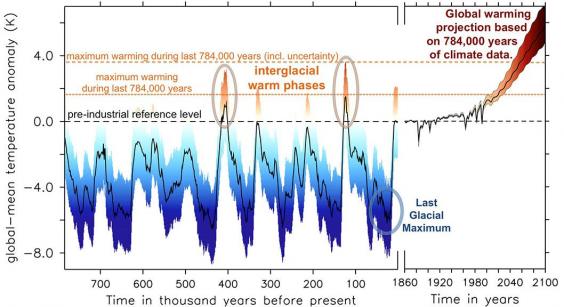
      With that in mind, take look at the graph from the study,   As I read it, the worst case is 4 degrees by 2040.

globaltemperature.jpg

From The Independent

   
And Robert points out that the study itself is conservative. 
"And it is also worth noting that the study categorizes its own findings as conservative estimates. That the world could, as an outside risk, see as much as four times the amount of carbon feedback (or as much as 2.7 ppm of CO2 per year) coming from soil if respiration is more efficient and wide-ranging than expected. If a larger portion of the surface soil carbon in newly warmed regions becomes a part of the climate system as microbes activate."
Is the study legit?  Apparently so.
"Professor Michael Mann, of Penn State University in the US, who led research that produced the famous “hockey stick” graph showing how humans were dramatically increasing the Earth’s temperature, told The Independent the new paper appeared "sound and the conclusions quite defensible".

It is pretty well accepted that 4 degrees is bad .  (!)
"The thing is, if 2 degrees C is extremely dangerous, 4 degrees C is absolutely catastrophic. In fact, according to the latest science, says Anderson, “a 4 degrees C future is incompatible with an organized global community, is likely to be beyond ‘adaptation’, is devastating to the majority of ecosystems, and has a high probability of not being stable.”
From here and here   
Professor Kevin Anderson, director of the Tyndall Centre for Climate Change in Britain, was quoted in The Scotsman  ahead of the 2009 Copenhagen conference saying the consequences were ‘‘terrifying’’.
‘‘For humanity it’s a matter of life or death ... we will not make all human beings extinct, as a few people with the right sort of resources may put themselves in the right parts of the world and survive. But I think it’s extremely unlikely that we wouldn’t have mass death at 4 degrees.
‘‘If you have got a population of 9 billion by 2050 and you hit 4 degrees, 5 degrees or 6 degrees, you might have half a billion people surviving.’’

      OK, this is pretty bad. And of course well before 2040, other odd things will occur.   As this article points out
"...the climate crisis will not appear as a climate crisis, at least not to most people in the U.S.  Rather, it will appear as a political crisis, often precipitated by economic upheaval.  It will come in the form of migration, of course, but also in the form of poverty and a growing underclass of people uprooted from their old livelihoods, with little support from a government and society stretched too thin by mounting crises.  Very likely it will have racist component, which doesn’t mean that there will all of a sudden be more horrible and bad people.  Rather, it means that when ecological and thus economic crises squeeze people, trust horizons shrink, fault lines widen, and people (good enlightened urban liberals, we are seeing, as well) become more tribal.  As Trump so clearly shows, these shrinking trust horizons are exceedingly easy to manipulate."
   However, it would be mistake to try to blame these crises on Trump or conservatives.  The author notes           
"I am repeatedly struck with how ignorant the average well-educated, politically-involved, often graduate-educated membr of the liberal elite is about issues having to do with the climate and the magnitude of the crisis that awaits our inaction.  ...... For these liberals, the climate remains an abstraction, one that “we” are “better on” (“we don’t deny climate change, they do!”), which is apparently enough for now. 

But the facts speak well enough for themselves, the problem is almost no one bothers to learn them, nor has the university or powerful centers of journalism taken a lead in mainstreaming ecological awareness.  So, for the sake of review, here are just a few (or many) basics.  Even the best case scenario has us on a path to warm the globe by around two degrees centigrade, though our actions and expectations are aiming at a place much warmer than that.   The damage that this alone will cause—never mind all the other ecological disasters occurring simultaneously—will ravage our way of life.  There is little reason to expect our current world order to survive the climate crisis unless we make drastic changes, especially in our consumption.  For climate change is not only about it getting hotter, it is about unravelling the web of ecological connections that maintain life as we know it.  To this end, I think most liberals remain oblivious to the delicate nature of ecological equilibriums and to the extent to which nature provides us with irreplaceable “services,” like clean(ish) water, soil, pollination, air, relative weather predictability, a balance among species (including pests and pestilence), a check on the spread of disease, and the list could go on

And yet anyone who tries too hard to assert the importance of climate issues or suggest that ecological destruction has to do with real human beings and their suffering is accused of being insufficiently concerned about other pressing issues that are already on the table.  Anyone who forefronts climate destruction, I have heard it said multiple times, is simply writing from a race, class, and gender subject-position that makes him or her insufficiently aware about the real problems affecting real people.  Unaware of the also basic fact that Americans (6% of the world population) consume about a quarter of all natural resources and create about a quarter of all emissions, these same “informed liberals” still cheer-on a rising U.S. GDP, while preparing to participate enthusiastically in this year’s “healthy retail season.”  This is not a blind-spot; this is an eclipse.  Liberal America, at least the part of it that makes a “decent” income, it bears mentioning, is also a greater squanderer of nature than less affluent rural America, the latter’s transfixion with NASCAR and ATV’s, and our membership in the Sierra Club, notwithstanding.  A couple of airplane flights, not to mention a second home in the country, is all it takes to send your own carbon footprint into orbit.  But such entitlements remain a third-rail of political discussion today.


Using  easy labels will not be helpful in understanding each other, and harder still understanding ourselves

"We are just doing what we were taught, following the expectations that we received from our formal education and informal socialization.  We certainly are not trying to make the planet uninhabitable, in fact many of strive to do just the opposite.  But the numbers do not lie and as history will someday be told, Americans led the charge towards the climate-cliff, cheering themselves on with great enthusiasm and little self-doubt.  It is far easier to put your own consumption and expectations about it into an accurate global perspective if you are not in the habit of dividing the world into good vs. evil."

We are heading into some really hard times.  We will be tempted to frame the problems in terms of good guys and bad guys  (and of course we will always be the "good" guys)  , of us and them.   And that will probably not be useful.  We will need to accept that we all created this mess, and will need to cooperate  to get through it.

"The whole system thinking that obliges one to admit our own complicity, and requires one to understand, to try to engage with the feelings and beliefs that people very different from oneself might have, to have sympathy for other’s with whom we may appear to have irreconcilable differences, puts us very close to the teachings of most religions. "


Labels: , , , ,

Thursday, November 10, 2016

What just happened

Something is happening
But you don't know what it is
-Bob Dylan
Manic depression
Is a frustrating mess
- Jimi Hendrix

Greetings
      Like most people, I spent most of yesterday trying to figure out what happened, how it happened, and what it means in terms of energy and climate.  In my view, Trump is mainly a salesman, who says whatever he thinks will be persuasive , so no one knows what he really thinks, or whether he has any abiding values or policies .   So prediction something of  a crap shoot. ( Here is what he says he'll do)
       Nevertheless, it's worth contemplating some possible scenarios.  Here's a few for your consideration .
    Dave Roberts at Vox, notes that things already looked grim on the climate front.  Now they look worse.  He also notes that either way , with Clinton or Trump, 2 degrees was in the cards  He thinks the fight is now about 3 degrees, and looks towards 2020.

"The truth is, hitting the 2-degree target (much less 1.5 degrees) was always a long shot. It would require all the world’s countries to effectively turn on a dime and send their emissions plunging at never-before-seen rates.
It was implausible, but at least there was a story to tell. That story began with strong US leadership, which brought China to the table, which in turn cleared the way for Paris. The election of Hillary Clinton would have signaled to the world a determination to meet or exceed the targets the US promised in Paris, along with four years of efforts to create bilateral or multilateral partnerships that pushed progress faster.
With steady leadership, the US and China would exceed their short-term goals. Other countries would have their willpower fortified and steadily ratchet up their commitments. All this coordinated action would result in a wave of clean energy innovation, which would push prices down lower, which would accelerate the transition.
The promise of US leadership was never about tons of US emissions; they are only 15 percent of the world’s total. (Though, as Chris Mooney notes, pledged US reductions accounted for about 20 percent of total reductions pledged in Paris.) It was about the US acting as a catalyst that sparked a virtuous, self-reinforcing cycle of escalating ambition, eventually building up the momentum necessary for a chance at 2 degrees.
That story is gone now. Dead. The US will not provide leadership — it will be an active, and very powerful, impediment. Under unified Republican leadership, progress on lowering emissions in the US will halt and reverse and US participation in international efforts to combat climate change will cease. (I will have more to say on the scope of the coming Republican policy disaster in another post.)
....
"... the chance of limiting temperature to 1.5 or 2 degrees is, for all intents and purposes, gone. There’s going to be severe, dangerous climate change. Millions of people will suffer.
The larger climate struggle is not over, of course. It never will be — 3 degrees is much worse than 2 and 4 much worse than 3. The fight goes on. But it is time to honestly acknowledge our failure and grapple with its consequences."
Richard Heinberg  agrees that it will bring to a halt any national action on energy or climate change   He makes a pitch for local resilience
"There will be no more federal support for climate action or research, for environmental protection (the EPA will be gutted), or for alternative energy. All federal lands will be opened up for oil, gas, and coal exploration. Most of Yellowstone will be paved over as a parking lot for a new Trump resort (okay, I’m kidding—a little). With the Executive Branch, Congress, and Supreme Court all dominated by the same party, there will be no brakes on efforts to defund government agencies, or overturn regulations of all kinds (on guns, banks, workplace safety, you name it). Having witnessed Trumpism’s success, a new generation of politicians will adopt the tactics of utterly demonizing their opponents. It’s hard to see how civility can return anytime soon. These will be dire times for women and minorities.
Crises won’t go away because government refuses to acknowledge or address them. Climate change, resource depletion, and over-reliance on debt are wolves at the door. In light of all this, Post Carbon Institute’s organizational strategy continues to make sense: Build resilience at the community level.
For the time being, national policy-based action on climate and other environmental issues is a closed door. But the most promising responses to our twenty-first century crises are showing up at the community level anyway. It’s in towns and cities across the nation, and across the world, where practical people are being forced to grapple with weird weather, rising seas, an unstable economy, and a fraying national political fabric. Whatever workable strategies are likely to be found will arise there. We see our job as helping that adaptive process however we can. This is not about winning; there is no finish line, no election day. Just a new opportunity each morning to encourage, educate, and build.
Erik Lindberg offers a somewhat different way of looking at things . He puts Trump into a more of a historical perspective,  the perspective of the limits to growth.   He suggests that a Trump is a predictable feature of a collapsing civilization, especially one which worships growth.  If we can"t have growth, someone is to blame - we need a scapegoat, and Trump offers a hand full..      
"From the perspective of a contracting civilization, Trump, or someone like him (perhaps even worse) was entirely predictable.  I have been waiting for him—with dread, yes, but also without surprise.  I have thus been able to ready myself for him and the truths he reveals about our fracturing and eroding society.
....For regardless of political affiliation, there is one official story about America: that it cannot contract.  If it does, then someone or something is to blame.  Given the reality of life in an empire that has reached its peak, or of living in a nation that consumes a quarter of the world’s resources, this is just about as bad a narrative as one can imagine.   There is no telling to what depths it might descend, nor how many Trumps it might create."
He points out that a Clinton victory would really have little effect on the slide that has been going on for years.    Its interesting to note that one could argue that we have run out of fuel for the "post war" prosperity, and that the white working class is feeling the pinch..   Median household income has stagnated.   Off shoring and automation had taken their toll.  And much as we might wish for it, neither Clinton nor Trump   (nor Sanders)  would be able to turn the clock back .
"Educated liberals are able to see directly through Trump’s story about making America great again.  But do these same people really believe that Clinton has some magic way to reverse years of job loss, deindustrialization, disenfranchisement?  Have you looked at a rustbelt city, driven over Gary Indiana on the freeway, or through the miles upon miles of Milwaukee (where the GMC plant once stood) beyond the sliver of prosperity sitting along the lake?   All this is not going to be made great again.  Our IPhones are not going to save us.   Clinton is not going to discover a hidden trove of low-hanging fruit, an untapped market of new cheap labor or of eager and moneyed consumers ready to buy more of the crappy stuff and junky culture that we market and sell, but can’t even make ourselves.  The coal mines are not coming back, Trump’s promises notwithstanding.  But neither is sort of sudden and unrepeatable consumer expansion that returns us to the 1964 poised for reemergence in our political fantasies.  No one is going to discover a way to grow the global economy at 3% per year without, at the same time, devastating the planet’s environment and ecology.  Clinton doesn’t have some magic new way forward or path into the future.  That little of this is noticed can of course be explained by the disgusting and repellent personality of Trump.  
      The fact remains that we still live in an incredible wealthy country, which is over shooting our resource base 4 or 5 times over.    This is not a sustainable and will not be sustained.   The American dream, that everybody can be rich, is just that : a fantasy.       Reality is beginning to creep in..   
      As for what is an appropriate response, I tend to agree with Heinberg, that a program of local resiliency will be useful.  Getting to know our neighbors, and helping each other out.  An of course, we will need to oppose scapegoating.  As Heinberg points out, these will be tough times for gays, immigrants,  women and people of color.   We will especially need to show that we stand with them. 

Labels: , , , , ,

Thursday, August 11, 2016

That Sinking Feeling

Oops I did it again
      -Brittney Spears
Somebody must change
     - Blind Faith (Can't find my way home)
Happy Overshoot day!
       I'm not quite sure what the appropriate activity for overshoot  day might be .   Out here in Polk County, shooting guns is always an accepted means of self expression, so maybe that's it...
    The footprint folks have a number of indicators that they use to track overshoot.  One of the is of course climate.  And human emmissions continue to accelerate
"The level of carbon dioxide in the atmosphere is not just rising, it's accelerating, and another potent greenhouse gas, methane showed a big spike last year, according to the latest annual greenhouse gas index released by the National Oceanic and Atmospheric Administration.
CO2 emissions totaled between 35 and 40 billion tons in 2015, according to several agencies. Some of that is absorbed by forests and oceans, but those natural systems are being overwhelmed by the sheer volume of new CO2. As a result, the inventory shows, the average global concentration increased to 399 parts per million in 2015, a record jump of almost 3 ppm from the year before."
But possibly more worrisome is that some of what used to be natural "sinks" of CO2 may now become "sources".    One of the largest terrestrial sink is the Amazon rainforest, which is no longer a guaranteed dink, but depending on drought and fire, also is sometimes a source of CO2.  see here  
"A severe drought is again stressing trees even as it is fanning wildfires to greater intensity than during 2005 and 2010. Early satellite measures seem to indicate that something even worse may be happening — the rainforest and the lands it inhabits are now being hit so hard by a combination of drought and fire that the forest is starting to bleed carbon back. This gigantic and ancient repository of atmospheric carbon appears to have, at least over the past two months, turned into a carbon source."
Speaking of trees, a recent study indicates that the changes in the timing of snowmelt in the northern forests , is affecting their absorption as well.
"Earlier snowmelt periods associated with a warming climate may hinder subalpine forest regulation of atmospheric carbon dioxide, according to the results of a new study.
The findings, which were recently published in Geophysical Research Letters, a journal of the American Geophysical Union, predict that this shift in the timing of the snowmelt could result in a 45 percent reduction of snowmelt period forest carbon uptake by mid-century.
A separate study, also published in Geophysical Research Letters, found that earlier, slower snowmelt reduces the amount of streamflow, a phenomenon with potentially drastic consequences…"
           But the bigger picture might be the planetary limits generally .   Recently scientists have attempted to define a "safe operating space" for the earth ecosystem.   They have identified a number of key limits   see here.   One of these is biodiversity .  A recent study , see here shows that we are already bumping into that limit.
"....international team of researchers has concluded that biodiversity loss has become so severe and widespread that it could affect Earth’s ability to sustain human life.
The researchers examined 2.38 million records of 39,123 terrestrial species collected at 18,659 sites around the world to model the impacts on biodiversity of land use and other pressures from human activities that cause habitat loss. They then estimated down to about the one-square-kilometer level the extent to which those pressures have caused changes in local biodiversity, as well as the spatial patterns of those changes.
They found that, across nearly 60 percent of Earth’s land surface, biodiversity has declined beyond “safe” levels as defined by the planetary boundaries concept, which seeks to quantify the environmental limits within which human society can be considered sustainable.
“We estimate that land use and related pressures have already reduced local biodiversity intactness — the average proportion of natural biodiversity remaining in local ecosystems — beyond its recently proposed planetary boundary across 58.1% of the world’s land surface, where 71.4% of the human population live,” the researchers write in an article published this month in the journal Science.
In other words, more than 70 percent of the global population lives in areas where the level of biodiversity loss has been so substantial that the ability of ecosystems to support humanity is now in question."

So, where are the "leaders"?  Asleep.  Here's one attempt to get them to pay attention

Prominent organizations try for the third straight election to get candidates to answer questions about climate change and other crucial issues.
Science, especially climate science, has again gotten so little attention in the presidential campaigns that a group of more than 50 science organizations is seeking to push it into the conversation.
The group, which includes the American Association for the Advancement of Science, The National Academy of Sciences, the American Geophysical Union and Duke University, represents more than 10 million scientists and engineers nationwide. It is calling on the U.S. presidential candidates to address a set of questions related to science, engineering, technology, health and the environment, including climate change. It is also encouraging the media, the moderators that ask the debate questions and voters themselves to ask these questions of the candidates in the course of the campaign.
“Science issues are coming to influence more and more of the policy dialogues, and politicians seem to be having a hard time incorporating complex science information into their policymaking process,” said Shawn Otto, chair ofScienceDebate.org, which is organizing the initiative.

Labels: , , , , ,