Thursday, June 25, 2015

Hot times


Hotter than a match head
    - Lovin Spoonful
If I don't get some shelter
ooh, yeah, I'm gonna fade away
-Rolling Stones

Greetings
         Seems like were due for a scorcher this weekend.    By "we" I mean everyone from Alaska to California.  see .e.g.   Worst Fire Conditions on record etc..  (see below).  (For a nice discussion of heat and human health, see this interview with Dr Robert Kopp on ecoshock radio )
       I had the opportunity to go to the Oregon Forest Fair this weekend.  (Thanks Mark H!)   And one of the main topics was forest fires and how to pay for for putting them out.  It could be expensive.   Recently BC announced it was burning through its fire fighting budget and the fire season has barely started.
        Those of you paying attention, are aware that weird heat waves are probably  a result of the the warming of the Arctic.
  I came across an interesting lecture form  Dr James Anderson of Harvard, which discusses the arctic warming in some detail..  see here, as a part of Harvard Heat Week.   (Thanks to Radio Eco shock - which BTW also has a nice piece on Northwest protests.  )  Towards the end of Dr Anderson's  talk he makes a good pitch for Harvard to divest from fossil fuels. and encourages civil, as well as uncivil disobedience. !,   But what really caught my attention was his statement that the loss of the ice was non reversible.  
 "Of course the immediate question is can we lose 70 percent of the ice volume in 30 years and return to a stable condition. I don't know anybody who has suggested how heat can be extracted from this system to re-form the ice structure. All of these feedbacks are operating in the same direction. And there's no known mechanism that can extract heat to re-form these ice structures... and so when you look at this question [of reversing Arctic ice loss], the answer quite clearly 'no'."  
(Thanks to Alex Smith or Radio Eco shock for the transcription.)
        I'm not sure what this means for the weather.  But I have the feeling it isn't good.
       Speaking of who is going to pay, Lloyds of London released a very interesting study of the likelihood some extreme events that could affect the insurance industry.  see here.   The report was prepared by the Global Sustainability Institute and  explores a scenario where climate and weather related  problems affect the food production system is key areas, resulting in food riots and , basically, a breakdown in civil society.   This could happen any time, but as we see below becomes more and more likley as we approach 2040.
      Here is a very interesting article exploring the model used by  the Global Sustainability Institute, on behalf of  Lloyds, including a comparison with LTG's World 3.   The modelers reaffirm that World 3 , although tremendously simpler than current models, remains " largely correct".      Running their model , and assuming no policy changes, suggest that the Lloyds scenario could be in our future.        
       “We ran the model forward to the year 2040, along a business-as-usual trajectory based on ‘do-nothing’ trends?—?that is, without any feedback loops that would change the underlying trend. The results show that based on plausible climate trends, and a total failure to change course, the global food supply system would face catastrophic losses, and an unprecedented epidemic of food riots. In this scenario, global society essentially collapses as food production falls permanently short of consumption.”
    
        Talking about bad things happening in 2040 is a lot different than talking about what might happen in 2100, or even 2050.   Perhaps this might get peoples attention?
        But, it is probably worth remembering that absent some magical new technology, the history of the next 40 years is already written as  Brad Plummer points out in his article EPA outlines our choices on global warmin, moderate disaster or major disaster.   The benefits of reduced carbon emissions don't show up until 2050.   
       What we really need is that brand new technology that sucks CO2 out of the air.   We are now betteing the farm on an untested technology called BECCS.   Will it work?  Here's Dave Robert's  assessment :
"But is large-scale BECCS plausible? There's the problem of finding a source of biomass that doesn't compete with food crops, the harvesting of which does not spur additional emissions, and which can be found in the enormous quantities required. The IPCC scenarios that come in below 2°C require BECCS to remove between 2 and 10 gigatons of CO2 a year from the atmosphere by 2050. By way of comparison, all the world's oceans combined absorb about 9 gigatons a year; all the world's terrestrial carbon sinks combined absorb about 10 gigatons a year."
.    
       
---------

“Worst Fire Conditions On Record” — As Heatwaves, Drought Bake North American West, Wildfires Erupt From California to Alaska

There are 146 wildfires burning in Alaska today. A total that is likely to see at least another dozen blazes added to it by midnight. A total that has already absorbed the entire firefighting capacity of the State and has drawn hundreds of firefighters from across the country in places as far away as Pennsylvania.
Alaska wildfires Sunday
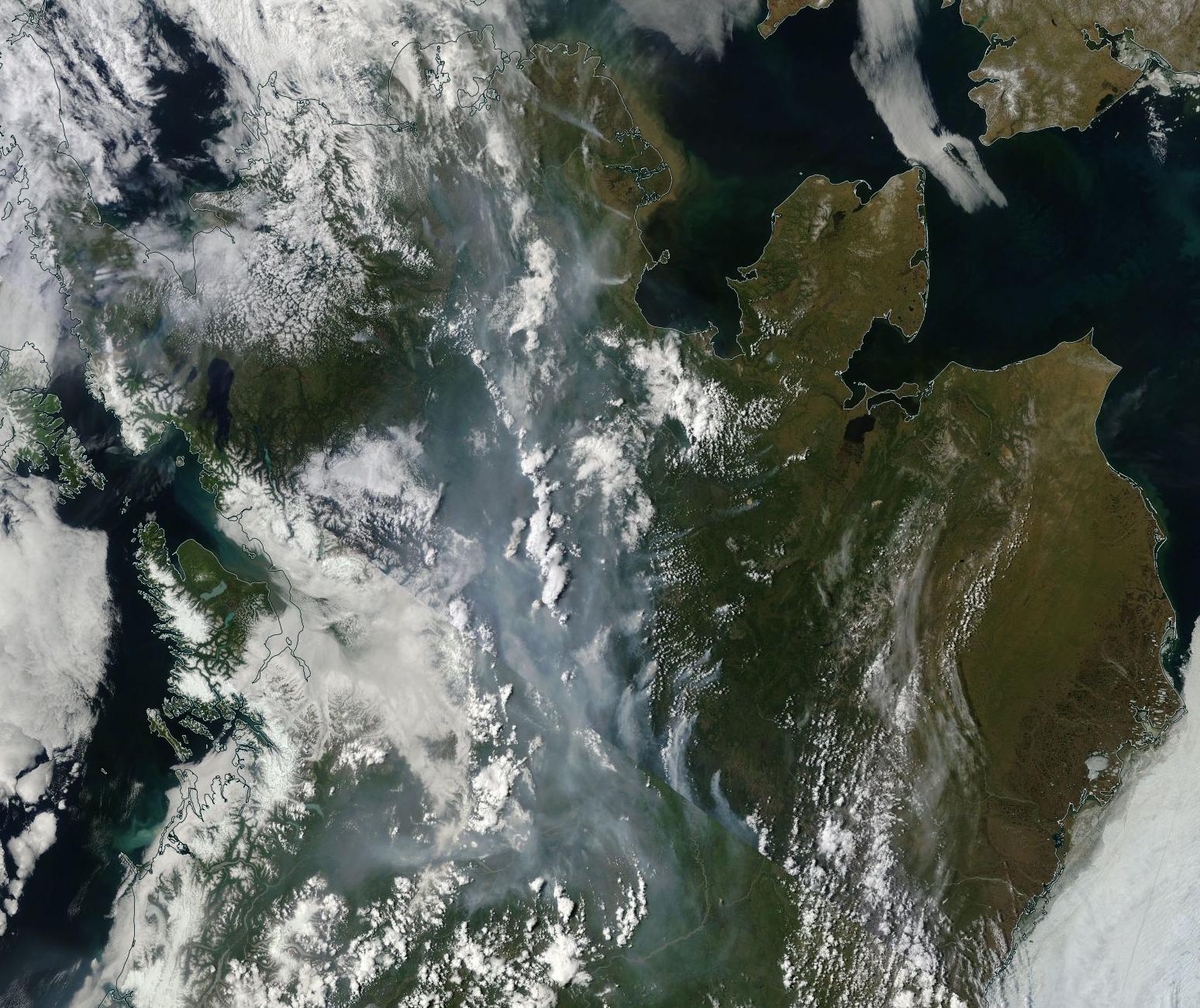
(MODIS satellite shot of wildfires erupting over a sweltering Southwestern Alaska on Sunday, June 21. Wildfires in permafrost regions of the Arctic like Alaska are particularly concerning as they are one mechanism that returns ancient sequestered carbon to the Earth atmosphere. A sign of a feedback set off by human warming that will worsen with continued fossil fuel emissions. Image source: LANCE-MODIS.)
Deadhorse, at the center of North Slope oil fields above the Arctic Circle set an all time record high of 82 degrees Fahrenheit (28 Celsius) on Sunday. That’s 3 degrees hotter than the previous all time record high of 79 degrees (26 C) set on August 16, 2004. The hottest reading for June at that location was a 68 degree (20 C) measure set in 2007. So, basically, Deadhorse just shattered the all-time record for June by 14 degrees (F) and the globally record hot summer of 2015 has only now gotten started.
Other locations experiencing new records for just Sunday included Kotzebue, which set a new all time record highest low temperature of 62 degrees (17 C). This reading broke the previous all time high minimum mark of 56 degrees (14 C), set in 1987. Bethel and Yakutat both tied their daily high minimum temperature records at 54 and 52 degrees (12 and 11 C), respectively.
And yesterday was just one day in long period of record heat for the State. Last month’s NOAA analysis showed temperatures fully 7 degrees Fahrenheit (4 C) above average. It’s a record heating that is now setting off severe wildfires all over Alaska. According to the state’sWildland Fire Information Center, the relentless heat and dryness has turned spruce, hardwoods, brush, and tundra into dry fuels vulnerable to any ignition source. Over the past week, ignition has come in the form of lightning — with most of Alaska’s 2015 wildfires set off by nature’s spark.
As a result we are seeing nearly double the number of fires during June compared to a typical year. Fires that have already destroyed 30 structures, forced evacuations, and tapped Alaska’s firefighting resources to its limits.
Wildfires Burning in the Rainforests of Washington as Major Heatwave Approaches
Record hot temperatures and wildfires, unfortunately, are not just an issue for Alaska. They’re a prevalent concern all up and down Western North America. A zone that has seen several years of record hot temperatures and dryness. Extreme weather events fueled by such global warming-linked phenomena as a Ridiculously Resilient high pressure Ridge over the Northeast Pacific that has kept heatwave and drought conditions firmly entrenched throughout much of the region for months and years. An atmospheric condition that is also linked to a hot ocean surface water ‘Blob’ in the Northeast Pacific (which is itself implicated in a growing number of marine species deaths).
Paradise-Fire-June-17
(Paradise Fire burning near a drought-shrunken creek in the rainforests of Olympia National Park, Washington. Image source: NPS and Wildfire Today.)
This week, the added heat also generated wildfires in unusual areas like the rainforests of Washington State’s Olympic Peninsula. Driest conditions since 1951 have resulted in a great deal of fire resiliency loss for forests in the region (1951 was the year of the historic Five Forks Fire, one of the worst ever to impact Washington State). Already, a rare early summer wildfire (called the Paradise Fire) has burned through 417 acres of forest.
Firefighters are doing their best to contain the blaze. But the record heat and dryness are multiplying fuel sources. Fires are enabled by dried lichens growing high up in the trees. When flames touch the lichens they rapidly ignite sending sparks to other lichen-covered tree tops. In this way, flames can leap rapidly from tree to tree under current conditions.
It’s very unusual to see fires in this rainforest zone. And when ignitions have occurred in those very rare cases, they have typically flared during late Summer and early Fall. So this June burning has fire officials very concerned — especially given the nearly unprecedented fire hazard conditions throughout the State. Conditions that are predicted to rapidly worsen as an extreme heatwave is expected to build through the coming weekend.
West Coast Heatwave Saturday
(A major heatwave is predicted to invade the US West and Northwest States this weekend. Washington and Oregon are predicted to experience temperatures more typical of desert sections of California and Arizona. Image source: Climate Reanalyzer.)
Temperatures over large stretches of Washington and Oregon are expected to climb into the 90s and 100s, possibly reaching the 110s (Fahrenheit — Celsius range from 33 to 45) by Sunday. For these typically cool, wet States, this brutal heat blow, should it emerge as predicted, will set off a spate of all time record high temperature readings, deepen drought conditions extending northward from California, and heighten fire conditions that are already in the range of worst ever experienced for sections of these States.
California Experiencing “Worst Fire Conditions On Record”
Moving further south along the U.S. West Coast we come at last to the drought hot zone that is California. A State that is now enduring its fourth year of drought. A drought that tree ring studies show is likely the worst such event in 1,000 years.
Ken Pimlott, Director of CAL FIRE noted:
We measure the fuel moisture content of all of the vegetation -the brush and the trees and we track that over the course of time and compare it month to month each year. And we put it through formulas and determine how much energy and how much heat it will put out when it’s burning. And we have seen -we saw it last year and we will see it again this year- we’ll be reaching records for potential heat output for times of the year that would normally not be burning in those conditions.
Wildfire nonexistent snowpack
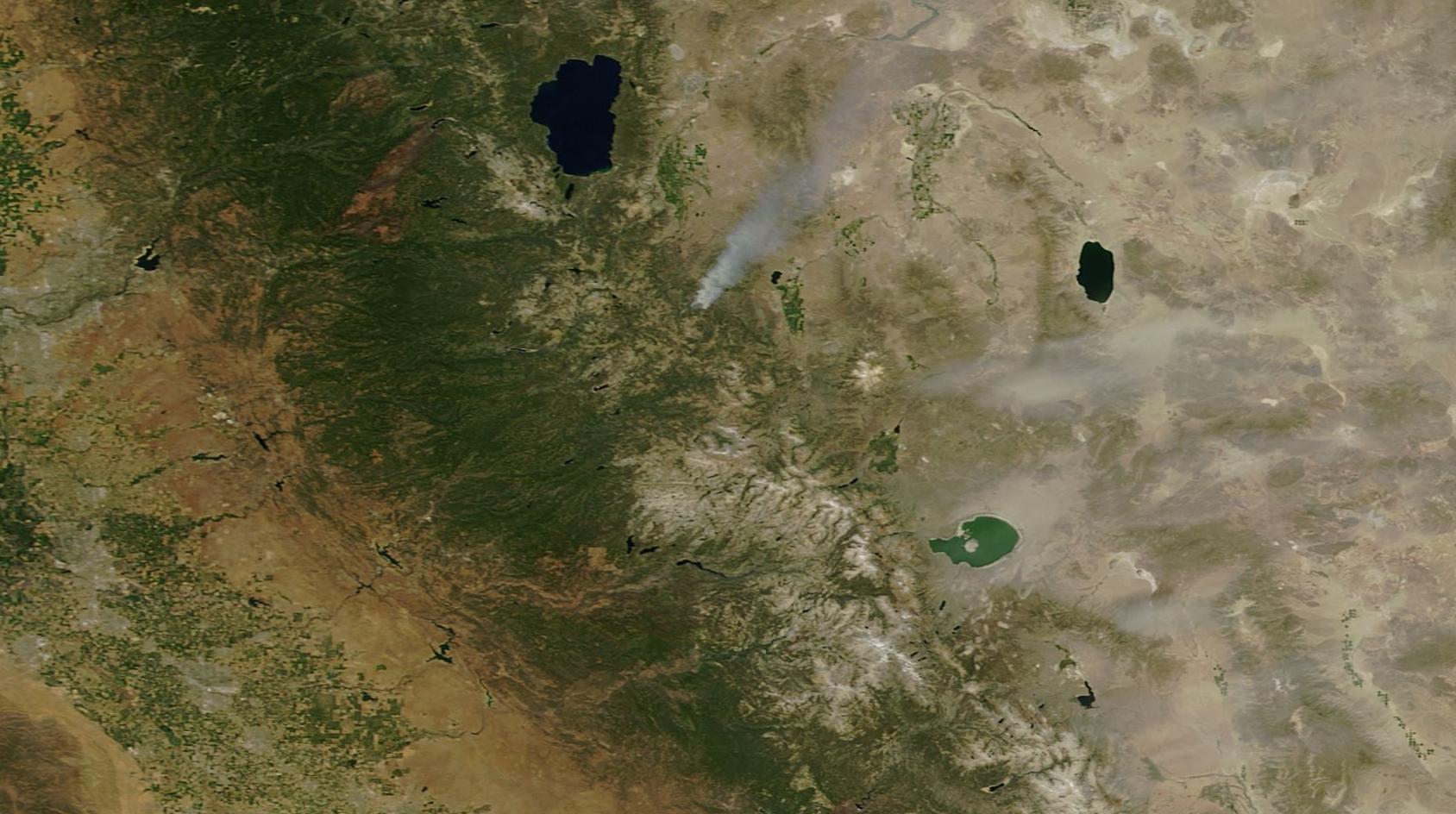
(Large wildfire burns in forests along the slopes of Sierra Nevada Mountains whose peaks are now entirely devoid of snow cover. Note that remaining glaciers are shown turning a dull brown in the June 21 MODIS satellite shot.)
So far this year over 1,100 wildfires have already ignited throughout the State. That’s nearly twice the typical number of 650 blazes popping up by this time of year. Exacerbating this stark context is a state water resource crisis compounded by non-existent Sierra Nevada snowpacks and dead trees that now number in the millions.
This is not Normal, Nor Should We View Widespread, Related Events in Isolation
Record and unusual Alaska, Washington, and California wildfires this season are, thus, not occurring in isolation, but as an inseparable feature of ongoing climate trends related to human-caused global warming. In this case, heatwaves are related to visible and extreme record ocean and atmospheric temperatures that have been ramping both globally and in the regions affected over past years and decades. And the fact that 2015 is continuing as the hottest year on record globally should also not be viewed as separate from the events witnessed all up and down the North American West Coast. Events that were largely predicted in many global climate models assessing the impacts of human based greenhouse gas warming on this vital national and global region.
We’ll end here by considering this thought — it’s only June, yet up and down the North American West Coast we are experiencing some of the worst heat, drought, and fire conditions ever recorded. It’s only June…
*   *   *   *
UPDATE NOON EST, JUNE 23, 2015: Satellite Imagery confirms that, over the past 24-48 hours, the wildfire situation in Alaska has continued to worsen. Widespread and large fires running throughout southwestern, central, northeastern and eastern Alaska today expanded and multiplied:
Wildfires Alaska June 22
(Fires flared to dangerous size across Alaska on June 22nd and 23nd. Image source: LANCE-MODIS)
These rapidly proliferating fires cover a diagonal swath stretching about 800 miles from southwest to northeast across the state. The fires are burning through Alaska’s permafrost zone and current intensity in the satellite image is similar to some of the worst Arctic fires we’ve seen during recent years. A substantial number of these fires feature smoke footprints indicating 5-10 mile active burn fronts. Smoke plume size is now large enough to become caught up in the Jet Stream and impact visual features of skies across the Northern Hemisphere.
Based on these satellite shots, it appears that Alaska is experiencing a heightening and very severe fire emergency — one that shows little sign of abatement over the next few days.

Labels: , , , , , , , , , ,

Monday, April 6, 2015

Near Future


The heat is on
     -Gloria Gaynor
Faster, faster, faster
     -Talking Heads (Air)

Greetings

     One problem with the climate change story, is that the studies tend to focus on what is likely to happen sometime in the future,  say, 2010.  And what is likely to happen , on average around the world.   So many degrees by 2100 on average, doesn't really tell people what they want to know.  And it doesn't really inspire people to take action.
       Happily, a resent study brings things into better focus.  The paper  "Near-term acceleration in the rate of temperature change.", helps to bridge that gap.   The authors break down the the time line into 40 year segments, and break out the world into regions.  They find that for many regions, including North America, the increases in temperature are likely to  grow at a faster rate than we are already experiencing.     These results are based on the IPCC models, and do not incorporate feedback mechanisms.
   Listen to an interview with one of the authors, Dr Stephan Smith , here.  He explains that North America is likely to warm more than the average, because is so large, and so less of the continent is buffered by the ocean.   "In North America, the models showed a change from about .7 to about 1.8 degrees Centigrade over a 40 year period.... that's about 1 to 3 degrees Fahrenheit over that period."

  Carbonbrief .org  has a good explanation of the study including this::
--------
"Rate of temperature change
The researchers analysed changes in temperature over 40-year periods, looking at how quickly the temperature rises from one decade to the next. By using 40-year periods, the researchers smooth out the year-to-year ups and downs in order to focus on the influence of human-caused climate change only.
By analysing past temperature records, the researchers found that for the 900 years before the 20th century, rarely any 40-year periods show warming of more than 0.1 degrees per decade.
But when they looked at the second half of the 20th century, the speed of temperature changes increased. Their analysis shows the rate of surface temperature rise in the Northern Hemisphere is now over 0.2 degrees per decade. 
Projected trends
The researchers also look at rates of change for the present and near future. Using climate models, they calculated rates of decadal temperature changes for 1971-2020. They then compared them to 1851-1930, before substantial human-caused warming occurred.
The projections are based on an Intergovernmental Panel on Climate Change (IPCC) scenario where global action is taken to limit greenhouse gas emissions. This means it assumes countries around the world will cut back on carbon emissions very quickly, which currently isn't the case.
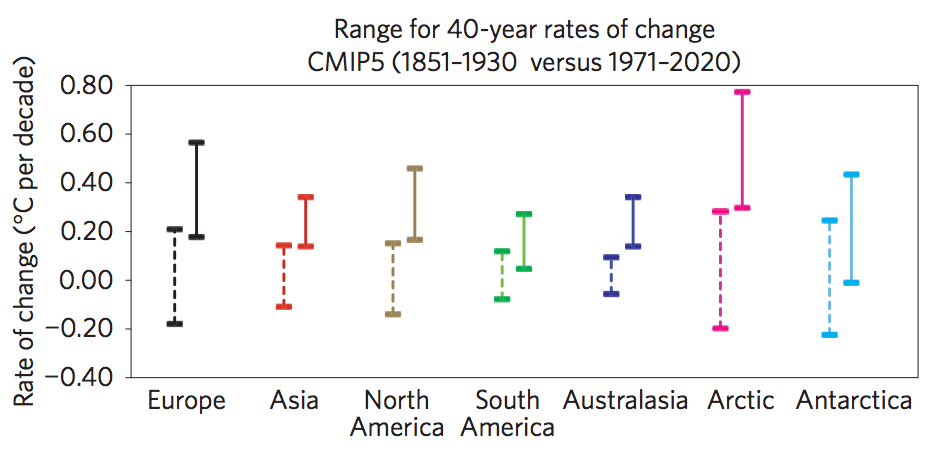
The graph below shows the results for each region of the world. Each bar shows the range in results from the climate models, with the solid lines showing 1971-2020 data and the dashed lines showing 1851-1930.
You can see the rates of change are projected to increase for all regions, with the Arctic standing out above the others. Temperatures in the Arctic are currently rising twice as fast as the global average. As Arctic sea-ice diminishes, energy from the sun that would have been reflected away by sea-ice is instead absorbed by the ocean, a phenomenon scientists call Arctic amplification.
Smith Et Al (2015) Fig 3a
Range of past (1851-1930, dashed lines) and near-future (1971-2020, solid lines) regional rates of surface temperature change per decade. Bars show the range of climate model results, based on emission scenario RCP4.5. Source: Smith et al. (2015)
Projections for the rest of the century show average rates of temperature change per decade could reach around 0.4 degrees in Europe and North America, and 0.6 degrees in the Arctic.
But as these results are from a scenario of limited greenhouse gas emissions, the rates could get even higher."

Labels: , , ,

Monday, February 16, 2015

How to Stay Warm


Last night I had a wonderful dream
...hope that it will come true
   -  the Majors
That was just a dream
   - REM ( Losing my religion)

Greetings
        Here's a fun article on the history of heating.  Lots of great pictures, of " old fashioned" furniture, and " foreign looking" devices.   Living in the age of exuberance, we are generally familiar with heating air rather than heating people.  But as we move into The Age of Limits, I suspect it's something we'll be thinking about more. 

         Here's an excellent interview with David Fridley, Post Carbon fellow, and Berkley Lab scientist, on that very Age of Limits.     He paints an interesting picture of our post carbon future.   It's not exactly a " green dream"., although it may be largely powered by wind and solar.   He pops some of the usual bubbles.  Why an energy saving device ( like a Prius) probably doesn't save as much as we hope. ( if it saves money - that money goes somewhere - causing more energy wasting mischief) .    How unlikely we'll all be driving electric cars ( the problem of scale - how much lithium is there, anyway? ).   The extent to which, wind and solar are dependent on coal - and the difficulty of creating a " self replicating" fossil free energy source.   The problems of running a high energy civilization on low EROI devices.  Here's a doozy. - many stripper wells have negative EROI!  ( the pump that runs on electricity (from coal) uses more energy that the oil  that is produced. -   but it still makes sense financially, because coal is cheap) 
http://energyskeptic.com/2014/fridley-alternative-energy-wont-save-us/

So, get used to wearing sweaters, and drinking hot tea

Labels: , , ,

Tuesday, January 13, 2015

Ozzie goes to the woodshed

We're going to blow a 50 amp fuse
     -Mick Jagger

Splish splash 
I was taking a bath
   - Bobby Darin

Greetings

     We are clearly in a difficult situation.  We are in an era of resource limits as well as serious ecological distress.  In addition, we seem convinced that the high energy lifestyle is appropriate and should be emulated by others.

      It is natural in this situation to turn to technology to solve our problems.  Whether it is nuclear, bio fuels,  carbon capture, or  geo engineering, we are attempting to prop up the paradigm of endless growth.    Where does renewable power and electric cars fit in?   Are they just more shiny things that provide a short term solution, only to leave us with worse problems?   Are they a "green" product, designed to make use consume more, but feel better about it?   Or are they part of a long term strategy the will lead to a more sustainable civilization.?

     What is "sustainable" anyway?  Something that  " meets the needs of the present without compromising the ability of future generations to meet their own needs"..  One might wonder what technological "solution" can make that claim..
      
    Or put another way:  what changes will be the most useful over the long term- behavioral or technological?

     Ozzie Zehner has attempted to raise some of these questions.  Unfortunately,in his zeal,  as shown below, he has made some missteps.   The promoters of technological solutions have also over stated the benefits, and understated the costs.   

     Nevertheless it is useful to look at the bigger issue.   What is the underlying assumption in the debate bet ween coal and wind.  Its that in all events , we must have growth, we must use more energy.   As long as we continue to hold that view, the fact that some of that energy is "green" may not matter.

    After all, in order to have much of a chance to avoid 2 degrees, we would probably need to reduce CO2 emissions by 80% by 2030.     What role can renewable energy  have in meeting that goal?.

    I have to confess I like renewable energy.  I use a solar water heater, and buy wind power from my utility.  But, I think may be a mistake to put too much emphasis in renewable energy as a strategy.  For one thing, I don't think we appreciate the size of such an undertaking.

     Here is an illustrative calculation from David McKay, author of Sustainable Energy Without the Hot Air.  From here

    " As a thought-experiment, let's imagine that technology switches and lifestyle changes manage to halve American energy consumption to 125 kWh per day per person. How big would the solar, wind and nuclear facilities need to be to supply this halved consumption? For simplicity, let's imagine getting one-third of the energy supply from each.
To supply 42 kWh per day per person from solar power requires roughly 80 square meters per person of solar panels.
To deliver 42 kWh per day per person from wind for everyone in the United States would require wind farms with a total area roughly equal to the area of California, a 200-fold increase in United States wind power.
To get 42 kWh per day per person from nuclear power would require 525 one-gigawatt nuclear power stations, a roughly five-fold increase over today's levels."

      
"Much of the current public discussion about our energy future tends to turn on the questions of which alternative energy sources to pursue and how to scale them up. But it is even more important to broadly reconsider how we use energy. We must strategize to meet basic human needs while using much less energy in all forms. Since this will require major societal effort sustained over decades, it is important to start implementation of conservation strategies well before actual energy shortages appear." 
--------

Here is Alex Smith from Ecoshock Radio


What follows is mostly a print version of my comments in this week's Radio Ecoshock show. 

IN MANY CASES I AGREE WITH OZZIE ZEHNER

Before I begin to counter some of Ozzie Zehners' positions on alternative energy, I want to outline the many ways I agree with Zehner. I appreciate his courage in speaking unpopular thoughts. I can't emphasize this enough. Ozzie Zehner, in his book "Green Illusions" and in his talks, raises fundamental issues about our direction into the future. Don't miss any opportunity to learn from him.

For example, Zehner says alternative energy cannot power the wasteful civilization we have not, without killing off the planet. I agree. A society powered by alternative energy will have to use a lot less power, and should, to preserve what is left of nature.

There are many ways this can happen, too many ways to list them all there. In short, we could stop making things that don't last, stop buying things we don't need, and make sure our purchases are the least ecologically and socially harmful possible. Those require a major change in lifestyles in developed countries, and changes in aspirations in less developed nations.

Alternative energy if properly applied can also reduce the waste involved in centralized power production and transmission. It drives me crazy that we lose about 50% of all electricity produced in the big grid model of transmission. Solar panels on the roof, or a wind generator in the yard (when appropriate) involves a few feet of transmission, rather than a continental grid. I suggest the rural electrification program of the 1930's needs to be reversed. We should power only major cities and corridors with the grid. Remote homes, farms and mines should produce their own power.

We can also get a lot smarter, either personally or through computer-mediated power management, to avoid the peaks of use that demand coal or other fossil fuel backup. There is no need for all fridges and washing machines to run at the same predictable times.

Demanding Passivhaus or net-zero standards for all new construction would eventually replace most of our inefficient building stock. Dump the all glass models for apartments and skyscraper office buildings, replacing them with smaller windows and insulated walls.

The list goes on, and Ozzie supports these kinds of energy changes. Green energy will not power the wasteful system we have now. In a coming Radio Ecoshock show, I plan to run an in-depth conversation about that, from the Post Carbon Institute. Meanwhile, Zehner is correct about trying to fill the "leaky bucket" we have now. "We don't have an energy crisis, we have a consumption crisis" he says. That's absolutely correct. [26:40]

There is also a lot of truth that the promise of green energy has paradoxically encouraged some people to carry on with deadly amounts of energy use. The drive for a technical fix is very strong. It's true just pasting a few solar panels on a complete energy hog of a building is window dressing. It's also true that we might very well wreck the earth if we engage in a binge of making and installing alternative energy to keep the status quo. Few sane people are suggesting that.

We may create a burst of new carbon, in a mass plan to change over from fossil fuel plants to solar and wind energy. However, as Mark Jacobson from Stanford told us, this new carbon can be offset by cleaner production anywhere from six months to a year later. Then there is a long period, up to 25 years or more, when carbon would be reduced greatly, from the alternative of not building that green energy.

I do object when Ozzie Zehner uses emotional triggers, which are not based on science. He compares solar power, for example, to a religion. Some of his heated words are not the language of science, but might be at home on Fox News. I feel he communicates a personal grudge which remains unexplained.

ELECTRIC VEHICLES

Let's start with electric vehicles.

In his Google talk, and in other talks, Ozzie says: "But the National Academy of Sciences did a study, a life-cycle analysis. It's the broadest life-cycle analysis done on electric cars and they found that the harm steming from electric cars are a little bit larger than the harm stemming from a regular internal combustion engine of a car the same size.

In fact the only way we can find that electric cars are cleaner is if we narrow our research to just one metric, like CO2.


First of all, this one narrow metric of carbon dioxide is actually the largest threat to humans and all species in millions of years. Building carbon dioxide threatens us with great harm, and possibly extinction. This is a completely different "metric" than possible increased cancers from improperly storing the toxic waste from batteries, or solar panels. Carbon dioxide is the really big deal, Reducing it is a bonus strong enough on it's own to justify electric cars. Ozzie doesn't tell us about the scale of threats.

The paper he refers to was published by The Nation Academies Press. It's "Hidden Costs of Energy: Unpriced Consequences of Energy Production and Use". The book represents the work of many scientists and was issued by a committee of the National Research Council in 2010.

You can find out more about Ozzie's objections to electric vehicles in his feature article in the publication "Spectrum". It was published June 20, 2013. The title is "Unclean at any Speed". 

The conclusions of the 2010 National Academy Press publication that Ozzie uses are directly contradicted by more recent research, in two papers published in the Proceedings of the National Academies of Science, or PNAS.

The first is "Valuation of plug-in vehicle life-cycle air emissions and oil displacement benefits" by Jeremy J. Michaleka et al. 

That study does not support the radical statements that Zehner makes in his talk. 

The most recent study was published by scientists in PNAS this November 2014, about two years after Ozzie's speech. It's titled "Life cycle air quality impacts of conventional and alternative light-duty transportation in the United States" by Christopher W. Tessuma et al. 

This paper summarizes the situation as follows:

"We find that powering vehicles with corn ethanol or with coal-based or 'grid average' electricity increases monetized environmental health impacts by 80% or more relative to using conventional gasoline. Conversely, EVs powered by low-emitting electricity from natural gas, wind, water, or solar power reduce environmental health impacts by 50% or more. Consideration of potential climate change impacts alongside the human health outcomes described here further reinforces the environmental preferability of EVs powered by low-emitting electricity relative to gasoline vehicles."

Sure, if you run electric cars on biofuels made of corn, or on coal, you make the environment worse. There's no suprise there. But electric vehicles can easily use clean sources, unlike gas vehicles. So far most electric vehicles have been sold in California, which uses very, very little corn ethanol or coal. Ozzie told his audience electric vehicles run on bull manure. New science shows they can be a much better choice, not only for the climate, but for public health. Sorry Ozzie.

CAN ALTERNATIVE ENERGY REPLACE ITSELF?

My next major objection to Ozzie's presentation is when he says alternative energy cannot replace itself. As we heard from Dan Miller, there are already solar manufacturing facilities run on solar power. Ozzie says:

"The problem is that certain types of industries rely on certain types of energy. So it's difficult to explore for copper and bring the trucks out there if they are only running on electricity." [ at 46:20 of this Radio Ecoshock show]

So I looked into that. My research finds that mining companies, particularly in South Africa, are beginning to power their intensive milling operations with alternative energy. See this article "Unlikely bedfellows: mines that run on solar or wind power" by Andrew Topf for example.

Certainly mines can operate with hydro power or nuclear power, which existing mines already use. Electricity is electricity, and that's what mines use most. 

Surely we can't run the big trucks on anything but fossil fuels? Nonsense. Electric vehicles can be stronger, with more torque, real working power, than any diesel engine.An all-electric mine is completely possible. Again, as we see often in his work, it seems to me that Ozzie's vision is limited by what exists today, the old fossil industrial model. That's the way it is, so it's the only way it could be, Zehner tries to tell us, reinforcing our stereotypes.

German heavy industry has run entirely fossil free on some days, including manufacturing wind generators. Iceland runs entirely on renewable geothermal energy - including it's energy-intensive aluminum industry.

SOLAR POWER A THREAT TO FORESTS? REALLY?

Next up: Ozzie Zehner spends much time in his talk explaining that solar power is a threat to our forests. This argument against deforestation by solar power is ludicrous. Ozzie found a few instances where solar panels were installed by cutting down trees. In the global picture of deforestation, the pin-prick of solar deforestation is so small it could not be seen. We should also remember the deforestation caused by tar sands mining, creating roads for fracking rigs, and mountain-top coal mining. He doesn't mention those or compare them. This argument is a straw man.

Similarly, the fact that some maintenance is needed for solar power in a desert setting is also a straw man agrument. First of all, a study done by an oil producing state like the United Arab Emirates is immediately suspect. They are evaluating a product that could wipe out their profits and possibly their economy. 

Secondly, what other source of energy runs with without employees? Coal-fired, gas-fired, oil-fired electric plants all need employees too, and regular maintenance. These power stations also occasionally explode, which solar does not. Oil and coal power plants kill people locally and even at great distances with their emissions. Solar operators might have to clean dust off the solar panels. So what? I wonder why Ozzie works so hard to catalog minor to very minor aspects of alternative energy? And why doesn't he give us comparable figures from fossil fuel plants?

SOLAR TO KILL OFF CIVILIZATION IN ONE GENERATION?

Ozzie says: "The Mohave Desert may be the Saudi Arabia of solar. But if we were to cover it with solar cells, and cover the world's deserts with solar cells, it would destroy civilization as we know it, within a single generation.

I would love to ask Ozzie about his sources, or even his reasoning for such a statement. First of all, no one is suggesting, especially Mark Jacobson, that we could or should "cover the world's deserts with solar cells". That is a vast area, and not what Jacobson said was needed at all. 

Nobody is suggesting we cover ALL the world's deserts with solar panels. The European Union worked through a plan to power most of Europe with a relatively small area of the Sahara desert. So Ozzie is arguing with a plan that has never been suggested by anyone that I know of.

Secondly, the idea that deploying solar fully would kill off civilization in a single generation is wild speculation, and the kind of scare statement we can do without.

He then says thermal solar has the same side effects, even though it is mainly concrete and glass, not the heavy metals in amounts used in other panels. Solar thermal may even use liquid sodium as batteries, instead of lithium. It's a quick statement that doesn't stand up to scrutiny.

SOLAR TO BANKRUPT THE U.S. GOVERNMENT?

"What if we multiply solar cells by 100 [times current production], which would incidentally bankrupt the federal government". 

This is another scare statement. Obviously, if we stopped subsidizing the fossil fuel industries, and used a free market system where the consumer of energy pays for not only the power, but the carbon pollution, we could multiply solar production by 100 times without bankrupting the federal government. Only a government built on fossil power and fossil industry corruption could go bankrupt by building clean energy. More fearful listener hears that we cannot proceed with green energy without bankrupting society, which is nonsense. [18:30]

Maybe you could reach a few trillion dollars in taxpayer costs if you based all your calculations on government give-aways meant to stimulate the beginning of an American solar industry. But who would stick with that? Once solar becomes more affordable, available, and common, it can easily compete with coal - assuming coal subsidies are dropped.

Anyway, the U.S. government seems headed for bankruptcy on it's own, with trillions of dollars in new debts, with no help from solar. China will likely increase it's solar power by 100 times what it had in 1990. I doubt the government will collapse because of that. It's a strange claim, and an extreme one, that does not help his argument.

WHY LEAVE OUT OTHER ALTERNATIVE ENERGY SOURCES?

Why does Ozzie Zehner pick up on solar energy as his main thrust against green energy. We'll grant him the time limitations in his talk - but still wind energy has become the major source of power for countries like Denmark, and provides a lot of power for Germany. We don't hear about geothermal energy, which already powers Iceland, and can do much more in many countries, including Australia and the United States. Then there's hydro power and nuclear power. I agree that nuclear is too dangerous to use, but it's there now.

My point is, we don't get a picture of solar energy as part of a large alternative energy mix, doing what it does best where it can. Instead we are brought to fear the expansion of some allegedly toxic giant.

Zehner doesn't offer us a balance between using alternative energy, with it's known risks, versus not using it, with the gigantic risk of mass extinction, including ourselves. As Dan Miller says, he doesn't really seem to get the big risks of climate change.

Assuming we have to choose between better health care (already available in almost every other developed country) and alternative energy is a false choice. We can do both. We will continue to use energy. It may as well be less harmful energy. Climate change threatens to wipe out not only our health, but our food and water sources in many cases.

DOES ADDING ALTERNATIVE ENERGY JUST INCREASE ENERGY WASTE?

Zehner says there is no proof that adding alternative energy actually decreases the use of fossil fuels. The Jevons Paradox, which he doesn't cite directly, calling it the "boomerang effect" has been true. It's a big worry, but the past is not necessarily an image of the future. For various reasons, the United States HAS decreased it's emissions and it's use of fossil fuels. Germany has greatly reduced their fossil fuel emissions, not only through the addition of solar and wind power, but also through better building techniques, mass transit, more energy awareness, and so on.

To say adding a cleaner energy source will just add to the waste, and make things worse, is demonstrably wrong already in some countries, and will become increasingly wrong, as more alternative energy is added to the mix.

HIS OTHER ARGUMENTS AGAINST SOLAR POWER

Zehner says solar panels have the illusion of a price drop, which are really based on subsidies. But he fails to provide the comparative assessment of massive subsidies to solar competitors, like oil and gas. These fossil fuels get direct subsidies and tax breaks of many billions of dollars from governments, for decades, while they build their empires. They get free dumping of carbon dioxide into the air, and do not pay for the health costs of the pollution. The whole highway system is build for their products. The subsidies to fossil fuels are almost beyond calculation, and make the tiny subsidies to solar and wind laughable.

His argument that solar panels tend to age, and parts like the regulators have to be replaced is specious. Anyone who runs a fossil powered car knows they fall apart, and need maintenance. Ditto power plants of any kind. How do the costs of solar power compare to fossil power, that's what we need to know, and that Ozzie doesn't provide. That is a disservice, warning us away from a source of power that may in fact be cheaper to maintain, but he doesn't tell us that.

Again in the so-tiny-it-doesn't-matter reasons to not install solar: the panels might be stolen. What are the figures for stolen solar in the United States? What about in Europe? He doesn't say. Your car is far more likely to be stolen. So don't ever buy a car? Would you buy that argument?

He's also found some solar panels not facing the sun. What percentage of solar installations is that? .0001 percent or less? Why look for human foibles to argue against a much cleaner technology which might prevent the climate catastrophe? It's a shopping list of pointless objections.

In his talk, Ozzie Zehner claims "Even some of the most expensive options for dealing with CO2 would be become cost-competitive long before today's solar technologies". Really? First of all, I'm not aware of ANY viable technology for reliably removing and storing CO2, other than not producing it, as solar does. So he's comparing a technology that does not exist, with one that does. Second, I haven't seen any such paper, nor are we likely to. I think it's an example of the extreme statments that Zehner makes, in the long reach to make his case.

While it may be true that the current manufacturing techniques making solar panels involves the release of greenhouse gases thousands of times more powerful than CO2, Zehner doesn't give us a comparison between these billion parts per million emissions, with the masses of CO2 averted by the use of solar. It's just the tip of an iceberg of facts and studies we need to evaluate this claim. Perhaps he includes such numbers in his book, where he has more space.

Zehner tells his audience "There's no evidence that alternative energy offsets fossil fuel use in the United States". First of all, why limit this statement to the United States, which is the world model for energy profligacy. The U.S. is more or less the last of the developed nation to deploy alternative energy on a scale which matters. America has avoided infrastructure like mass transit, high-speed rail and other techniques which can match up well with alternative energy to reduce fossil dependence. It's a misleading statement, implying that alternative energy cannot reduce fossil fuel use, which is a wrong-headed approach. [16.:30]

Ozzie says: "Most importantly, alternative energy financing relies ultimately on the kind of economic growth that fossil fuels provide." This is an intriguing argument, with some truth. However, as discussed above, continuing to find and provide fossil fuels also relies on growth. The growth model may be breaking, which threatens all energy sources, not just solar. 

Because once installed solar does not require the continued production and importation of fuel, it may in fact be a better answer to the problem of needing continual growth. In any case, it is the large economic system of growth that is unsustainable, not the power system feeding it. If we disinvest from things like Tar sands and Arctic drilling, not to mention military, we could create much more alternative energy, even without growth. [19:10]

WHY SLAG GREEN ENERGY?

Zehner repeatedly maligns people who want solar power as being religious, worshipping solar cells and setting up temples to them. [at 29:10] Then he says we make a "fetish" out of solar cells, using a negative image from psychology. Let's stop the vilification of people trying to find solutions to climate change. Zehner frankly fails to offer good solutions himself. Sorry, his solutions of better health care and densification of cities will take decades, and we don't have that long.

Zehner replies to a question about Mark Jacobson's research, by saying "if you ask a ridiculous question, you can find a ridiculous answer". [54:10] Is it ridiculous to ask if we can find enough power using alternative energy sources? I don't think so. Listen to my recent Radio Ecoshock interview with Mark Jacobson. He says Jacobson hasn't asked meaningful questions. In fact, Ozzie's answer is very weak and dismissive of the work of a major scientist, who has published over 100 valuable scientific papers. Jacobson at Stanford is far above Ozzie's grade. [and 55:20]

One of Ozzie's questioners asks if there is any example for history of conserving our way out of a crisis? (41:50). That is the crux of Zehner's argument, but he has no such examples. He might have given the Soviet Union, or Cuba after 1990 as examples, but did not.

IN THE END, I AGREE WITH A LOT HE SAYS...

I've run out of time, before I could go into the many more ways I agree with Ozzie Zehner. He's dead on about our addiction to technical solutions, and our harmful consumer lifestyles. We have a tendency to damage nature with the best of intentions.

I like Ozzie Zehner and his work. He serves as a valuable caution of how we can do alternative energy in damaging ways. But I think his main venture is a disservice to the future. We need solar, wind, hydro, geothermal, and all sorts of non-carbon energy. We need them quickly.

"Clean energy is less energy" says Zehner. Yes that's true, but clean energy is not a situation of NO energy. We will continue to use energy, and getting it from the Canadian Tar Sands, or Arctic deep water drilling, will fill the atmosphere with carbon and kill us. We need to use the greenest tech to produce the minimum energy we need.

Fortunately, Ozzie Zehner can't stop solar or any green energy. I'm told one out of four homes in Australia has solar panels on the roof right now. European countries are decarbonizing rapidly. The nations that listen to Ozzie, and stall new forms of climate-friendly power, will be last in the economic competition. America needs to catch up quickly, or be stuck in a left-behind old coal age.

At the end of his talk, Ozzie Zehner calls for "a green movement that is not simply a receptacle for energy firms and car companies to plug into. A green movement that looks beyond the eco-gadgets on the stage to consider the social and environmental justices behind the curtain." He's absolutely right. I applaud Ozzie Zehner for demanding we move into the future with our eyes open, always asking questions.

Next week, we'll conclude this series on the prospects for alternative energy, with a conversation with a Fellow of the Post Carbon Institute.

I'm Alex Smith. Find all our past Radio Ecoshock programs free at the web siteecoshock.org. Or listen to our most recent programs at the Ecoshock Soundcloud page.

Thank you for listening, and thank you for caring about our world.

Labels: , , , ,