Thursday, June 25, 2015

Hot times


Hotter than a match head
    - Lovin Spoonful
If I don't get some shelter
ooh, yeah, I'm gonna fade away
-Rolling Stones

Greetings
         Seems like were due for a scorcher this weekend.    By "we" I mean everyone from Alaska to California.  see .e.g.   Worst Fire Conditions on record etc..  (see below).  (For a nice discussion of heat and human health, see this interview with Dr Robert Kopp on ecoshock radio )
       I had the opportunity to go to the Oregon Forest Fair this weekend.  (Thanks Mark H!)   And one of the main topics was forest fires and how to pay for for putting them out.  It could be expensive.   Recently BC announced it was burning through its fire fighting budget and the fire season has barely started.
        Those of you paying attention, are aware that weird heat waves are probably  a result of the the warming of the Arctic.
  I came across an interesting lecture form  Dr James Anderson of Harvard, which discusses the arctic warming in some detail..  see here, as a part of Harvard Heat Week.   (Thanks to Radio Eco shock - which BTW also has a nice piece on Northwest protests.  )  Towards the end of Dr Anderson's  talk he makes a good pitch for Harvard to divest from fossil fuels. and encourages civil, as well as uncivil disobedience. !,   But what really caught my attention was his statement that the loss of the ice was non reversible.  
 "Of course the immediate question is can we lose 70 percent of the ice volume in 30 years and return to a stable condition. I don't know anybody who has suggested how heat can be extracted from this system to re-form the ice structure. All of these feedbacks are operating in the same direction. And there's no known mechanism that can extract heat to re-form these ice structures... and so when you look at this question [of reversing Arctic ice loss], the answer quite clearly 'no'."  
(Thanks to Alex Smith or Radio Eco shock for the transcription.)
        I'm not sure what this means for the weather.  But I have the feeling it isn't good.
       Speaking of who is going to pay, Lloyds of London released a very interesting study of the likelihood some extreme events that could affect the insurance industry.  see here.   The report was prepared by the Global Sustainability Institute and  explores a scenario where climate and weather related  problems affect the food production system is key areas, resulting in food riots and , basically, a breakdown in civil society.   This could happen any time, but as we see below becomes more and more likley as we approach 2040.
      Here is a very interesting article exploring the model used by  the Global Sustainability Institute, on behalf of  Lloyds, including a comparison with LTG's World 3.   The modelers reaffirm that World 3 , although tremendously simpler than current models, remains " largely correct".      Running their model , and assuming no policy changes, suggest that the Lloyds scenario could be in our future.        
       “We ran the model forward to the year 2040, along a business-as-usual trajectory based on ‘do-nothing’ trends?—?that is, without any feedback loops that would change the underlying trend. The results show that based on plausible climate trends, and a total failure to change course, the global food supply system would face catastrophic losses, and an unprecedented epidemic of food riots. In this scenario, global society essentially collapses as food production falls permanently short of consumption.”
    
        Talking about bad things happening in 2040 is a lot different than talking about what might happen in 2100, or even 2050.   Perhaps this might get peoples attention?
        But, it is probably worth remembering that absent some magical new technology, the history of the next 40 years is already written as  Brad Plummer points out in his article EPA outlines our choices on global warmin, moderate disaster or major disaster.   The benefits of reduced carbon emissions don't show up until 2050.   
       What we really need is that brand new technology that sucks CO2 out of the air.   We are now betteing the farm on an untested technology called BECCS.   Will it work?  Here's Dave Robert's  assessment :
"But is large-scale BECCS plausible? There's the problem of finding a source of biomass that doesn't compete with food crops, the harvesting of which does not spur additional emissions, and which can be found in the enormous quantities required. The IPCC scenarios that come in below 2°C require BECCS to remove between 2 and 10 gigatons of CO2 a year from the atmosphere by 2050. By way of comparison, all the world's oceans combined absorb about 9 gigatons a year; all the world's terrestrial carbon sinks combined absorb about 10 gigatons a year."
.    
       
---------

“Worst Fire Conditions On Record” — As Heatwaves, Drought Bake North American West, Wildfires Erupt From California to Alaska

There are 146 wildfires burning in Alaska today. A total that is likely to see at least another dozen blazes added to it by midnight. A total that has already absorbed the entire firefighting capacity of the State and has drawn hundreds of firefighters from across the country in places as far away as Pennsylvania.
Alaska wildfires Sunday
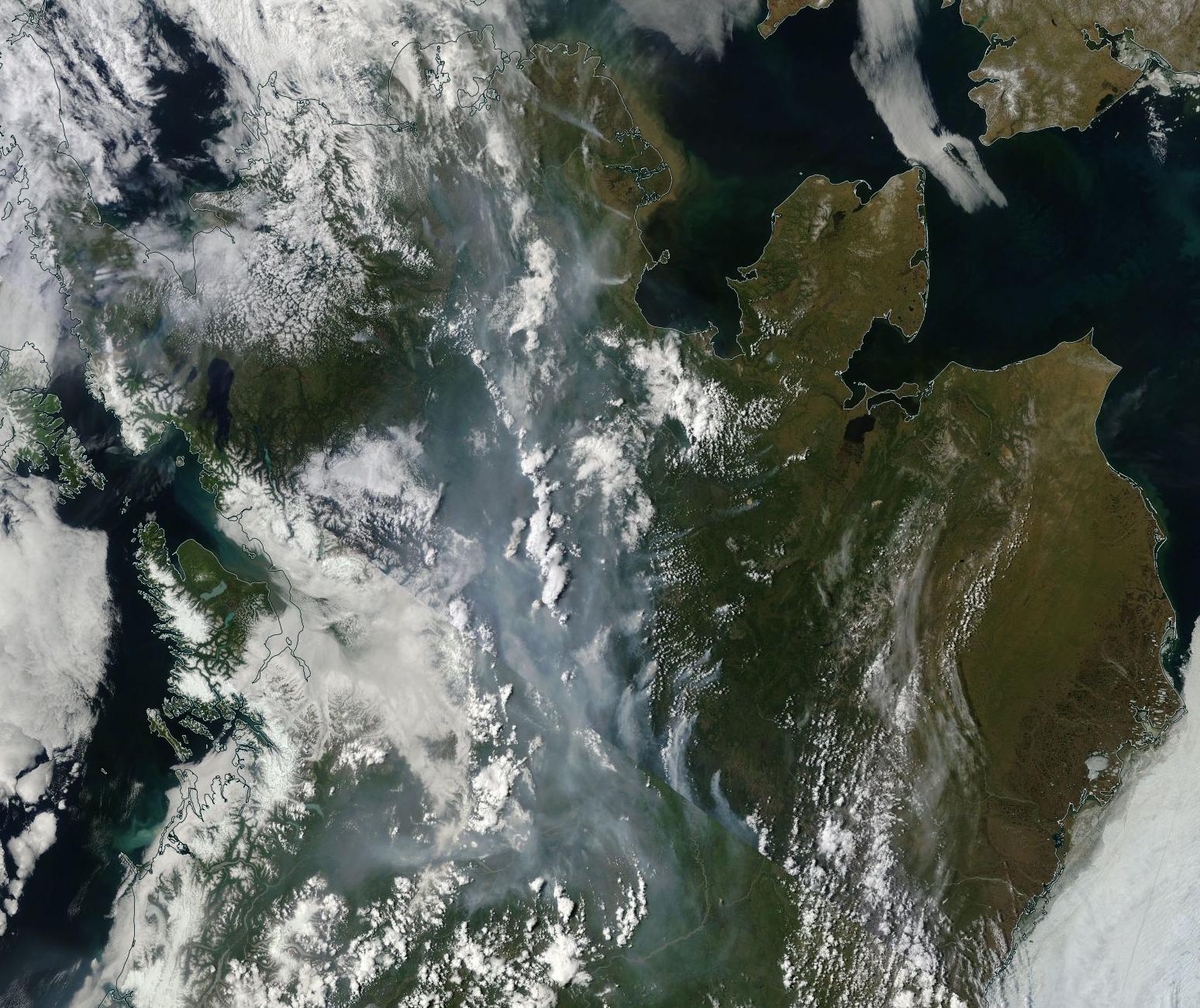
(MODIS satellite shot of wildfires erupting over a sweltering Southwestern Alaska on Sunday, June 21. Wildfires in permafrost regions of the Arctic like Alaska are particularly concerning as they are one mechanism that returns ancient sequestered carbon to the Earth atmosphere. A sign of a feedback set off by human warming that will worsen with continued fossil fuel emissions. Image source: LANCE-MODIS.)
Deadhorse, at the center of North Slope oil fields above the Arctic Circle set an all time record high of 82 degrees Fahrenheit (28 Celsius) on Sunday. That’s 3 degrees hotter than the previous all time record high of 79 degrees (26 C) set on August 16, 2004. The hottest reading for June at that location was a 68 degree (20 C) measure set in 2007. So, basically, Deadhorse just shattered the all-time record for June by 14 degrees (F) and the globally record hot summer of 2015 has only now gotten started.
Other locations experiencing new records for just Sunday included Kotzebue, which set a new all time record highest low temperature of 62 degrees (17 C). This reading broke the previous all time high minimum mark of 56 degrees (14 C), set in 1987. Bethel and Yakutat both tied their daily high minimum temperature records at 54 and 52 degrees (12 and 11 C), respectively.
And yesterday was just one day in long period of record heat for the State. Last month’s NOAA analysis showed temperatures fully 7 degrees Fahrenheit (4 C) above average. It’s a record heating that is now setting off severe wildfires all over Alaska. According to the state’sWildland Fire Information Center, the relentless heat and dryness has turned spruce, hardwoods, brush, and tundra into dry fuels vulnerable to any ignition source. Over the past week, ignition has come in the form of lightning — with most of Alaska’s 2015 wildfires set off by nature’s spark.
As a result we are seeing nearly double the number of fires during June compared to a typical year. Fires that have already destroyed 30 structures, forced evacuations, and tapped Alaska’s firefighting resources to its limits.
Wildfires Burning in the Rainforests of Washington as Major Heatwave Approaches
Record hot temperatures and wildfires, unfortunately, are not just an issue for Alaska. They’re a prevalent concern all up and down Western North America. A zone that has seen several years of record hot temperatures and dryness. Extreme weather events fueled by such global warming-linked phenomena as a Ridiculously Resilient high pressure Ridge over the Northeast Pacific that has kept heatwave and drought conditions firmly entrenched throughout much of the region for months and years. An atmospheric condition that is also linked to a hot ocean surface water ‘Blob’ in the Northeast Pacific (which is itself implicated in a growing number of marine species deaths).
Paradise-Fire-June-17
(Paradise Fire burning near a drought-shrunken creek in the rainforests of Olympia National Park, Washington. Image source: NPS and Wildfire Today.)
This week, the added heat also generated wildfires in unusual areas like the rainforests of Washington State’s Olympic Peninsula. Driest conditions since 1951 have resulted in a great deal of fire resiliency loss for forests in the region (1951 was the year of the historic Five Forks Fire, one of the worst ever to impact Washington State). Already, a rare early summer wildfire (called the Paradise Fire) has burned through 417 acres of forest.
Firefighters are doing their best to contain the blaze. But the record heat and dryness are multiplying fuel sources. Fires are enabled by dried lichens growing high up in the trees. When flames touch the lichens they rapidly ignite sending sparks to other lichen-covered tree tops. In this way, flames can leap rapidly from tree to tree under current conditions.
It’s very unusual to see fires in this rainforest zone. And when ignitions have occurred in those very rare cases, they have typically flared during late Summer and early Fall. So this June burning has fire officials very concerned — especially given the nearly unprecedented fire hazard conditions throughout the State. Conditions that are predicted to rapidly worsen as an extreme heatwave is expected to build through the coming weekend.
West Coast Heatwave Saturday
(A major heatwave is predicted to invade the US West and Northwest States this weekend. Washington and Oregon are predicted to experience temperatures more typical of desert sections of California and Arizona. Image source: Climate Reanalyzer.)
Temperatures over large stretches of Washington and Oregon are expected to climb into the 90s and 100s, possibly reaching the 110s (Fahrenheit — Celsius range from 33 to 45) by Sunday. For these typically cool, wet States, this brutal heat blow, should it emerge as predicted, will set off a spate of all time record high temperature readings, deepen drought conditions extending northward from California, and heighten fire conditions that are already in the range of worst ever experienced for sections of these States.
California Experiencing “Worst Fire Conditions On Record”
Moving further south along the U.S. West Coast we come at last to the drought hot zone that is California. A State that is now enduring its fourth year of drought. A drought that tree ring studies show is likely the worst such event in 1,000 years.
Ken Pimlott, Director of CAL FIRE noted:
We measure the fuel moisture content of all of the vegetation -the brush and the trees and we track that over the course of time and compare it month to month each year. And we put it through formulas and determine how much energy and how much heat it will put out when it’s burning. And we have seen -we saw it last year and we will see it again this year- we’ll be reaching records for potential heat output for times of the year that would normally not be burning in those conditions.
Wildfire nonexistent snowpack
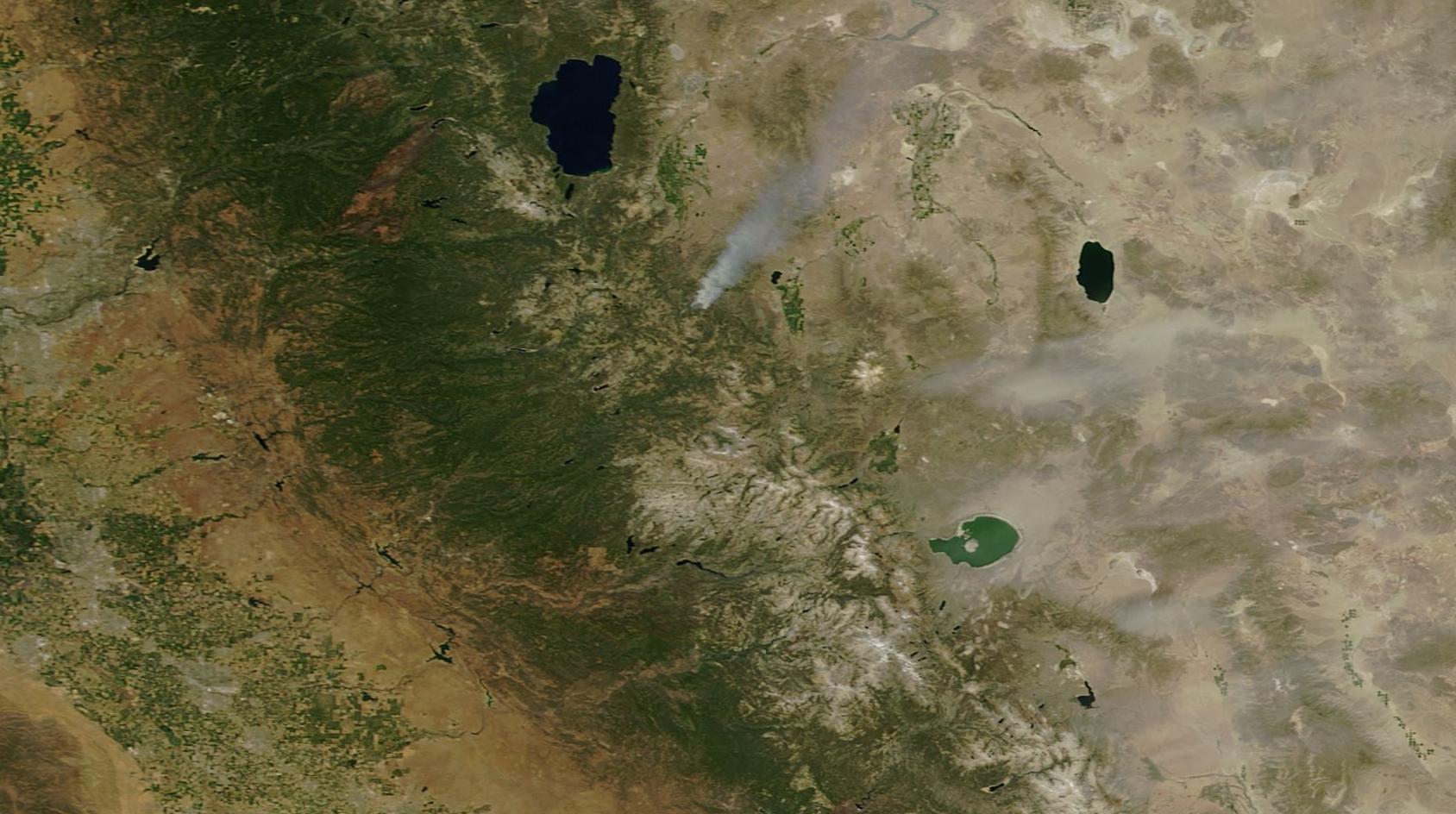
(Large wildfire burns in forests along the slopes of Sierra Nevada Mountains whose peaks are now entirely devoid of snow cover. Note that remaining glaciers are shown turning a dull brown in the June 21 MODIS satellite shot.)
So far this year over 1,100 wildfires have already ignited throughout the State. That’s nearly twice the typical number of 650 blazes popping up by this time of year. Exacerbating this stark context is a state water resource crisis compounded by non-existent Sierra Nevada snowpacks and dead trees that now number in the millions.
This is not Normal, Nor Should We View Widespread, Related Events in Isolation
Record and unusual Alaska, Washington, and California wildfires this season are, thus, not occurring in isolation, but as an inseparable feature of ongoing climate trends related to human-caused global warming. In this case, heatwaves are related to visible and extreme record ocean and atmospheric temperatures that have been ramping both globally and in the regions affected over past years and decades. And the fact that 2015 is continuing as the hottest year on record globally should also not be viewed as separate from the events witnessed all up and down the North American West Coast. Events that were largely predicted in many global climate models assessing the impacts of human based greenhouse gas warming on this vital national and global region.
We’ll end here by considering this thought — it’s only June, yet up and down the North American West Coast we are experiencing some of the worst heat, drought, and fire conditions ever recorded. It’s only June…
*   *   *   *
UPDATE NOON EST, JUNE 23, 2015: Satellite Imagery confirms that, over the past 24-48 hours, the wildfire situation in Alaska has continued to worsen. Widespread and large fires running throughout southwestern, central, northeastern and eastern Alaska today expanded and multiplied:
Wildfires Alaska June 22
(Fires flared to dangerous size across Alaska on June 22nd and 23nd. Image source: LANCE-MODIS)
These rapidly proliferating fires cover a diagonal swath stretching about 800 miles from southwest to northeast across the state. The fires are burning through Alaska’s permafrost zone and current intensity in the satellite image is similar to some of the worst Arctic fires we’ve seen during recent years. A substantial number of these fires feature smoke footprints indicating 5-10 mile active burn fronts. Smoke plume size is now large enough to become caught up in the Jet Stream and impact visual features of skies across the Northern Hemisphere.
Based on these satellite shots, it appears that Alaska is experiencing a heightening and very severe fire emergency — one that shows little sign of abatement over the next few days.

Labels: , , , , , , , , , ,

Thursday, April 17, 2014

IPCC Plan B - Suck It Up


Smoke in the water
Fire in the sky
   -Deep Purple

They're trying to wash us away
 -Randy Newman (Louisiana)


Greetings 

      Here's a twist.  We're shooting for "under 450".   But it that doesn't work., may be we could overshoot it by a bit, and then  go "carbon negative" for a while, and get back to 450.

    How to go "carbon negative"  -   Good old CCS - Carbon capture and Storage.   Or the bio-fuels version  - BECCS.   Se  New Scientist article (below)

    Sounds pretty good?

    Maybe not.  Nafeez Ahmed suggests that the idea is not well thought out.

Dr Smolker of Biofuelwatch, in contrast, said that the IPCC's central emphasis on biofuels with carbon capture is a "dangerous distraction" from the task of "deeply altering our entire relationship to energy consumption." She highlighted an unwillingness to recognize the "fundamental link between 'endless growth economics' and ecological destruction."


"The underlying assumption appears to be that business as usual [BAU] economic growth must be sustained, and industry and corporate profits must be protected and maintained. But if we focus on 'BAU economics', seeking and accepting only bargain basement options for addressing global warming - the costs will be far more severe."  


------
No option left but to suck CO2 out of air, says IPCC

16:47 14 April 2014 by Fred Pearce
For similar stories, visit the Climate Change Topic Guide

It is a beguiling idea: grow crops that suck carbon dioxide from the air, burn them to generate electricity, then bury the resulting CO2. The result? Less CO2 in the air, and less climate change.

This idea's time has come. The new report of the Intergovernmental Panel on Climate Change (IPCC), published on Sunday in Berlin, Germany, says "widespread" use of bioenergy with carbon capture and storage (BECCS) will probably be needed to stop the world warming by 2 °C, the politically agreed danger threshold.

That reflects the urgency of the situation. After 20 years of talk, the world is still accelerating towards climate catastrophe. Emissions grew faster between 2000 and 2010 than in each of the three previous decades.

The IPCC blames economic growth, which now adds twice as much to emissions as population growth does. (The report does not cover the years since 2010, when emissions may have risen more slowly despite continued economic growth.)

The heart of the report is a study of over 1000 scenarios of possible energy and climate futures. It lays out what scientists believe it will take to keep global warming below 2 °C this century. Achieving a better-than-even chance will probably mean at least tripling the proportion of energy coming from low-carbon sources, it says.

The key is to generate electricity without emitting CO2. Low-carbon sources currently provide 30 per cent of electricity, mostly from dams and nuclear power. That must rise to 80 per cent by 2050, with solar panels and wind turbines coming to the fore. New forms of solar will also play a role .

"Mitigation does not mean the world has to sacrifice economic growth," saysOttmar Edenhofer of the Potsdam Institute for Climate Impact Research in Germany, who co-chaired the report. But the burning of fossil fuel must virtually end by 2100, unless the emissions are buried using carbon capture and storage(CCS).

The report is neutral about nuclear power because of issues with nuclear waste, safety, proliferation and public image. But it does support natural gas as a "bridge technology" to replace coal until renewables take over or CCS becomes widespread.

Other cost-effective changes cited in the report include massive boosts to energy efficiency in industry and home heating, and reducing transport emissions through more efficient vehicles, more compact cities and more high-speed rail to cut air miles.

That's the right idea, says Brian Hoskins of the Grantham Institute for Climate Change in London. "We already have the technologies," he says. "We should stop wringing our hands and just get on with it."

Keeping below a 2 °C rise probably means keeping CO2 concentrations in the air below 450 parts per million. We are already up from a pre-industrial 280 ppm to400 ppm. Most scenarios the IPCC examined overshot 450 ppm and required recovery through "negative emissions" – BECCS, or some other CO2-sucking technology – later this century. CCS could be risky, but we may have no choice, the IPCC says.

The report should galvanise the UN negotiators who are drafting a global climate deal to be signed next year. But the hottest topic from the report may be its backing for negative emissions and CCS. It was published in Germany, a country with geology, climate policies and skills that make it an ideal test bed for the technology (see "German energy crisis points towards climate solution"). But the German public hates CCS. Last week Jochen Flasbarth, state secretary at Germany's federal environment ministry, told New Scientist that buried CO2 is seen as almost as bad as nuclear waste.

Read more: Climate report 2014: Your guide to the big questions

Labels: , , ,