Monday, January 15, 2018

After the horse has left the barn


I went to the desert on a horse with no name
It felt good to get out of the rain

-  America

Well be riding Wildfire
  -Micheal Murphy


Greetings. And Happy New Year


      Personally, I'm not too sad to see 2017 go. 2017 was when we hit the carbon threshold of 400 ppm 400

Last year marked the first time in several million years that atmospheric concentrations of CO2 passed 400 parts per million. By looking at what Earth’s climate was like in previous eras of high CO2 levels, scientists are getting a sobering picture of where we are headed.
Last year will go down in history as the year when the planet’s atmosphere broke a startling record: 400 parts per million of carbon dioxide. The last time the planet’s air was so rich in CO2 was millions of years ago, back before early predecessors to humans were likely wielding stone tools; the world was a few degrees hotter back then, and melted ice put sea levels tens of meters higher.
“We’re in a new era,” says Ralph Keeling, director of the Scripps Institution of Oceanography’s CO2 Program in San Diego. “And it’s going fast. We’re going to touch up against 410 pretty soon.”
There’s nothing particularly magic about the number 400. But for environmental scientists and advocates grappling with the invisible, intangible threat of rising carbon dioxide levels in the atmosphere, this symbolic target has served as a clear red line into a danger zone of climate change.
(For an interesting discussion of some of the scientific papers from 2017 see "What we Lerned about the Climate System in 2017 That should send shivers down the spines of policy makers.")
And a few other disturbing things happened in 2017.  Are they canaries in a coal mine?    Some ecosystems are, or have, moved into new states.  Permanently. 

For instance, coral reefs     (I don't like it much when people start talking about " last rites for an ecosystem ")


A study published Thursday in Science by some of the world’s top coral experts amounts to last rites for the ecosystems often referred to as “the tropical rainforests of the sea.” Scientists surveyed 100 reefs around the world and found that extreme bleaching events that once occurred every 25-30 years now happen about every five or six years.
“These impacts are stacking up at a pace and at a severity that I had never anticipated, even as an expert,” says Kim Cobb, a climate scientist and coral researcher at the Georgia Institute of Technology. “It’s really the rapidity of it that is so sobering and shocking — and for me personally, life-altering.”
“Before the 1980s, mass bleaching of corals was unheard of,” Terry Hughes, a coral scientist at Australia’s James Cook University and lead author of the new study, said in a statement.
The new study finds that 94 percent of surveyed coral reefs have experienced a severe bleaching event since the 1980s. Only six sites surveyed were unaffected. They are scattered around the world, meaning no ocean basin on Earth has been entirely spared.

Interview with one of the authors here


The region is now definitively trending toward an ice-free state, the scientists said, with wide-ranging ramifications for ecosystems, national security, and the stability of the global climate system. It was a fitting venue for an eye-opening reminder that, on its current path, civilization is engaged in an existential gamble with the planet’s life-support system.
In an accompanying annual report on the Arctic’s health — titled “the Arctic shows no sign of returning to reliably frozen region of recent past decades” — the National Oceanic and Atmospheric Administration, which oversees all official U.S. research in the region, coined a term: “New Arctic.”

This, of course, has devastating effects on the humans and other animals who relied on the " old arctic".    
The loss of sea ice is already having profound changes all the way down at the base of the Arctic food web. As more sunlight hits darkly-colored open water, more heat energy is retained, and temperatures are rising further. That’s kicking off what Mathis, of NOAA’s Arctic Program characterizes as “an almost runaway effect,” involving a lengthening of the growing season, a greening of the tundra, a surge in wildfires, and a boom in plankton growth. All that adds up to a wide-ranging disruption to patterns that Arctic natives have relied on for millennia.

But it also has other knock effects, like melting permafrost 

In the NOAA report, Arctic scientists lay out their best ideas of what this shift could mean for the world. Their depictions are sobering.
Take, for instance, the hypothesis of University of Alaska-Fairbanks permafrost scientist Vladimir Romanovsky: So far, 2017 has seen the highest permafrost temperatures in Alaska on record. If that warming continues at the current rate, widespread thawing could begin in as few as 10 years. The impact of such defrosting “will be very very severe,” Romanovsky says, and could include the destruction of local infrastructure — like roads and buildings — throughout the Northern Hemisphere and the release of additional greenhouse gases that have been locked for generations in the ice.

Roughly a quarter of the planet is slowly turning into a perpetual desert.

A study published Monday inpre-industrialNature Climate Change contains a stark warning for humankind: If global temperatures rise 1.5 degrees C above pre-industrial levels by 2050, between 20 and 30 percent of the world’s land surface could face desertlike conditions.
Swaths of Asia, Europe, Africa, Central America, and southern Australia would be hit particularly hard by drought and aridification, the long-term reduction of moisture in soil. More than 1.5 billion people currently live in these regions
Things would go much better, the researchers find, if we managed to stay within 1.5 degrees Celsius of pre-industrial levels. Manoj Joshi, one of the study authors from the University of East Anglia, said in a statement: “Our research predicts that aridification would emerge over about 20-30 percent of the world’s land surface by the time the global mean temperature change reaches 2 degrees Celsius.

 But two thirds of the affected regions could avoid significant aridification if warming is limited to 1.5 degrees Celsius.”
Kind of spooky -   read that last sentence again .   One third of the desertification happens before we hot 1.5  (2040?). 

“Loss of oxygen in many ways is the destruction of an ecosystem,” Breitburg says. “If we were creating vast areas on land that were uninhabitable by most animals, we’d notice. But we don’t always see things like this when they are happening in the water… These low-oxygen zones occur naturally, but have grown by more than 4.5 million square kilometers — an area roughly as large as the entire European Union—just since the mid-20th century. In part that’s because of rising temperatures.
  So, welcome to a new era
So, what are we doing about it ?  We have two responses   One is widely advertised. Another is a bit more hidden
The one that's obvious is called "decoupling ".    It is hoped that that by installing renewables, and making machinery more efficient, fossil fueled plants will become unnecessary.   The economy would grow, and fossil fuel use would shrink.      So far that hasn't really paid off. 
"... it is just not happening, at least at the global scale. Just take a look at this image:

Note how closely related the GDP an the world's energy consumption are. It is impressive because the GDP is measured in terms of money flows.

 For an interesting review of how little has been accomplished through efficiency efforts see here   (hat tip Sarah D).  This study shows how little fossil fuel has been displaced by renewable power to date . (2012)   But  still one hopes.   We need a substantial change.  Here is an illustration of what it would take.  From here

"...true "decoupling" would mean inverting the trend, as shown below (again from Le Petit's paper), where we see what we expect from the IEA scenarios


As you see, true decoupling is quite a challenge. 


Everyone seems to admit that "decoupling" will not get us to  1.5 or 2 degrees above pre industrial  So, the backstop is "Negative Emissions Technologies" , which essentially means sucking the carbon out of the air.  As more fully explained in this November 2017 video, by Kevin Anderson.  Anderson points out that not only  is our reliance on this technology hidden in the fine print,   technology not yet exist,  the policy makers are 

It also assumes that we can run things in reverse.  That we can put CO2 in the atmosphere now, and take it out later, and everything will go back to where it was.  This is apparently not the case for the ocean

"The researchers based their simulation on real-world carbon dioxide emissions from 1800 to 2005, and then projected those emissions into the year 2250. Then they simulated what would happen if technology could remove 18 billion tons of carbon dioxide per year—about half of present-day emission rates—from 2250 until 2700. The researchers found this did decrease atmospheric CO2 levels but could not restore the ocean’s preindustrial dissolved oxygen content or temperature. Even after 450 years of geoengineering, the model ocean was still almost as acidic as it would have been without any intervention at all.


 “It is clear that rather than trying to clean up a mess, it would be wiser to simply not create the mess in the first place.”


What can we expect in 2018?  Here's a hint.     Sacrifice areas.   
The IPCC is due to release a report on the likelihood and effects of achieving 1.5 degrees.  Reuters has obtained a draft .  It confirms that there is a   low probability of success: “There is very high risk that […] global warming will exceed 1.5 degrees Celsius above pre-industrial levels [should emissions continue at the current pace].”The draft also states that meeting the climate goal would require an “unprecedented” leap from fossil fuels to renewable sources of energy and extensive reforms everywhere from industry to agriculture."    

"Additionally, while curbing global temperatures would help reduce some of the worst impacts of climate change, including sea level rise and droughts, it would not be enough to protect the planet’s most fragile ecosystems, including polar ice caps and coral reefs.
One wonders what else will be sacrificed on the alter of the growth of the industrial economy.  The Amazon?  Low lying areas in South east Asa? 


And as for the Negative Emissions Technology ?

"Gabriel Marty, a climate change analyst and former U.N. Framework Convention on Climate Change (UNFCCC) delegate for France, told Futurism that it’s too soon to speculate on the content of the final report.However, once it is released, he said readers should note the treatment of the uncertainties and risks of the so-called “bio-energy with carbon capture and storage (BECCS)” technologies designed to suck carbon emissions out of the atmosphere.  The risks associated [with heavily relying on these technologies] must be clearly outlined,” said Marty. “They do not exist yet, the scale that would be needed would be enormous, and the adverse impacts on land and water resources would likely be huge.”According to sources familiar with the IPCC’s proceedings, the panel has been criticized in the past for being too coy about the limitations of BECCS and for understating their risks in order to present the 2 degrees Celsius target as “still viable.”

So it goes...

Labels: , , , , , ,

Sunday, August 6, 2017

Free riders, death spirals, cabbages and kings


From all these mistakes
We must surely be learning
     -Beatles

I don't need no sports car
I can walk anytime around the block
      -Bob Dylan

Greetings


Is it overshoot day already?  How time flies.  Happy Overshoot Day


"This means that in seven months, we emitted more carbon than the oceans and forests can absorb in a year, we caught more fish, felled more trees, harvested more, and consumed more water than the Earth was able to produce in the same period," World Wildlife Fund and Global Footprint Network said in a statement.
"The costs of this global ecological overspending are becoming increasingly evident around the world," the groups added, "in the form of deforestation, drought, fresh-water scarcity, soil erosion, biodiversity loss, and the buildup of carbon dioxide in the atmosphere."
Last year, Earth Overshoot Day fell on August 8, an indication that the world's population is accelerating the pace with which it blows through the planet's annual resource budget from year to year. 

          Just another reminder of the need to turn the "SS Industrial Economy" away from the iceberg, and quickly.  But just how quickly can we turn, and who's going to pay the bill?

          Let's take a look at utilities.  For years their mandate was to provide power reliably, and a low cost.  For their troubles, they we entitled to a reasonable profit, as determined by the PUC.  Large centralized coal and gas plants worked pretty well .  They lasted a long time, so construction costs were spread out, and a big chunk of the costs were fuel, which didn't have to be paid upfront. 

          But, times change .   Now people want clean energy.  Some people want to generate their own energy and use the utility as aback up.  Some people want to have their own back up.  Some want to walk away.     Now , with the advent of cheap rooftop solar, and cheaper batteries , it is much more feasible for customers to walk away, especially in sunny states .  For some customers, that is.  Customers who can afford the up front costs .  But once they have left, who will be left to pay for grid, and all the sunk costs that the utility has in large centralized plants?  The remaining ratepayers ?   The government ?
    
           Sound familiar?   Kind of like the medical insurance mess we are in.   Are we going to have a "hookup mandate", like the "medical insurance mandate"?

          In this post Dave Roberts explains the utilities (and our) conundrum.      And here he suggest ways to reorganize our relationship with electricity and the grid.  .


          There's a similar problem with transportation. Robert Scribbler has an enthusiastic piece about the Tesla, calling it a Beautiful Machine to Change the World   It is p[retty.  And it will go pretty fast  ( 140 mph, 0-60 in 5.5 secs)   He points to a study that says electric vehicles could reduce our CO2 emissions to  between 1/2 and 1/10th that of a fossil fuel vehicle including manufacturing.     But,  we have a huge investment in the current transportation system.  In order to move to an electricity based system we will need to scrap a lot of infrastructure  - like fueling stations , fuel trucks, tankers, tank farms, refineries,  and of course cars.

           Let's look at cars.   The current fleet is overwhelmingly fossil based -  although there are 2 million EVS they only amount to .02% of the fleet..  Sales of EVS are growing rapidly,  but they have been unable to catch up to sales of regular IC vehicles.  In fact it may take more than a decade for the EV sales to stop the continuing growth in the total number of fossil fueled vehicles.  Here is an interesting article from Robert Rapier, where he points out that EVS are not substituting for IC sales, but are merely supplementing them. 

         Its a pretty straightforward arithmetic problem.  Every year a huge number of cars are sold.  Some are replacing cars that are junked.  Some are to meet the demand of new drivers.  Last year 88 million cars were sold,  up 4.8% from the previous year.  Less than 1 million were EVS .    That 4.8% growth represents the new demand.    So let's say car sales grow 3% next year.  So that's (88*.03) =2.64 million new cars added!  Let's say the EV growth rate is 25%,  so 950,000 units would be sold.   Still more IC than EV!   The next year its around 3 million and 1 million.  The tortoise and the hare.   At some point, the EV sales catch up, and then, hopefully, oil use begins to drop.    But, as  noted, that may be ten years from now.
           (I am going to ignore, for the time being that cars consume only 50% of the oil used , and that , so far, there is no mass producued electricity based, tractor trailer, , agricultural machinery, airplane, container ship etc) ,  

       And there is still a question of how much, and how soon,  the EV sales would reduce fossil fuel consumption.  See  this study which suggests that if 75% of the fleet were electric tomorrow, CO2 emissions would drop by less than 20%.    Why is that?  Well, the electrical system just isn't that clean yet..  

       Is the electric system likely to become clean quickly?   Not as quickly as we'd like to imagine.  The size of the investment is mind boggling.  See here


"...phasing out fossil fuels over 50 years – wind and solar plants need to be installed at eight to ten times current rates by 2035.
Financially, this corresponds with capital investment in wind and solar PV plants plus batteries of around US$3 trillion per year (in 2015 dollars) and average lifetime capital cost in the order of US$5 trillion to US$6 trillion per year.
This implies that total expenditure on energy supply will increase its share of world spending, reducing scope for other expenditure. "


       Here's an odd note-  even though renewables have been growing steadily, the percent of electric generation by fossil fuels has not changed in the last 10 years.

"...over the last decade (2005-2015) the share of renewables in our electricity mix has increased by approximately 5-6 percent. This is good news. However, over this same period, the share from nuclear production has decreased by almost exactly the same amount (5-6 percent)."

        So, are EV's the solution?   They might help, but not as much as we'd like to believe.  We actually need to get out of our cars altogether..   Here is a nice piece by George Monbiot  on our transportation system. His conclusion?


"Electric cars solve only part of the problem. They occupy less air, but just as much road and parking space. The resources required to manufacture them – and the volume of mines and ports and processing plants that wreck rare habitats around the world – might even intensify. While the total carbon emissions and air pollution caused by electric cars will be lower than those the fossil system produces, electricity use will have to rise. If you are among those who support electric cars but oppose nuclear power, you may have to reconsider one of your positions.
So let’s explore some pollution solutions that change this ridiculous system, rather than extending it indefinitely. Why not – through shifting road space from cars to bicycles in the form of safe cycle lanes – aim to make cycling the main form of urban transport? Why not launch a scrappage scheme that trades cars for public transport tokens

See also  this  suggesting that  we don't need "different" cars as much as we need "fewer cars"
'
"Oliver Hayes, Friends of the Earth air pollution campaigner, said: “Electric cars are critical in the fight against climate change and deadly air pollution, but they’re not a panacea. We must now build the infrastructure that reassures ordinary people that cycling and walking is safe, and invest in public transport that is consistently clean, cheap and reliable.”
   It seems the road between here and Our Renewable Future is filled with potholes.   We'd like to ride in style, and not have to give up any of our perks.  But if we don't change our ways, by  the time we get to that golden future, what do you suppose the world will look like?

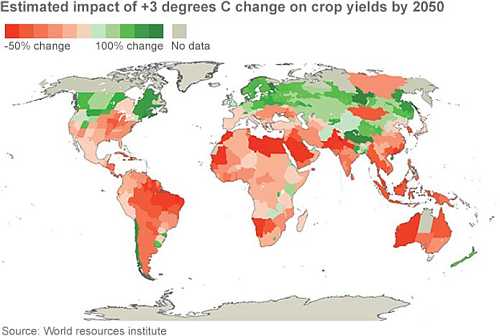
         Here's one view from the IPPC.   On average its not so bad.  But there are winners and losers.  Some remain kings, some hope for cabbage.


Labels: , , , , , , , ,

Wednesday, March 8, 2017

Your money or your life

They say the best things in life are free
well you can keep them for the birds and bees
     - the Beatles

Say a prayer 
for the salt of the earth
     -The Rolling Stones


Greetings


       I ran across a review by Kevin Anderson,  of Leonardo DiCaprio's film, Before the Flood.  Its worth reading.  Here.    He says that the movie does provide some good information, but that it leaves the viewer with the impression that there are easy technical solutions to climate change,  which do not require any changes to our life style.  He says:

"Certainly huge strides towards low carbon energy could be achieved now with existing energy supply and demand technologies. The research, development and deployment of promising new technologies, including Musk’s solar-battery future, could be accelerated. But Paris and carbon budgets frame an urgent problem far beyond the multi-decadal timeframe of deploying sufficient new energy technologies to displace fossil fuels. Deep and early mitigation through reduced fossil-fuel use by high emitters is key to both extending the window for this technology-transition and for leaving sufficient emission space for those in poverty to have near-term access to fossil fuel energy."

He also has some harsh words about the film's claim that a person can be "carbon neutral " by buying offsets,  saying, 

"I really doubt that the Pope, whose Encyclical makes more systems-level sense than the plethora of glossy reports dispensed by green-growth ‘think’ tanks (and who was interviewed for the film), would sanction the ongoing “buying of indulgences”. For that’s what it is. The emissions from first-class flights, grand hotel rooms and travelling film crews are changing the climate now – and will for the next ten thousand years. The deed’s been done – and no amount of conscience-salving finance can assuage the climate impact. Ok, the projects funded may have real and important value – but asking someone else to diet whilst we binge on high-carbon fun is simply fraudulent. "

      For all his good intentions, Leo doesn't want to give up his lifestyle.  None of us do.  Leo is worth $245 million.   He has the lifestyle of the rich and famous.   (But that's OK, I think he's a good actor.)  The rest of us just have the lifestyle of the rich.   After all, we are the top 10% of the world.     (Interesting fact:   The top 10%  is responsible for 90% of the CO2 .   That's us.    The folks whose  income is greater than $23 a day - $8400 per year.      ). 
      So naturally, we hope that technology and "green growth", can reduce CO2 while increasing GNP, so we can continue to enjoy that life.   Eric Lindberg, in his article,  Economic Growth A Primer , makes an effective argument that this is a comforting illusion, but that any growth of GDP is likely to continue make things worse .  He notes that 

"  As the global economy grows, species go extinct, rainforests are permanently lost, carbon emissions grow, and the world becomes hotter and hotter.  These trends are not reversing, nor is there any credible sense that they might.

Interestingly Bill Gates  (net worth  $85 B ), seems to agree with Lindberg , at least in part.    He says

"What’s amazing is how our intense energy usage is one and the same as modern civilization. That is, for all the great things that happened in terms of human lifestyle, life span, and growing food before 1800, civilization didn’t change dramatically until we started using coal in the U.K. in the 1800s 

He also doesn't think that renewables will provide the answer
  
"Today’s technologies are a good start, but not good enough. Some places don’t get enough regular sunlight or reliable wind to depend heavily on these sources. In any case, these and other clean-energy technologies are still too expensive to be rolled out widely in poor countries. They’re getting cheaper, but many developing countries aren’t waiting for these tools to become affordable. They’re building large numbers of coal plants and other fossil-fuel infrastructure now. That’s very unfortunate, but it’s understandable. We can’t expect them to wait decades for cleaner alternatives when their people need energy now.
So, Gates is looking for an "energy miracle".   

For an interesting exploration of the hype about fast renewable energy is taking over, and how much capacity has been built. see  How Renewable Energy Advocates are Hurting the Climate Cause 


Lindberg  is not looking for a miracle, he has a different solution, stop economic growth.

"True, economic growth does provide some short-term benefits and gains, and recessions are legitimately painful and destructive.  But economic growth is nevertheless the greatest threat to humanity today, and those most devoted to economic growth will, as its consistent performance begins to wane in the future, perhaps be the greatest political threat to ordinary people of the world."  


           Another certified rich guy, Warren Buffet, (net worth $76.9 billion) has famously said "Only when the tide goes out,do you discover who has been swimming naked."

           It seems that the tide is going out    NOAA reports:


"The annual growth rate of atmospheric carbon dioxide measured at NOAA’s Mauna Loa Observatory in Hawaii jumped by 3.05 parts per million during 2015, the largest year-to-year increase in 56 years of research.


           Even the super rich are feeling nervous , and hope to avoid the impacts by building  "lifeboats "-  small compounds in places like New Zealand,  complete with airfields and planes. ( one wonders how such compounds will do in a "long emergency"

        The impacts to "regular people" has begun.  Today, climate change accounts for 87 per cent of disasters worldwide. Some of the worst droughts in decades are continuing to unravel across southeastern Africa and Latin America. Cyclonic storms, floods, wildfires, and landslides are bearing on the world’s most vulnerable populations.


 Some suggest that we "brace for impact"  

"The challenge of adaptation directly exposes the climate crisis as a crisis of social justice. All disasters break open the wounds of unequal societies. Storms do not discriminate, but they do make landfall on landscapes riven by disparities of wealth, power and safety.

The labels of ‘natural disaster’ and ‘extreme weather’ can mislead us into thinking that the principal dangers we face stem from the atmosphere’s furies. But as geographer Jesse Ribot writes, ‘vulnerability does not fall from the sky.’ The wreckage of climate change is the product of collision: between environmental conditions and human realities."
         Some people can't afford swim suits. 


         For an interesting exploration of energy, climate and poverty, you may want to take a look at part of  Bill Gate's blog  Life In the Dark.     (I was quite taken by the picture of the Nigerian students, with no electricity at home, studying under street lights.)


-------

PS

              According to Kevin Anderson, if carbon emissions were to peak in 2020,   any hope of avoiding  a 2 degree rise would involve, " on the order of 10 percent reductions a year after 2020, leading to total decarbonization by 2035-45."

      With that in mind , lets look the "cap and trade" bill that has been introduced in the Oregon legislature.(  HB 2135 ).  It would  require carbon reductions on the following timetable .  By 2025 : 20% reduction , by 2035 : 45%, by 2050 : 75%. 
    

      What's the proper response to this?   Obviously it fails the "Anderson test".  Most glaring is that it never requires "decarbonization"  at all. Not by 2035-45 as Anderson suggest.  Not by 2050.   We never get to 100% reduction.  Ever.  Is it a "step in the right direction"?.    In some sense it is.  But, clearly, this bill is not shooting for 2 degrees.    But,  as they say, "politics is the art of the possible.:  What is possible, may not be what is necessary.


       One possible way to look at all this, is by analogy .   When a ship is taking on water, you attempt to pump out the excess, , but there is a point at which the pumps are overwhelmed, see  e.g The Titanic..  At that point, pumping water will not improve things.   It's not a "step in the right direction".   It wouldn't really make it "less bad", because the ship is going down.  At that point it is time to put your energy elsewhere,  handing out life jackets , and   providing an orderly evacuation .    

     Similarly,  reduction in carbon emissions will be useful, but only up to a point.  That point is when the enough tipping points have been reached, and the climate change is self sustaining.  After that reductions will have no impact. 

 Have we crossed that line?  Hopefully not


     In any event, one way or the other, we had probably better "brace for impact".

Labels: , , , , , , ,