Free riders, death spirals, cabbages and kings
From all these mistakes
We must surely be learning
-Beatles
I don't need no sports car
I can walk anytime around the block
-Bob Dylan
Greetings
Is it overshoot day already? How time flies. Happy Overshoot Day
"This means that in seven months, we emitted more carbon than the oceans and forests can absorb in a year, we caught more fish, felled more trees, harvested more, and consumed more water than the Earth was able to produce in the same period," World Wildlife Fund and Global Footprint Network said in a statement."The costs of this global ecological overspending are becoming increasingly evident around the world," the groups added, "in the form of deforestation, drought, fresh-water scarcity, soil erosion, biodiversity loss, and the buildup of carbon dioxide in the atmosphere."Last year, Earth Overshoot Day fell on August 8, an indication that the world's population is accelerating the pace with which it blows through the planet's annual resource budget from year to year.
Just another reminder of the need to turn the "SS Industrial Economy" away from the iceberg, and quickly. But just how quickly can we turn, and who's going to pay the bill?
Let's take a look at utilities. For years their mandate was to provide power reliably, and a low cost. For their troubles, they we entitled to a reasonable profit, as determined by the PUC. Large centralized coal and gas plants worked pretty well . They lasted a long time, so construction costs were spread out, and a big chunk of the costs were fuel, which didn't have to be paid upfront.
But, times change . Now people want clean energy. Some people want to generate their own energy and use the utility as aback up. Some people want to have their own back up. Some want to walk away. Now , with the advent of cheap rooftop solar, and cheaper batteries , it is much more feasible for customers to walk away, especially in sunny states . For some customers, that is. Customers who can afford the up front costs . But once they have left, who will be left to pay for grid, and all the sunk costs that the utility has in large centralized plants? The remaining ratepayers ? The government ?
Sound familiar? Kind of like the medical insurance mess we are in. Are we going to have a "hookup mandate", like the "medical insurance mandate"?
In this post Dave Roberts explains the utilities (and our) conundrum. And here he suggest ways to reorganize our relationship with electricity and the grid. .
There's a similar problem with transportation. Robert Scribbler has an enthusiastic piece about the Tesla, calling it a Beautiful Machine to Change the World It is p[retty. And it will go pretty fast ( 140 mph, 0-60 in 5.5 secs) He points to a study that says electric vehicles could reduce our CO2 emissions to between 1/2 and 1/10th that of a fossil fuel vehicle including manufacturing. But, we have a huge investment in the current transportation system. In order to move to an electricity based system we will need to scrap a lot of infrastructure - like fueling stations , fuel trucks, tankers, tank farms, refineries, and of course cars.
Let's look at cars. The current fleet is overwhelmingly fossil based - although there are 2 million EVS they only amount to .02% of the fleet.. Sales of EVS are growing rapidly, but they have been unable to catch up to sales of regular IC vehicles. In fact it may take more than a decade for the EV sales to stop the continuing growth in the total number of fossil fueled vehicles. Here is an interesting article from Robert Rapier, where he points out that EVS are not substituting for IC sales, but are merely supplementing them.
Its a pretty straightforward arithmetic problem. Every year a huge number of cars are sold. Some are replacing cars that are junked. Some are to meet the demand of new drivers. Last year 88 million cars were sold, up 4.8% from the previous year. Less than 1 million were EVS . That 4.8% growth represents the new demand. So let's say car sales grow 3% next year. So that's (88*.03) =2.64 million new cars added! Let's say the EV growth rate is 25%, so 950,000 units would be sold. Still more IC than EV! The next year its around 3 million and 1 million. The tortoise and the hare. At some point, the EV sales catch up, and then, hopefully, oil use begins to drop. But, as noted, that may be ten years from now.
(I am going to ignore, for the time being that cars consume only 50% of the oil used , and that , so far, there is no mass producued electricity based, tractor trailer, , agricultural machinery, airplane, container ship etc) ,
And there is still a question of how much, and how soon, the EV sales would reduce fossil fuel consumption. See this study which suggests that if 75% of the fleet were electric tomorrow, CO2 emissions would drop by less than 20%. Why is that? Well, the electrical system just isn't that clean yet..
Is the electric system likely to become clean quickly? Not as quickly as we'd like to imagine. The size of the investment is mind boggling. See here
"...phasing out fossil fuels over 50 years – wind and solar plants need to be installed at eight to ten times current rates by 2035.Financially, this corresponds with capital investment in wind and solar PV plants plus batteries of around US$3 trillion per year (in 2015 dollars) and average lifetime capital cost in the order of US$5 trillion to US$6 trillion per year.This implies that total expenditure on energy supply will increase its share of world spending, reducing scope for other expenditure. "
Here's an odd note- even though renewables have been growing steadily, the percent of electric generation by fossil fuels has not changed in the last 10 years.
"...over the last decade (2005-2015) the share of renewables in our electricity mix has increased by approximately 5-6 percent. This is good news. However, over this same period, the share from nuclear production has decreased by almost exactly the same amount (5-6 percent)."
So, are EV's the solution? They might help, but not as much as we'd like to believe. We actually need to get out of our cars altogether.. Here is a nice piece by George Monbiot on our transportation system. His conclusion?
"Electric cars solve only part of the problem. They occupy less air, but just as much road and parking space. The resources required to manufacture them – and the volume of mines and ports and processing plants that wreck rare habitats around the world – might even intensify. While the total carbon emissions and air pollution caused by electric cars will be lower than those the fossil system produces, electricity use will have to rise. If you are among those who support electric cars but oppose nuclear power, you may have to reconsider one of your positions.
So let’s explore some pollution solutions that change this ridiculous system, rather than extending it indefinitely. Why not – through shifting road space from cars to bicycles in the form of safe cycle lanes – aim to make cycling the main form of urban transport? Why not launch a scrappage scheme that trades cars for public transport tokens
"Oliver Hayes, Friends of the Earth air pollution campaigner, said: “Electric cars are critical in the fight against climate change and deadly air pollution, but they’re not a panacea. We must now build the infrastructure that reassures ordinary people that cycling and walking is safe, and invest in public transport that is consistently clean, cheap and reliable.”
It seems the road between here and Our Renewable Future is filled with potholes. We'd like to ride in style, and not have to give up any of our perks. But if we don't change our ways, by the time we get to that golden future, what do you suppose the world will look like?
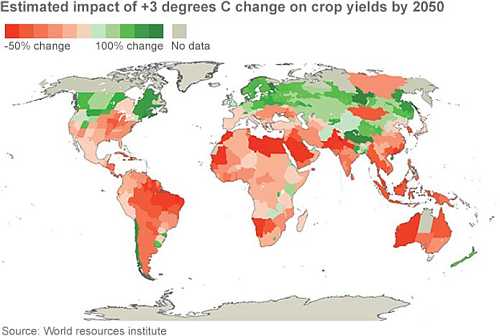
Here's one view from the IPPC. On average its not so bad. But there are winners and losers. Some remain kings, some hope for cabbage.
Labels: climate, Dave Roberts, death spiral, EV, free rider, Robert scribbler, solar, Tesla, Utility
posted by Walter @ 3:52 PM
0 Comments

