Sunday, August 6, 2017

Free riders, death spirals, cabbages and kings


From all these mistakes
We must surely be learning
     -Beatles

I don't need no sports car
I can walk anytime around the block
      -Bob Dylan

Greetings


Is it overshoot day already?  How time flies.  Happy Overshoot Day


"This means that in seven months, we emitted more carbon than the oceans and forests can absorb in a year, we caught more fish, felled more trees, harvested more, and consumed more water than the Earth was able to produce in the same period," World Wildlife Fund and Global Footprint Network said in a statement.
"The costs of this global ecological overspending are becoming increasingly evident around the world," the groups added, "in the form of deforestation, drought, fresh-water scarcity, soil erosion, biodiversity loss, and the buildup of carbon dioxide in the atmosphere."
Last year, Earth Overshoot Day fell on August 8, an indication that the world's population is accelerating the pace with which it blows through the planet's annual resource budget from year to year. 

          Just another reminder of the need to turn the "SS Industrial Economy" away from the iceberg, and quickly.  But just how quickly can we turn, and who's going to pay the bill?

          Let's take a look at utilities.  For years their mandate was to provide power reliably, and a low cost.  For their troubles, they we entitled to a reasonable profit, as determined by the PUC.  Large centralized coal and gas plants worked pretty well .  They lasted a long time, so construction costs were spread out, and a big chunk of the costs were fuel, which didn't have to be paid upfront. 

          But, times change .   Now people want clean energy.  Some people want to generate their own energy and use the utility as aback up.  Some people want to have their own back up.  Some want to walk away.     Now , with the advent of cheap rooftop solar, and cheaper batteries , it is much more feasible for customers to walk away, especially in sunny states .  For some customers, that is.  Customers who can afford the up front costs .  But once they have left, who will be left to pay for grid, and all the sunk costs that the utility has in large centralized plants?  The remaining ratepayers ?   The government ?
    
           Sound familiar?   Kind of like the medical insurance mess we are in.   Are we going to have a "hookup mandate", like the "medical insurance mandate"?

          In this post Dave Roberts explains the utilities (and our) conundrum.      And here he suggest ways to reorganize our relationship with electricity and the grid.  .


          There's a similar problem with transportation. Robert Scribbler has an enthusiastic piece about the Tesla, calling it a Beautiful Machine to Change the World   It is p[retty.  And it will go pretty fast  ( 140 mph, 0-60 in 5.5 secs)   He points to a study that says electric vehicles could reduce our CO2 emissions to  between 1/2 and 1/10th that of a fossil fuel vehicle including manufacturing.     But,  we have a huge investment in the current transportation system.  In order to move to an electricity based system we will need to scrap a lot of infrastructure  - like fueling stations , fuel trucks, tankers, tank farms, refineries,  and of course cars.

           Let's look at cars.   The current fleet is overwhelmingly fossil based -  although there are 2 million EVS they only amount to .02% of the fleet..  Sales of EVS are growing rapidly,  but they have been unable to catch up to sales of regular IC vehicles.  In fact it may take more than a decade for the EV sales to stop the continuing growth in the total number of fossil fueled vehicles.  Here is an interesting article from Robert Rapier, where he points out that EVS are not substituting for IC sales, but are merely supplementing them. 

         Its a pretty straightforward arithmetic problem.  Every year a huge number of cars are sold.  Some are replacing cars that are junked.  Some are to meet the demand of new drivers.  Last year 88 million cars were sold,  up 4.8% from the previous year.  Less than 1 million were EVS .    That 4.8% growth represents the new demand.    So let's say car sales grow 3% next year.  So that's (88*.03) =2.64 million new cars added!  Let's say the EV growth rate is 25%,  so 950,000 units would be sold.   Still more IC than EV!   The next year its around 3 million and 1 million.  The tortoise and the hare.   At some point, the EV sales catch up, and then, hopefully, oil use begins to drop.    But, as  noted, that may be ten years from now.
           (I am going to ignore, for the time being that cars consume only 50% of the oil used , and that , so far, there is no mass producued electricity based, tractor trailer, , agricultural machinery, airplane, container ship etc) ,  

       And there is still a question of how much, and how soon,  the EV sales would reduce fossil fuel consumption.  See  this study which suggests that if 75% of the fleet were electric tomorrow, CO2 emissions would drop by less than 20%.    Why is that?  Well, the electrical system just isn't that clean yet..  

       Is the electric system likely to become clean quickly?   Not as quickly as we'd like to imagine.  The size of the investment is mind boggling.  See here


"...phasing out fossil fuels over 50 years – wind and solar plants need to be installed at eight to ten times current rates by 2035.
Financially, this corresponds with capital investment in wind and solar PV plants plus batteries of around US$3 trillion per year (in 2015 dollars) and average lifetime capital cost in the order of US$5 trillion to US$6 trillion per year.
This implies that total expenditure on energy supply will increase its share of world spending, reducing scope for other expenditure. "


       Here's an odd note-  even though renewables have been growing steadily, the percent of electric generation by fossil fuels has not changed in the last 10 years.

"...over the last decade (2005-2015) the share of renewables in our electricity mix has increased by approximately 5-6 percent. This is good news. However, over this same period, the share from nuclear production has decreased by almost exactly the same amount (5-6 percent)."

        So, are EV's the solution?   They might help, but not as much as we'd like to believe.  We actually need to get out of our cars altogether..   Here is a nice piece by George Monbiot  on our transportation system. His conclusion?


"Electric cars solve only part of the problem. They occupy less air, but just as much road and parking space. The resources required to manufacture them – and the volume of mines and ports and processing plants that wreck rare habitats around the world – might even intensify. While the total carbon emissions and air pollution caused by electric cars will be lower than those the fossil system produces, electricity use will have to rise. If you are among those who support electric cars but oppose nuclear power, you may have to reconsider one of your positions.
So let’s explore some pollution solutions that change this ridiculous system, rather than extending it indefinitely. Why not – through shifting road space from cars to bicycles in the form of safe cycle lanes – aim to make cycling the main form of urban transport? Why not launch a scrappage scheme that trades cars for public transport tokens

See also  this  suggesting that  we don't need "different" cars as much as we need "fewer cars"
'
"Oliver Hayes, Friends of the Earth air pollution campaigner, said: “Electric cars are critical in the fight against climate change and deadly air pollution, but they’re not a panacea. We must now build the infrastructure that reassures ordinary people that cycling and walking is safe, and invest in public transport that is consistently clean, cheap and reliable.”
   It seems the road between here and Our Renewable Future is filled with potholes.   We'd like to ride in style, and not have to give up any of our perks.  But if we don't change our ways, by  the time we get to that golden future, what do you suppose the world will look like?

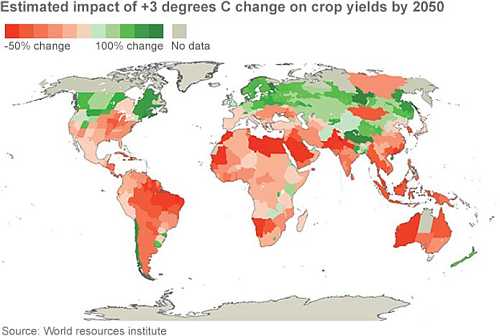
         Here's one view from the IPPC.   On average its not so bad.  But there are winners and losers.  Some remain kings, some hope for cabbage.


Labels: , , , , , , , ,

Saturday, April 6, 2013

Solar Power and Utilities


Greetings

    Now that solar is getting cheaper, what's that mean for utilities

    Good question!    Below Dave Roberts explains a new Citigroup report.   The intermittentcy of solar has the effect of increasing the need for peaker plants, which can be ramped up quickly,  and encouraging the retirement of base load coal plants, which can't  .  So that's nice   Seems like all this construction, and retirement will result in a higher cost to the consumer.  Which may encourage conservation.

     In the short term, it is not entirely clear whether this new configuration will , in fact, improve the climate situation.   Natural gas power plants are better than coal plants, only if leakage can be kept below 3.2%.  But recent reports have measured leakages of 3.6 to 7.9%.  see also  Bridge to Nowhere

     But there is a also another aspect.  Cheap solar also encourages firms to build  out their own solar arrays.  They get the benefits of the utility on cloudy days and at night, while using their own cheap solar on sunny days.   The result ?    See below    Higher prices for the rest of us , more build out,  fewer customers.  The death spiral

"Utilities “do realize that distributed solar is a mortal threat to their business,” said Mr. Crane, speaking at The Wall Street Journal’s ECO:nomics conference on Thursday in Santa Barbara, Calif.
“They can’t cut costs, so they will try to distribute costs over fewer and fewer customers.” This, he said, will increase costs for the customers, and will drive more of them toward distributed solar. "

Perhaps a good analogy is how email affected the Post Office.     Once there was a cheaper alternative, the Post Office had fewer and fewer customers


Citigroup: Renewables will triumph and natural gas will help

Banking giant Citigroup recently issued a report [PDF] that ought to thrill fans of renewable energy. However, tucked inside the good news is a pill that some greens will find difficult to swallow.
The good news is that Citi expects renewable energy to triumph; it believes that typical forecasts like those from the International Energy Agency are too pessimistic. Contrary to a certain strain of conventional wisdom, it says, shale gas will not crowd out renewable energy. Quite the opposite.
The pill? Citi expects it will take lots of natural gas — more than we’re currently using, in the medium term — to get to a power system run primarily on renewables. In fact, renewables and shale gas are in a “symbiotic” relationship, the report says, each helping the other increase market share. If that’s true, a moratorium on fracking, called for by many greens, might serve to inhibit the spread of renewable energy.
There are two reasons to see renewables and natural gas as mutually reinforcing. The first and most familiar is that renewables — at least wind and solar — are intermittent and require backup plants that can quickly ramp on and off (“peaker” plants) to support them. Those peaker plants typically run on natural gas.
The second reason is less well understood. It is illustrated by Germany’s experience. Here’s a key graphic where Citi models what it would look like if Germany’s current portion of renewable energy were doubled. The three charts represent power supply on three days — a winter day, a sunny workday, and a sunny weekend day.
Citigroup: double Germany renewables
Citigroup
Click to embiggen.
As you can see on the right, at the brightest part of a sunny weekend day, solar will supply not just peak demand, but almost the entire load.
That creates an interesting dynamic. At low penetration, solar just eats into the peak, which means it will push out peaker plants, mainly natural gas. That’s what’s happening in Germany now. But as solar grows, it starts eating beyond the peak, down into the baseload power that comes from coal and nukes. Here’s the thing, though: Baseload plants are not built to ramp up and down quickly or frequently, certainly not several times a week. If solar eats into a big chunk of their daily demand, they will likely start retiring. Then there will be a need for more natural-gas backup plants. (I wrote about all this in some detail here.)
Eventually, when renewables grow enough, the amount of power needed from peaker plants will decline, but because renewables remain highly variable, there will still be a need for back-up plants to be ready in case of an unexpected weather event (or, y’know, nighttime). That poses a challenge for utilities. Right now, power plants get paid for power; if they don’t produce power, they don’t get paid. Pushing more renewables onto the grid means that utilities will need to find some way to pay for capacity, not just power. In other words, they need to pay peaker plants to sit there, ready, just in case. “Ultimately,” the Citi analysts told E&E, “we believe that the system will move to a capacity payment mechanism to remunerate utilities for low utilization rates on plants that must remain open as backup generation.”
(Incidentally: the need for backup capacity is imposed on the grid by renewables, but as clean energy skeptics often complain, with some justification, it rarely gets counted among the costs of renewables. But that’s a topic for another post.)
Now. In theory, the need for natural gas to play these two supporting roles could be reduced and eliminated through a combination ofwide geographic dispersion of renewables, a more robust grid, more energy storage, and more non-intermittent renewables like geothermal or biogas. But given how fast renewables are ramping up, and how far those other pieces are from being in place, natural-gas peakers are likely to play a key role for several decades to come.
Anyhoo, the report concludes that “the requirement for ‘peaking power’ rises as renewable penetration increases,” so “gas-fired power is not only compatible with renewables, it is in many ways essential for its large-scale adoption.”
But there’s an important qualification:
However, this symbiotic age of gas and renewables can only really come about if renewable technologies become more competitive against conventional fuels, and this is the key area of analysis of this note.
That’s what Citi drills into: whether renewables are getting cheap enough, fast enough, to enter into this mutually reinforcing cycle with natural gas.
Good news: They are!
Shale gas, despite its triumphal reputation, faces substantial uncertainties. If methane emissions from fracking turn out be as bad as some of the high-end estimates, there could be serious environmental regulations coming down the pike. And the price of natural gas will not stay low forever. Citi estimates it will rise from its current absurd lows of $3 or $4 per MMBTU to around $5 or $6 or even $7, and that’s in the U.S., where it’s super-cheap. In other regions it is already considerably more expensive than that, and will stay so for the near future.
Renewables, meanwhile, are steadily, predictably heading down the cost curve toward “grid parity,” that moment when they are competitive with coal and natural gas without subsidies. Residential solar is already there in many places:
In many countries — Germany, Spain, Portugal, Australia, and the South-West of the US — residential-scale solar has already reached ‘grid-parity’ with average residential electricity prices. In other countries grid-parity is not far away; we forecast that grid-parity will be attained by Japan in 2014-2016, South Korea in 2016-2020, and by the UK in 2018-2021.
Utility-scale solar won’t be far behind:
On our analysis utility-scale solar power will gain competitiveness with gas-fired power in the medium term in many regions, even if gas prices stay low. For regions with solar insolation of 1900 kWh/kW/year — as in the South-West US or Saudi Arabia — utility scale solar is already cheaper than gas-fired power at a natural gas price of $15/MMBtu, and by 2020 for a gas price of ~$6-8/MMBtu.
And wind power is competitive in a growing number of places as well:
Wind power is significantly cheaper than solar power, and in most countries wind delivers electricity at a far lower cost than the residential electricity price. On the utility scale, wind power is already competitive with gas-fired power in many regions. In the US, for example, wind power would be cheaper than gas-fired power at a natural gas price of under ~$6/MMBtu.
Many of the places where renewables are developing quickly are places where shale gas is expensive and will be slow to penetrate. This chart, which estimates when grid parity will arrive in various countries, is information-dense but worth examining closely:
Citigroup: renewables parity
Citigroup
Click to embiggen.
This has always been the strength of renewables: Once they are cheap enough, they are quick to spread. It takes much less time to build out wind and solar in a place where there are none than it does to create a shale gas industry (mine for natural gas, expand production, and build a bunch of gas plants) where there is none. The renewables boom is just waiting for falling clean-energy prices to cross over rising fossil fuel prices, and it’s happening.
Citi summarizes its investment thesis as follows:
Investors should focus initially on shale plays in areas as development continues, i.e. starting with the US, and then moving medium/longer term into other areas such as China. Renewables is currently overshadowed by austerity and dwindling subsidies, which are creating a backdrop of weak demand and crippling overcapacity, all of which is hurting manufacturers. While renewable developers therefore ought to be more attractive (via low equipment costs), subsidy cuts are having their impact, alongside other issues such as grid constraints in the markets such as China which would otherwise be growing. However, as our experience curve analysis suggests, investing in the medium/longer term in developers in regions with early competitive cross-overs of renewables vs. fossil fuels makes sense, and as this demand comes through, this should also help manufacturers with a second phase of non-subsidy-led demand once the shakeout of inefficient overcapacity and consolidation has taken place.
Translation: shale gas will boom in the short-term, but renewables will rise in the medium-term.
The message here is simple: take heart. Shale gas will not swamp and displace renewables, it will help them. Renewables will become cheaper than fossil fuels in the medium- to long-term. It’s happening now in some places, it will happen in others soon. Obviously the rise of renewables could be accelerated by policy, and should be. It won’t happen fast enough to avert the worst of climate change without a policy boost.
But it will happen. History is on the side of clean energy.

----

-------


WSJ: Solar a “Mortal Threat” to Utilities

March 25, 2013


Three weeks ago, I had my 5 minutes at a local “listening session” on energy, put on by the Governor of my fair state.
My main message was that a technological sea change is coming in energy production – and if regulatory and utility policy do not anticipate the further build out of wind, solar, and distributed energy, the transition is going to be ugly.  Traditional energy producers who think they can hold back the tide will be like typewriter makers trying to bad-mouth word processors. They are going to go away.
I had coffee last week with a well-informed friend, who agreed with me that this is an oncoming freight train. He pointed me to some new survey results from Ernst & Young.
Renewable Energy World:
We conducted a telephone survey of executives involved in corporate energy strategy at 100 companies with revenues of US$1 billion or more. Questions focused on energy spend, types of energy used, energy strategy, and outlook.
The companies were those in energy-intensive sectors with a balanced global distribution. 72% have revenues exceeding US$1 billion, and 28% revenues of US$10 billion or more.
-
41% of respondents report generating some form of renewable energy with company-owned or controlled resources. Most of these generate power with photovoltaic solar (25%), followed by biomass/biogas generation (20%) and the use of biofuels in company-owned fleets (19%). Wind and geothermal have 7% uptake.
Renewable energy still makes up a relatively small proportion of company generation though. Only 11% of respondents say it accounts for more than 5% of their total energy production.
This looks set to change though:
  • 51% of respondents say company-owned renewable generation would increase over the next five years
  • 16% expect it to increase significantly
As photovoltaic solar hits grid parity at more and more regions of the country, big customers are going to make investments in producing their own power. Many of them will still be connected to the grid as a back-up, but will expect to be able to sell their excess power generation onto the grid. They will make those desires known to their political allies.
Electric utilities will see their revenues drop, and will be forced to raise rates on remaining customers, further encouraging those customers to explore their own generation options as technology improves.
This is the making of a classic utility death spiral – and it is coming on like a tidal wave that will be as irresistible as  the internet, and just as disruptive.
Today, more confirmation from Wall Street Journal:
Traditional transmission and distribution utilities will have to deal with distributed solar power, and it won’t be a pretty fight, according to David Crane, president and chief executive of NRG Energy, a large independent power producer.
Utilities “do realize that distributed solar is a mortal threat to their business,” said Mr. Crane, speaking at The Wall Street Journal’s ECO:nomics conference on Thursday in Santa Barbara, Calif.
“They can’t cut costs, so they will try to distribute costs over fewer and fewer customers.” This, he said, will increase costs for the customers, and will drive more of them toward distributed solar.
-
Lyndon Rive, co-founder and chief executive of SolarCity, said that “a super-majority of utilities will do whatever they can” to stop companies like his from increasing their market share. “They will create fear tactics,” he said.
Look for stories about “Solar Cell Syndrome” to hit the denial circuit.
____________


How big utilities propose to kill solar PV

By  on 9 July 2012
Print Friendly
A couple of nasty figures have been produced in recent weeks that will give energy companies – retailers, generators and distributors – cause to reflect on how they will manage to satisfy their shareholders’ insatiable appetite for increased profits in coming years.
The figures were inter-related. The first lot were the updated demand forecasts issues by the Australian Energy Market Operators. Demand for 2012/13 is now likely to be nearly 10 per cent below where it was predicted just a year ago, and demand out to 2020 might be 30 per cent below the most optimistic predictions. For an industry that has relied on an unremitting correlation of electricity demand to GDP growth, this has been a shock to the system.
AEMO chief Matt Zema acknowledged the problems facing the industry as it tries to eke out more revenue in the face of declining demand. Essentially, he said in an interview with RenewEconomy, as demand falls and investment in fixed infrastructure increases, the cost per megawatt grows – creating a vicious circle, or what AGL Energy described in a document last week as the Energy Market Death Spiral.
Part of this reduction has been blamed on reduced manufacturing, and partly on reduced demand from households and business in response to surging electricity costs, and on the massive investment in infrastructure to cope with peak demand. But the most enduring, and growing factor, at least on the demand side, is the penetration of solar PV. And AEMO forecasts give little consolation to the established industry – the amount of solar PV in the Australian market is tipped to grow 10-fold over the next two decades, and its impact on revenue and profits for the incumbent generators, retailers and network operators will increase accordingly.
Private forecasts suggest that the growth of solar PV could be much greater than that recognised by AEMO. Yingli, the world’s largest solar PV manufacturer in 2012, has said that Australia could, in fact, become the first “mass market” for solar PV in the world – thanks to a combination of declining costs, rising grid prices, lots of sun and innovative financing models.
RenewEconomy has written before that the proliferation of solar PV in the mass market – reducing household energy costs and offering negative cost emissions abatement – has the potential to redefine the energy price debate, if the politicians could seize the moment. But they are under intense pressure from the industry, and all along the value chain from retailers to state government-owned distributors.
AGL Energy’s answer to the “death spiral” was to push for time-of-use tariffs to ease pressures on the disadvantaged – low income earners and pensioners – and to help reduce peak demand. “It is not about making the industry more profitable, it’s not about that at all,” AGL Energy senior economist and co-author of the report Paul Simshauser told Radio National’s Saturday Extra program on the weekend.
Most observers, however, could conclude that is exactly what it is about, and the industry can be expected (their shareholders will surely demand it) to fight not just for tariff changes outlined in the AGL document, but also to fight back against the incursion of solar PV. They might not be able to kill it, but by acting to reduce its attraction, they could rein in its growth.
Here are some tactics that are being suggested to deal with what AGL Energy managing director Michael Fraser described on the Radio National Breakfast program 10 days ago as the “infiltration” of solar PV and distributed energy. “It’s been a good thing,” Fraser said. “But we will have to watch that.”
Replace net metering with gross metering
There is talk that at least one utility is working on a proposal to push for gross tariffs to replace net tariffs. Gross tariffs were popular in some states at the height of the inflated feed-in tariffs, because householders received a premium price for every kW of solar they produced. With the winding back of feed-in tariffs, net metering has been introduced which allows households to use solar PV as a hedge against rising electricity prices, using the electricity they produce to reduce their requirements from the grid.
However, while this offers significant savings to householders, this cuts the retailers and the network operators out of the game, and net metering would become even more attractive under the time-of-use tariffs proposed by the likes of AGL Energy, because those tariffs (around 52c/kW or more) are introduced when solar PV is producing the most. By introducing gross metering, particularly at low tariffs, it effectively deprives the householder of the right to “self consume” because, for accounting purposes, the householder must export all electricity back to the grid and import all its use at a higher price. This reduces the hedge the householder has against rising grid prices, and the value of solar and ties the volume of energy consumed into the spread sheets of the retailers and network operators.
Tariff changes and expansion of demand tariffs
Several readers – small business and farmers – have complained of tariff changes in Queensland and elsewhere that impose a higher “demand” charge for connection to the grid, and lower per kWh tariffs – again reducing the attraction of solar PV for self consumers. Geoff Bragg from the Solar Energy Industry Association highlighted the issue in this analysis, pointing out that some utilities wanted to expand such a tariff to smaller commercial users and even residential users.
“Anyone who currently installs solar as a small commercial user on a tariff in the range of 20 to 40c/kWh would be in for a rude shock if their tariff was switched to a 5 to 10c/kWh charge plus large standing charges or peak KVA penalties. The savings from slowing the meter down would be decimated,” he wrote. “Imagine if this same argument were moved across to the residential sector. Our customers might find themselves paying 8c/kWh plus $7 a day to be connected to the network or peak demand penalties perhaps? Supplying their own kWhs with solar wouldn’t make sense …. the future of the Australia PV industry could be in the balance.”
Retrospective tariff changes
The NSW Coalition government tried it on last year, before being forced to back down. However, one unremarked-upon part of the new Queensland package, which includes the slashing of the net feed-in tariff from 44c to 8c, and then to nil from 2014, is the change in rules to rental properties and properties that are sold. Anyone changing the name of an account – either through the sale of a property, or because of a different tenant – will lose their right to the 44c/kW tariff and will be switched over the 8c/kWh tariff. (It probably should be noted that most retailers and network operators in Queensland are government owned).
Absolute caps
Generators in Germany and Italy, the world’s two largest solar PV markets in 2011, were pushing for the deployment of solar PV to be capped to protect their earnings. In Germany, a cap of 3 to 3.5GW was contemplated. But the solar PV industry is now a powerful voice in Germany and, with the support of state governments, the federal government backed down. It has now announced that once solar PV deployment reaches 52GW (double its level of the end of 2011), then subsidies will end. Some experts think that will occur by 2015. German policy makers are now seeking to design a new system. Italy was put under pressure by its dominant utility, Enel, which complained of major losses in generation profits from the merit order effect. Italy cut its subsidies, but actually increased its target for renewables.
Network limitations
These are similar to an absolute cap. They are decisions by distributors to ban the installation of new rooftop solar PV, as has happened in WA, or to limit their size, as has happened in Queensland. The recent report by the CSIRO, however, suggests that distributors are not trying very hard, and/or are using solar as a scape-goat to hide other issues. The CSIRO report concluded that at current levels of around 10 per cent penetration there would be no problems for network operators. Indeed, even at 40 per cent, there should be little difficulty, although some weak, rural grids would need to address some issues, but these were considered manageable.
Changing renewable energy targets
The Renewable Energy Target is considered untouchable because it has bipartisan support, but both Labor (in Victoria) and the Coalition (Howard Government) have form in back-tracking on announced renewable targets. The same forces that won changes then are busy behind the scenes now, and are planning to put immense pressure on the Climate Change Authority when it conducts its review this year.
A change to the large-scale renewable target would limit the growth opportunities for both wind farms and utility-scale solar. A change to the small-scale technology target is also mooted. Although the multiplier is due to wind back to one in July, 2013 – would the government contemplate scrapping renewable energy certificates for small-scale deployment?
Planning restrictions: bury solar in red tape.
This has worked effectively to suppress the wind industry in Australia, mostly through the introduction of planning regulations that vastly restrict the opportunities for large wind farms. With distributed solar PV, that would be harder to control, but authorities could always try to bury the product in red tape. Barry Cinnamon, the CEO of Westinghouse Solar, now owned by Australia’s CBD Energy, wrote in Forbes last week that the cost of rooftop solar in the US was twice that of Germany because of the amount of paperwork and red tape that installers had to go through. And produced this graph to illustrate his point.
“Even though solar panel costs are about the same, in almost every other category German costs are lower,” Cinnamon wrote. “In Germany, the residential solar industry has no red tape, there is a highly‐tuned supply chain to get equipment to customer job sites, installers get projects completed in a day, permitting is virtually automatic, costs to acquire a customer are very low and overhead is negligible.
“In Germany, you don’t need permission to connect to the utility, you don’t need a building permit, you don’t need any inspections and you don’t need financing (it’s automatic with a German bank). When rooftop solar was in its infancy, some of these regulations made sense. Now that rooftop solar is standardised, simpler, and safer – and the panels are much cheaper – this paperwork is unnecessary. This red tape is holding back the industry from creating even more jobs, driving innovation and building true energy security for our nation.”

Labels: , , ,