Wednesday, July 22, 2015

Movin' on


 No where to run
nowhere to hide
     - Martha and the Vandellas

Running on Empty
Running Blind
     - Jackson Brown

Greetings

      Every now and then I have an "oh shit!" moment .  My latest was when I found out that there are wild fires in the rain forest of the Olympic peninsula.       (or here)  I  mean,  they get like 12 feet of rain there.!!    Give me a break.  Out here in the coast range, we only get 7 feet !   Up to now, I think in the back of my mind, I thought that Oregon was a "safe" place climate wise.  Maybe a little more rain.in the winter, sun in the summer  But not fires in the rain forest..  

     Our friends at FEMA recommend having a "bug out bag" in case of emergencies.  The idea being that you can actually get to some place safer.  But,  I'm wondering where that place is.

      Interestingly it seems that climate scientists may be asking themselves the same question.  A recent article in Esquire highlighted this noting that Jason Box, noted glaciologist, among others  have moved out of the US.  He moved to Denmark

“In Denmark,” Box says, “we have the resilience, so I’m not that worried about my daughter’s livelihood going forward. But that doesn’t stop me from strategizing about how to safeguard her future—I’ve been looking at property in Greenland. As a possible bug-out scenario.”

       Jason Box, knows a lot more about climate change than I do, so I find that  a little unsettling.  
       Other folks are already fleeing climate related distress.  150,000  fled Africa between 20911 and 2014.  Another half a million are waiting to leave.    Should we call them climate refugees?    It turns out that by and large climate refugees don't only leave because of storms, droughts, or other direct climate impacts.  People generally hunker down and hope for better times.   One reason they do move, is civil unrest or civil war,  A recent study in Nature points to Climate Change as a significant factor in the current civil war in Syria:

"The study is the first of its kind to look at a modern, ongoing war. Kelley says that his team focused on the Syrian conflict because it was preceded by a well-documented series of events: the drought caused agriculture to collapse in the country’s northeastern ‘breadbasket’ region, displacing roughly 1.5 million people to urban areas that were already stressed by rapid population growth and an influx of refugees from Iraq.
The situation spawned discontent over mismanagement of ground water and agricultural policies that favoured water-intensive crops such as cotton. Although natural-resource mismanagement may not have been the primary grievance driving the uprising, “there was clearly significant social unrest because of the drought,” says Femia."
          This is not really unexpected.  It was predicted by a 2007 Department of Defense Report.  The World Bank noted the same.   Jim Yong Kim, the president of the World Bank

"... said he believes battles over food and water would begin within the next five to ten years as climate change begins to affect food production. He urged campaigners and scientists to work together to create a solution.

       So, am I packing for Greenland?   No, but things do feel a little different.  I guess I'd better get to work pruning and thinning our woodlot.  I don't want our piece of the rain forest to go up in smoke, if I can help it. ! 

Labels: , , ,

Friday, October 31, 2014

Methane Levels spike


Tiny bubbles in the wine
make you feel happy
make you feel fine
    -Don Ho

Some people say not to worry bout the air
some people never had experience with air
... Air can hurt you. too
    - Talking Heads


Greetings

      As you may recall about 252 million years ago, about 90% of the species on earth were wiped out, thanks to an abrupt climate change   Recently   Scientists at MIT announced what they believe was the culprit

 ".... a form of microbes -- specifically, methane-producing archaea called Methanosarcina -- that suddenly bloomed explosively in the oceans, spewing prodigious amounts of methane into the atmosphere and dramatically changing the climate and the chemistry of the oceans."


        Perhaps coincidentally, scientists in Sweden have found a similar  methane producing microbe in recently thawing permafrost.  See  Newly discovered methane producing microbe blooms in permafrost thaw.

        Meanwhile, as seen below, methane levels in the atmosphere seem to be on the rise...

______


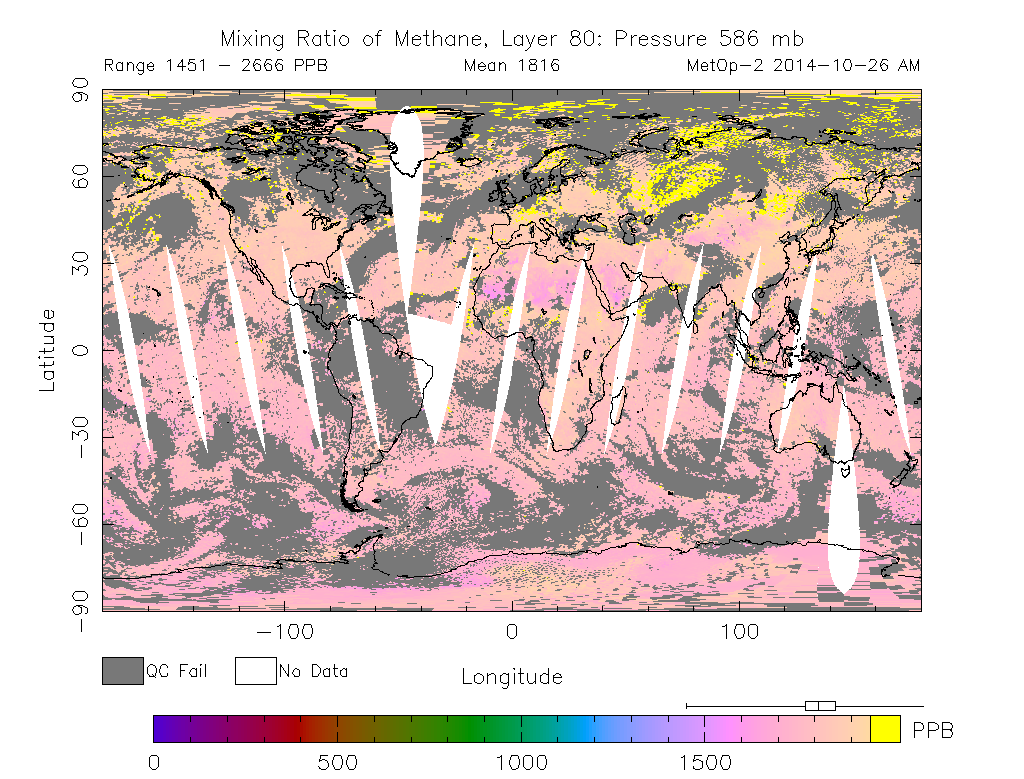
Ominous Arctic Methane Spikes Continue — 2666 Parts Per Billion on October 26th

Imagine, for a moment, the darkened and newly liberated ocean surface waters of the Kara, Laptev, and East Siberian Seas of the early 21st Century Anthropocene Summer.
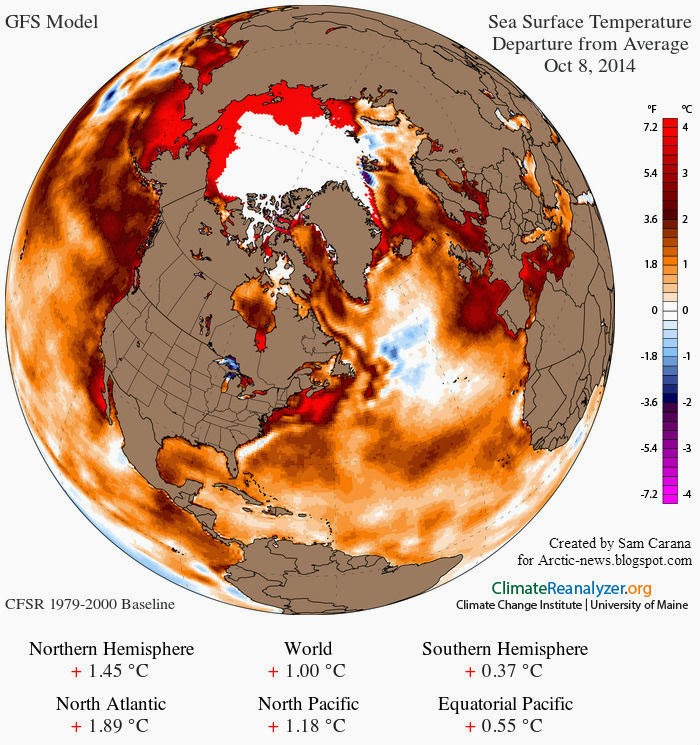
Where white, reflective ice existed before, now only dark blue heat-absorbing ocean water remains. During summer time, these newly ice-free waters absorb a far greater portion of the sun’s energy as it contacts the ocean surface. This higher heat absorption rate is enough to push local sea surface temperature anomalies into the range of 4-7 C above average.
Remnant Arctic sea surface heat
(Remnant extreme heat at Arctic Ocean surface on October 8, 2014. Extraordinary warmth in the range 0f 4-7 C above average is due to recent loss of summer sea ice in the Kara, Laptev, East Siberian and Beaufort Seas. Newly exposed dark surface waters absorb more of the sun’s rays which results in a highly visible temperature anomaly. Image source: Climate Reanalyzer. Image archived by: Arctic News.)
Some of the excess heat penetrates deep into the water column — telegraphing abnormal warmth to as far as 50 meters below the surface. The extra heat is enough to contact near-shore and shallow water deposits of frozen methane on the sea-bed. These deposits — weakened during the long warmth of the Holocene — are now delivered a dose of heat they haven’t experienced in hundreds of thousands or perhaps millions of years. Some of these deposits weaken, releasing a portion of their methane stores into the surrounding oceans which, in turn, disgorges a fraction of this load into the atmosphere.
The rate of release intensifies throughout summer. But during the Arctic Fall, it reaches a peak. Then, as sea ice begins to re-form over the surface waters, a kind of temperature inversion wedge develops. The surface cools and the ice solidifies — forming an insulating blanket, trapping heat. The insulating layer, in turn, pushes the anomalously hot mid level waters toward the bottom. This process delivers a final and powerful dose of heat to the Arctic Ocean bottom water and sea bed.
Methane release rates spike as the methane flooding up from the sea bed squeezes out through cracks in the newly forming ice or bubbles up through open waters just beyond the ice edge.
Observed Arctic Methane Over-Burden
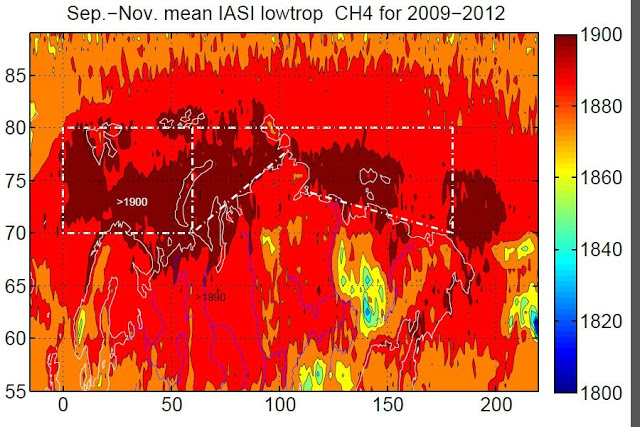
During recent years, a troubling methane over-burden has been observed in the atmosphere above these regions during the months of September through November. Dr. Leonid Yurganov — a researcher at the University of Maryland — has been using the IASI sensor to record these events. Last year, he developed this map of September through November methane readings for the 2009-2012 period:
Arctic methane concentrations Sep-Nov 2009-2012
(Highest lower troposphere global atmospheric methane readings were found in the region of the East Siberian, Laptev and Kara seas during September through November of 2009 through 2012. Data provided by IASI. Image source: Dr. Leonid Yerganov via Arctic News.)
The readings above show near-surface averages over a three month period in the regions of highest release. Note that highest methane levels occur over coastal Siberia and in the above ocean zones of near-Russia Arctic Ocean waters.
These measurements have been ramping higher in recent years with near-surface readings in the range of 1950 to 2000 ppb now common for the months of September through November in the areas affected (for comparison, global surface averages are now in the range of 1840 ppm).
By themselves, these measurements are evidence of a substantial Arctic methane release. But further up in the troposphere — at the mid cloud level — even higher levels of methane have been recorded.
For as methane releases from the sea and land surface, it becomes trapped in the mid-cloud layer. There, a sandwich of cloud and moisture form a cap beneath which methane tends to concentrate. In this layer, readings can be quite a bit higher than surface measurements. Recent years have shown numerous instances where methane readings in the mid-cloud layer spiked above 2300 parts per billion.
Last year during September, the now annual plume of methane emitting from the Arctic Oceanpushed readings as high as 2571 parts per billion at this level of the atmosphere. It was a reading more than 700 parts per billion above the global surface average. A spike fueled by the anomalously high rates of methane emission from the Arctic surface waters and Siberian tundra during the Fall of 2013.
This year, despite extraordinarily spotty coverage due to cloud interference, the METOP sensor found Arctic methane concentrations in the range of 2666 parts per billion in the mid cloud layer. The spike occurred just this past Sunday and exceeds the September 2013 spike by 95 parts per billion — a level more than 800 parts per billion above current global surface averages.
Arctic methane spike 2666
(Arctic methane spikes to 2666 parts per billion in the mid-cloud layer on Sunday October 26. Image source: OSPO/METOP.)
In combination, observations of a rapidly warming Arctic Ocean and observations of Arctic methane readings between 6 and 60 percent above the global average in near surface regions and in the mid cloud layer are a clear signal that human-caused Arctic warming is forcing an ever-greater methane release. To a greater and greater extent, large carbon stores are being weakened and tapped by the various mechanisms that are an up-shot of human warming. The location of these large-scale releases, as observed in the satellite record, is confirmation of ground and ocean based observations conducted by Arctic researchers such as Dr. Semiletov and Shakhova. And the releases themselves may well be some validation of our more dire concerns.
This new spike is yet more evidence of a sizeable, anthropogenic-spurred, release that is impacting not only regional methane levels, but global levels as well. Whether this newly observed release is part of a slow global response to the initial human heat forcing — one that will take centuries to fully emerge — or is part of a much more rapid and dangerous response to an also very rapid human heat forcing is now unclear.
What is clear is that feedbacks to the human heat forcing are now starting to become plainly visible. That they are providing evidence of a stronger release from some sources on a yearly basis. A troubling amplifying feedback to the already dangerous and extraordinary human emission. One that should serve both as a warning and as a spur to reduce and eliminate human greenhouse gas emissions from all sources and to switch energy systems away from fossil fuels as swiftly as possible.
Links:

Labels: , , ,

Thursday, September 18, 2014

Paint it Black


I wanted to see it painted, painted black
Black as night, black as coal
     - Mick Jagger

Oh the pictures have been washed in black
Tatooed everything
     -Pearl Jam (Black)


    Greetings 

     Here are some stunning pictures of  the snow in Greenland, taken by Dr Jason Box.   He is not sure where the black dust is coming from, but he knows its not good.

   "Box gives the stunning stats: “In 2014 the ice sheet is precisely 5.6 percent darker, producing an additional absorption of energy equivalent with roughly twice the US annual electricity consumption.”

     Unfortunately recent measurements have shown that  the ice in both Greenland and the Antarctic are melting at an unprecedented rate

     Here's a fun idea.  Climate Change tourism!   

“Some people we met there were saying things like, ‘I want to visit Greenland before it completely disappears. I want to see polar bears before they are completely extinct,’ ” says Alban Kakulya, a photographer in Geneva who spent three weeks in Greenland in 2009. His photographs manage to capture the island’s otherworldly beauty as well as the incongruity of pampered, sneaker-clad cruise passengers milling around what was once regarded as a forbidding landscape.


Photo by Jason Box
Isn’t ice supposed to be white?
Photo by Jason Box
Jason Box knows ice. That’s why what’s happened this year concerns him so much.
Box just returned from a trip to Greenland. Right now, the ice there is … black:
Photo by Jason Box
Dark ice is helping Greenland’s glaciers retreat.
Photo by Jason Box
Photo by Jason Box
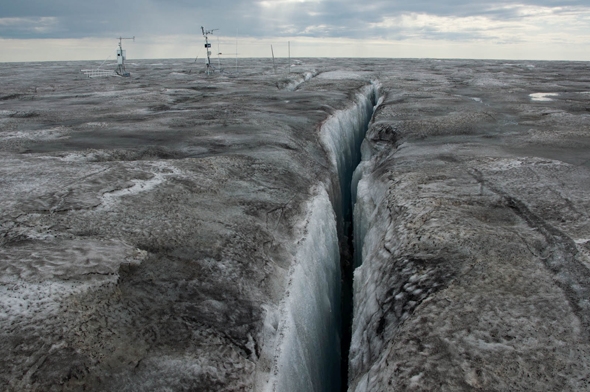
Crevasses criss-cross the Greenland ice sheet, allowing melt water to descend deep beneath the ice.
Photo by Jason Box
Photo by Jason Box
This year, Greenland’s ice was the darkest it’s ever been.
Photo by Jason Box
Photo by Jason Box
Box and his team are trying to discover what made this year’s melt season so unusual.
Photo by Jason Box
Photo by Jason Box
Box marks his study sites, appropriately, with black flags.
Photo by Jason Box
Photo by Jason Box
Box’s ‘Dark Snow’ project is the first scientific expedition to Greenland to be crowdfunded.
Photo by Jason Box


The ice in Greenland this year isn’t just a little dark—it’s record-setting dark. Box says he’s never seen anything like it. I spoke to Box by phone earlier this month, just days after he returned from his summer field research campaign.

 “I was just stunned, really,” Box told me.

The photos he took this summer in Greenland are frightening. But their implications are even more so. Just like black cars are hotter to the touch than white ones on sunny summer days, dark ice melts much more quickly.

As a member of the Geological Survey of Denmark and Greenland, Box travels to Greenland from his home in Copenhagen to track down the source of the soot that’s speeding up the glaciers’ disappearance. He aptly calls his crowdfunded scientific survey Dark Snow.

This year was another above-average melt season in Greenland.

Courtesy of The National Snow and Ice Data Center

There are several potential explanations for what’s going on here. The most likely is that some combination of increasingly infrequent summer snowstorms, wind-blown dust, microbial activity, and forest fire soot led to this year’s exceptionally dark ice. A more ominous possibility is that what we’re seeing is the start of a cascading feedback loop tied to global warming. Box mentions this summer’s mysterious Siberian holes and offshore methane bubbles as evidence that the Arctic can quickly change in unpredictable ways.

This year, Greenland’s ice sheet was the darkest Box (or anyone else) has ever measured. Box gives the stunning stats: “In 2014 the ice sheet is precisely 5.6 percent darker, producing an additional absorption of energy equivalent with roughly twice the US annual electricity consumption.”

Perhaps coincidentally, 2014 will also be the year with the highest number of forest fires ever measured in Arctic.

Box ran these numbers exclusively for Slate, and what he found shocked him. Since comprehensive satellite measurements began in 2000, never before have Arctic wildfires been as powerful as this year. In fact, over the last two or three years, Box calculated that Arctic fires have been burning at a rate that’s double that of just a decade ago. Box felt this finding was so important that he didn’t want to wait for peer review, and instead decided to publish first onSlate. He’s planning on submitting these and other recent findings to a formal scientific journal later this year.

Arctic and sub-Arctic fires were more powerful in 2014 than ever recorded before.

Photo by Jason Box/NASA

Box’s findings are in line with recent research that shows the Arctic is in the midst of dramatic change.

A recent study has found that, as the Arctic warms, forests there are turning to flame at rates unprecedented in the last 10,000 years. This year, those fires produced volumes of smoke and soot that Box says drifted over to Greenland.

In total, more than 3.3 million hectares burned in Canada’s Northwest Territories alone this year—nearly 9 times the long term average—resulting in a charred area bigger than the states of Connecticut and Massachusetts combined. That figure includes the massive Birch Creek Complex, which could end up being the biggest wildfire in modern Canadian history. In July, it spread a smoke plume all the way to Portugal.

In an interview with Canada’s National Post earlier this year, NASA scientist Douglas Morton said, “It’s a major event in the life of the earth system to have a huge set of fires like what you are seeing in Western Canada.”

Box says the real challenge is to rank what fraction of the soot he finds on the Greenland ice is from forest fires, and what is from other sources, like factories. Box says the decline of snow cover in other parts of the Arctic (like Canada) is also exposing more dirt to the air, which can then be more easily transported by the wind. Regardless of their ultimate darkening effect on Greenland, this year’s vast Arctic fires have become a major new source of greenhouse gas emissions from the thawing Arctic. Last year, NASA scientists found “amazing” levels of carbon dioxide and methane emanating from Alaskan permafrost.

Earlier this year, Box made headlines for a strongly worded statement along these lines:

That tweet landed Box in a bit of hot water with his department, which he said now has to approve his media appearances. Still, Box’s sentiment is inspiring millions. His “f’d” quote is serving as the centerpiece of a massive petition(with nearly 2 million signatures at last count) that the activist organization Avaaz will deliver to “national, local, and international leaders” at this month’s global warming rally in New York City on Sept. 21.

Future Tense is a partnership of Slate, New America, and Arizona State University.

Eric Holthaus is a meteorologist who writes about weather and climate for Slate’s Future Tense. Follow him on Twitter.

Labels: , , , ,

Wednesday, August 6, 2014

Tell the truth


And my best friend my doctor
won't even tell me what it is I've got

      - Bob Dylan 

Tell me lies, 
tell me sweet little lies

     - Fleetwood Mac


Greetings

     Just stumbled onto this info on the conference on "radical emissions reductions" put on by Anderson and   Bows.  You have to hand to those folks for telling it like is .  They say the "developed" nations have to go first, and do the most,  having gotten most of the gains from the fossil era.  !0% per year reductions, each year until 2030.   Tough medicine, but no tougher than the alternative.

      Another guy who is coming out and saying what needs to be said, is the glaciologist Jason Box.   In his comment on the recent research by Stockholm University, reporting methane plumes escaping for the sea floor, he made the  "tweet heard round the world" saying: 

  “If even a small fraction of Arctic sea floor carbon is released to the atmosphere, we're fucked.”

 See more here
  
----

From Climate code Red

On 10-11 December 2013, a Radical Emissions Reduction Conference was held at the Royal Society, London under the auspices of the Tyndall Centre for Climate Change Research at the University of East Anglia. The conference's purpose was described as:

Today, in 2013, we face an unavoidably radical future. We either continue with rising emissions and reap the radical repercussions of severe climate change, or we acknowledge that we have a choice and pursue radical emission reductions: No longer is there a non-radical option. Moreover, low-carbon supply technologies cannot deliver the necessary rate of emission reductions – they need to be complemented with rapid, deep and early reductions in energy consumption – the rationale for this conference.
Prof. Kevin Anderson and Dr. Alice Bows-Larkin, both from the Tyndall Centre, were instrumental in in framing the challenge for the conference. In 2010, they noted in aresearch paper that: 
…while the rhetoric of policy is to reduce emissions in line with avoiding dangerous climate change, most policy advice is to accept a high probability of extremely dangerous climate change rather than propose radical and immediate emission reductions.
And in 2012 in “A new paradigm for climate change”, Anderson and Bows call for academic rigour in elaborating the scientific and economic choices:
    … academics may again have contributed to a misguided belief that commitments to avoid warming of 2°C can still be realized with incremental adjustments to economic incentives… as the remaining cumulative budget is consumed, so any contextual interpretation of the science demonstrates that the threshold of 2°C is no longer viable, at least within orthodox political and economic constraints…
    
     At the same time as climate change analyses are being subverted to reconcile them with the orthodoxy of economic growth, neoclassical economics has evidently failed to keep even its own house in order. This failure is not peripheral. It is prolonged, deep-rooted and disregards national boundaries, raising profound issues about the structures, values and framing of contemporary society… This catastrophic and ongoing failure of market economics and the laissez-faire rhetoric accompanying it (unfettered choice, deregulation and so on) could provide an opportunity to think differently about climate change… 

    It is in this rapidly evolving context that the science underpinning climate change is being conducted and its findings communicated. This is an opportunity that should and must be grasped. Liberate the science from the economics, finance and astrology, stand by the conclusions however uncomfortable. But this is still not enough. In an increasingly interconnected world where the whole — the system — is often far removed from the sum of its parts, we need to be less afraid of making academic judgements. Not unsubstantiated opinions and prejudice, but applying a mix of academic rigour, courage and humility to bring new and interdisciplinary insights into the emerging era. Leave the market economists to fight among themselves over the right price of carbon — let them relive their groundhog day if they wish. The world is moving on and we need to have the audacity to think differently and conceive of alternative futures.
Their writings which underpin the conference's rationale, include: A new paradigm for climate change, Beyond ‘dangerous’ climate change: emission scenarios for a new world, and Reframing the climate change challenge in light of post-2000 emission trends. More recently, Anderson's Avoiding dangerous climate change demands de-growth strategies from wealthier nations more explicitly lays out some of the key assumptions.

So to the conference itself, and many thanks to Shane White for wading through the conference videos and taking extensive notes which form the basis of these blogs.

Anderson's presentation was entitled "'Avoiding dangerous climate change’: Why we need radical reductions in emissions", and it kicked off the conference. The video ishere plus slides.

Anderson starts with the proposition that stabilisation at 2°C remains a feasible goal of the international community, just. [Readers of this blog will know well that at less than 1 degree of warming, there is a good deal of evidence that climate change is already dangerous and of the view of leading scientists that 2°C hotter is not an acceptable climate target but a disaster.]

Anderson makes the point that radical mitigation has economic benefits, not financial. He says it is time to wrestle economics away form the financiers. The word economics originates from the Greek oikonimia, meaning stewardship of the household; no mention of money. The word financial comes from the Greek chrematistic meaning the making of money. If making money is our priority then 2°C is not viable. If we’re interested in the wellbeing of our lives and the planet, then 2°C is viable with a successful economy. 

The science message contained within latest IPCC report hasn’t changed in the last 20 years. This science is mature. But what has changed, says Anderson, is that:
  • Since IPCC AR4 in 2007, an additional 200 billion tonnes of carbon dioxide (GtCO2) has been released;
  • Annual emissions are ~70% higher than at the time of the first report in 1990;
  • Atmospheric carbon dioxide  levels are higher than during past 800 thousand years.
The world says it is still committed to make a fair contribution “To hold the increase in global temperature below 2°C, and take action to meet this objective consistent with science and on the basis of equity”. (Copenhagen Accord 2009).


So why do we need to concentrate on energy demand rather than supply? Because, says Anderson,  in 2013 it’s too late to only rely solely on the supply side. We need to focus on the demand side now too.

So what of future emissions? Everything built today based on fossil fuels is locking ourselves into a high carbon future: power stations, large scale infrastructures, built environment, aircraft and ships. All this infrastructure will be in place for 30 to 100 years.


Emissions in the above chart are higher than emissions in IPCC’s highest emission pathway (RCP8.5), with 2% a year growth from 2020.  Are such rising emissions scenarios realistic? They are certainly viable, says Anderson,  since UK is considered a leading country on climate change and the UK has made extensive fossil fuel investments.

Current pathway leads to emissions of greater than 2500 GtCO2 for the period 2000–2050, and 5000 GtCO2 for 2000–2100. Yet for a 66% chance of less than 2°C, we can emit only 1000 GtCO2. Along our current pathway all of that will be emitted by 2032. There is nothing left for emissions by 2032.


The carbon dioxide trend, says Anderson,  is “perfectly in line with a temperature increase of 6°C, which would have devastating consequences for the planet” as IEA chief economist Faith Birol has noted. Whether it is 4, 5 or 6°C doesn’t mean too much; they’re all devastating.

There is nothing we can do significantly in the wealthy parts of the world to get emissions down with just low carbon supply in the short term. The only thing we can do now is reduce our demand. The supply side is a pre-requisite in the long term to holding temperature below 2°C.


This analysis is global. But premised on the basis of equity, poor countries shouldn’t be forced to suffer by reducing their emissions demand by the same rate as us in the short term.

So let’s assume non-Annex 1 nations (developing nations) collectively peak their emissions by 2025 (which a a big ask) and reduce emissions thereafter by 6 to 8% per year. Then what emissions budget is left for the rich, developed Annex 1 nations? The answer is that Annex 1 nations require at least a 10% reduction in emissions year on year (this is based on analysis a few years old so 10% is a bit low now). That means a 40% reduction by 2018 (c.f 1990), 70% reduction by 2024, and 90% by 2030 (remembering that these these are radical emission reductions but provide a 66% chance of less than 2°C.

Asks Anderson: Is above viable? Is 4, 5 or 6°C a better option? No.

Radical emission reductions on the basis of equity are viable by:
  • Equity: Small group of people make radical and early reductions (40-60% of emissions are from 1-5% of the population) i.e. those in Annex 1 countries.
  • Technology: demand side can deliver early and large reductions (why are low efficiency products on the market when high efficiency products are available?)
  • Growth: There are alternative measures of a good life. Above a certain threshold GDP is a poor proxy for welfare.
So in summary, a radical plan looks something like this:
  • Low carbon energy supply is pivotal in the long term but can’t be built fast enough in order to solely be relied upon for 2°C, so;
  • Radical reductions in energy demand from now to ~2030. Radical reductions in energy demand over one decade are possible if carefully planned. This extends the window to get the low carbon energy supply in place.
  • A Marshall plan to build 100% low carbon energy supply by 2030–2040.
Anderson concluded by quoting Robert Unger that“at every level the greatest obstacle to transforming the world is that we lack the clarity and imagination to conceive that it could be different.” He said the paradigm he had outlined will be dismissed as not being practical, but 4, 5 or 6°C is impractical and certainly not equitable.

Labels: , , , , , ,