Wednesday, July 22, 2015

Movin' on


 No where to run
nowhere to hide
     - Martha and the Vandellas

Running on Empty
Running Blind
     - Jackson Brown

Greetings

      Every now and then I have an "oh shit!" moment .  My latest was when I found out that there are wild fires in the rain forest of the Olympic peninsula.       (or here)  I  mean,  they get like 12 feet of rain there.!!    Give me a break.  Out here in the coast range, we only get 7 feet !   Up to now, I think in the back of my mind, I thought that Oregon was a "safe" place climate wise.  Maybe a little more rain.in the winter, sun in the summer  But not fires in the rain forest..  

     Our friends at FEMA recommend having a "bug out bag" in case of emergencies.  The idea being that you can actually get to some place safer.  But,  I'm wondering where that place is.

      Interestingly it seems that climate scientists may be asking themselves the same question.  A recent article in Esquire highlighted this noting that Jason Box, noted glaciologist, among others  have moved out of the US.  He moved to Denmark

“In Denmark,” Box says, “we have the resilience, so I’m not that worried about my daughter’s livelihood going forward. But that doesn’t stop me from strategizing about how to safeguard her future—I’ve been looking at property in Greenland. As a possible bug-out scenario.”

       Jason Box, knows a lot more about climate change than I do, so I find that  a little unsettling.  
       Other folks are already fleeing climate related distress.  150,000  fled Africa between 20911 and 2014.  Another half a million are waiting to leave.    Should we call them climate refugees?    It turns out that by and large climate refugees don't only leave because of storms, droughts, or other direct climate impacts.  People generally hunker down and hope for better times.   One reason they do move, is civil unrest or civil war,  A recent study in Nature points to Climate Change as a significant factor in the current civil war in Syria:

"The study is the first of its kind to look at a modern, ongoing war. Kelley says that his team focused on the Syrian conflict because it was preceded by a well-documented series of events: the drought caused agriculture to collapse in the country’s northeastern ‘breadbasket’ region, displacing roughly 1.5 million people to urban areas that were already stressed by rapid population growth and an influx of refugees from Iraq.
The situation spawned discontent over mismanagement of ground water and agricultural policies that favoured water-intensive crops such as cotton. Although natural-resource mismanagement may not have been the primary grievance driving the uprising, “there was clearly significant social unrest because of the drought,” says Femia."
          This is not really unexpected.  It was predicted by a 2007 Department of Defense Report.  The World Bank noted the same.   Jim Yong Kim, the president of the World Bank

"... said he believes battles over food and water would begin within the next five to ten years as climate change begins to affect food production. He urged campaigners and scientists to work together to create a solution.

       So, am I packing for Greenland?   No, but things do feel a little different.  I guess I'd better get to work pruning and thinning our woodlot.  I don't want our piece of the rain forest to go up in smoke, if I can help it. ! 

Labels: , , ,

Friday, October 31, 2014

Refugee

Should I stay or should I go, now
If I go, there will be trouble
If I stay, it will be double
      -The Clash

You don't have to live
like a refugee
   -Tom Petty

Greetings

    Are we entering the era of climate refugees?     I tend to think of Islands slipping under the sea., see e.g ,Tuvalu residents seek residency in New Zealand  but perhaps it also will  be drought that will trigger some mass movements.

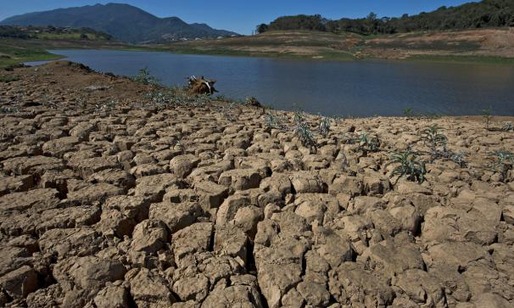
   For instance , things are looking grim for Sao Paulo, Brazil.  .  A city of 20 million, it is facing the worst drought in 80 years.   The reservoir which feeds it is reported to be a 3% capacity.    the drought is also affecting Brazil's hydroeltric capacity

-------


Images of the drought conditions in Brazil's Cantareira water system, which supplies water to 45 percent of Sao Paulo. Credit: Getty Images / via the Weather Channel
South America's biggest and wealthiest city may run out of water by mid-November if it doesn't rain soon. São Paulo, a Brazilian megacity of 20 million people, is suffering its worst drought in at least 80 years, with key reservoirs that supply the city dried up after an unusually dry year. — Thompson Reuters Foundation
One of the most important reservoirs in Brazil is the Cantareira watershed, which supplies around 45% of the city of São Paulo's water. Back in August, authorities warned that the city, which is the largest on the continent, could run out of water in 100 days if the waters dropped to 12%. Now, supplies are at a record 3.3% and creating shortages for over 30% of the city's 44 million residents. According to the Financial Times, residents in 70 other cities in the state of São Paulo have experienced water outages, some of which have gone on for days. Despite some minor efforts to curb usage – such as reducing water pressure by 75% at night–, Vicente Andreu, president of Brazil's Water Regulatory Agency, has stated that São Paulo should prepare for a "collapse like we've never seen before" in the next few weeks.
President Dilma Rousseff, who just won reelection, had used the drought as a major campaign issue. She claimed that Governor Geraldo Alckmin, whose a member of the opposition party, has not been doing enough to curb the water shortages, even asserting that he refused federal money that was offered. Reuters reports that vital restrictions on water usage never were passed because of fear of reprisals in these elections.
Part of the reason that the drought is so exceptional is because of climate change and deforestation, scientists assert. A leading climate scientist, Antonion Nobre states, "Humidity that comes from the Amazon in the form of vapor clouds - what we call 'flying rivers' - has dropped dramatically, contributing to this devastating situation we are living today." The Amazon rainforest in Brazil has been ravaged by deforestation in recent years. A forested area the size of New York City was hewed over the course of a single year, between 2012 and 2013. The lack of trees – which once released billions of gallons of water – coupled with changes to the global climate are, quite literally, drying the region out.
The economic toll from the drought is already beginning to be felt and will likely grow worse. Half of the country's textile producers are in São Paulo and are unable to continue their dyeing processes because of the water scarcity. Solvay’s Rhodia chemical plant halted some of its production, as well. Meanwhile, concerns that the drought will affect the country's soybean production has brought up prices worldwide. The state of São Paulo is responsible for a third of Brazil's GDP, so any slowdown there would bring down the country's overall growth.
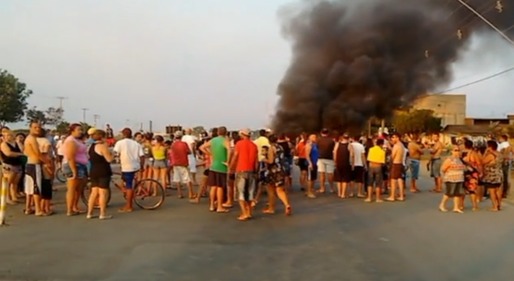
Brazil has been racked by protests for the past several years. Now, people are rioting explicitly because of water (or the lack thereof). In the city of Ito, outside of São Paulo, people have beenburning buses and hijacking water tankers
Of course, the state of São Paulo is not the only place in the world currently experiencing water shortages. According to the Global Drought Information System, other regions experiencing extreme drought conditions include: Northern China, Somalia, Kenya, the southwest United States, and most of Australia. 
 

Labels: , ,