Friday, August 28, 2015

Purple waves


Purple Haze
   -Jimi Hendrix

Purple Rain
    -Prince


Greetings

     Hope you are having a fun summer.   I think I had too much fun in the garden to pay much attention to the climate.  But here is something that caught my eye.

    Oregon's purple waves off Neskowin?      No, not that, although it is pretty spooky.  A bacteria that eats hydrogen sulfide - an early indication of a coming Canfield Ocean? (A a deadly hothouse ocean state implicated in 5 of 6 major mass extinction events)

     No, something much more mundane, -  a top scientist at Woods Hole suggesting that the threat of catastophic permafrost thaw is "real and imminent".    Is this something to worry about?  After all, the permafrost is pretty far away. Its way up north.   A lot father than Neskowin anyway.  And "real and imminent"    That's pretty vague. But it's that word "catastrophic"  that is troublesome-it  seems like it might be worth paying attention.

     So, lets take a look.  As we know, the permafost is frozen soil located in arctic and subarctic regions, and it contains a lot of carbon (1,300 billion tons!   - or twice as much carbon as is already in the atmosphere).  Happily that carbon is frozen, so it can't get into the atmosphere.   So far anyway.  Of course if it does get warm up there, warm enough to melt this frozen stuff, the carbon released could start a sort of chain reaction, creating more warming, which melts more permafrost.    Et cetera    Its one of those nasty "tipping points"  that could put the whole mess on autopilot and out of human control.  Here is a nice article from Nature - good bed time reading
    All that carbon.    And here's the weird part.  None of that carbon is included in the IPCC projections.   It seems that they were concerned that there weren't enough scientific papers on it yet.
       So, when would this happen?  What would it take?    One study says it might start once the average temperature of the earth rises above 1.5 degrees above per industrial levels.   Perhaps 2 degrees?   In 2011, Dr Kevin Shaefer of the US Snow and Ice Data Center, suggested it could start in 20 years.    But that was before the discovery that the permafrost was also being warmed by microbes.!!!

      -----

Top Scientist — Threat of Catastrophic Permafrost Thaw is “Real and Imminent”

There’s a lot of carbon stored in the Arctic’s thawing permafrost. According to our best estimates, it’s in the range of 1,300 billion tons (see Climate Change and the Permafrost Feedback). That’s more than twice the amount of carbon already emitted by fossil fuels globally since the 1880s. And the sad irony is that continuing to burn fossil fuels risks passing a tipping point beyond which rapid destabilization and release of those carbon stores becomes locked in.
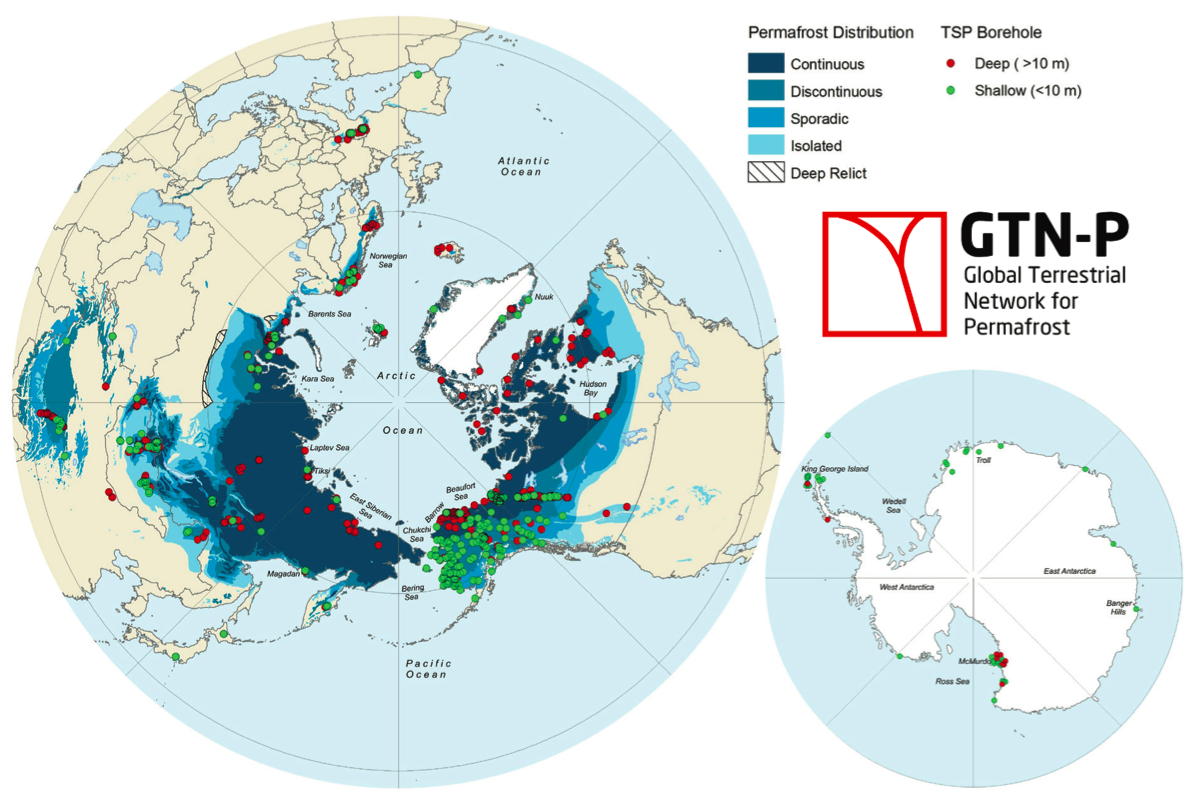
permafrost_map
(Global permafrost coverage as recorded by the World Meteorological Organization. A 2 C global warming threshold is generally thought to be the point at which enough of the Arctic permafrost will go into catastrophic destabilization, to result in a global warming amplifying feedback that then thaws all or most of the rest. The 2 C threshold was chosen because it is the bottom boundary of the Pliocene — a time when this permafrost store formation began. However, there may be some risk that enough of the store could become unstable at lesser levels of warming — crossing the tipping point sooner than expected. Image source: WMO.)
At issue is the fact that most of this carbon has been stored during the past 2 million year period of ice ages and interglacials. Due to human fossil fuel burning, we are now entering a period in which the Arctic is becoming warmer than at any time in at least the past 110,000 years. And with atmospheric CO2 levels now hitting and exceeding concentrations last seen during the Pliocene of 2-3 million years ago, large swaths of that carbon store may be in jeopardy of rapidly thawing. Such a thaw would release yet more CO2 and heat trapping methane into the atmosphere.
It’s something to worry over even if you’re not one of those, like Sam Carana, who’s concerned about a potential catastrophic methane release. And it doesn’t take a climate scientist to tell you that we’ve already seen some disturbing increases in methane emissions from thermokarst lakes, from permafrost regions themselves, through the permafrost and duff-destroying mechanisms of Arctic wildfires, from submerged seabed tundra in the ESS, and from the odd new features we’re now calling methane blowholes.
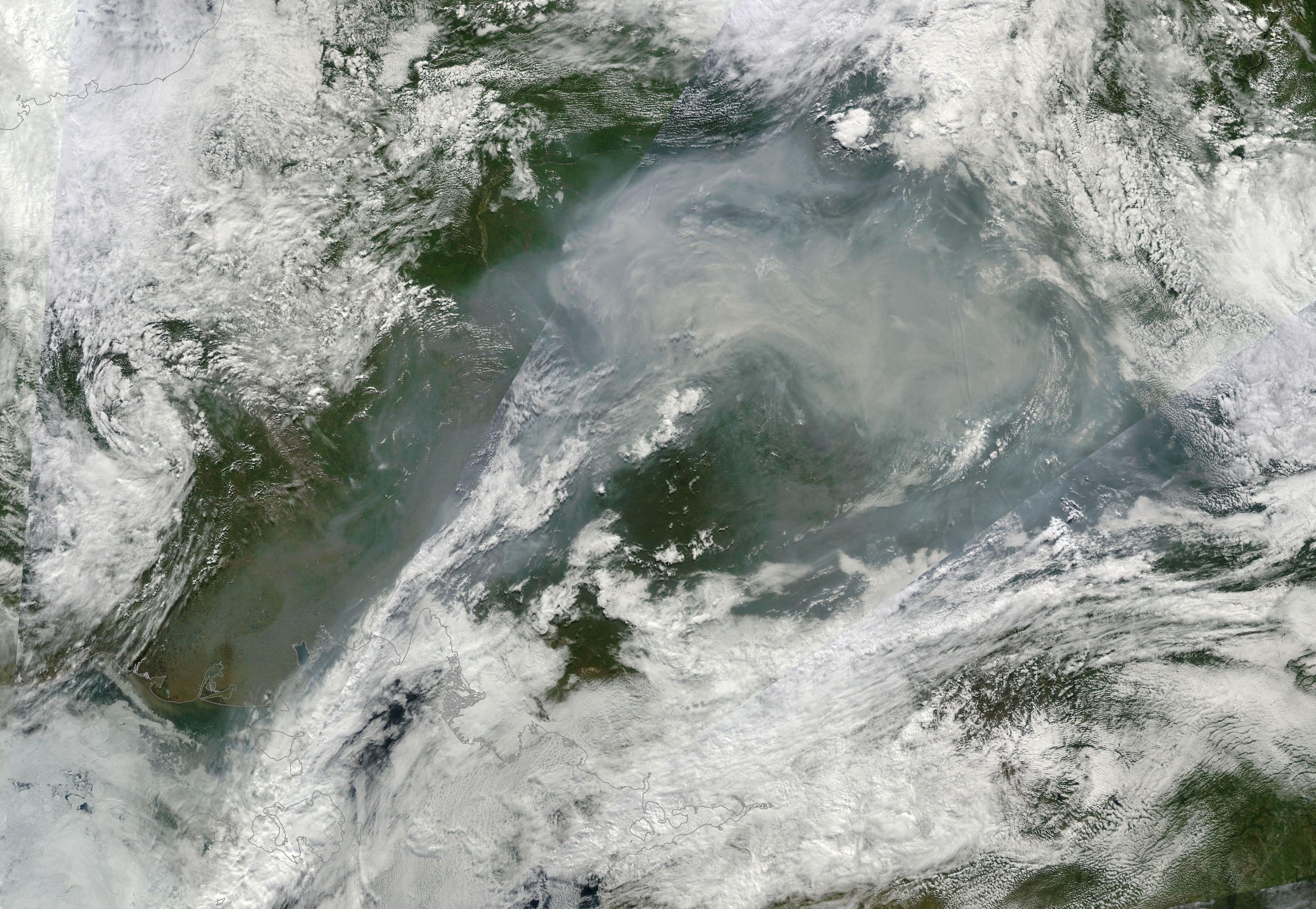
smoke-from-siberian-tundra-fires-august-1-2014
(Are large Siberian fires like this outbreak on August 1 of 2014 indicative that the Arctic permafrost carbon stores are nearing a critical tipping point? Top scientists think we should find out as quickly as possible. Image source: LANCE-MODIS.)
Top Woods Hole Scientist Calls for Tipping Points Investigation
With so much carbon stored in the permafrost, any level of warming that begins to unlock significant volumes of its massive store can result in passing a climate change point of no return. Setting off amplifying feedbacks that do not stop until much or all of that carbon is released and we’ve been propelled into new, much hotter, climate states. Given the fact that we are already starting to enter the range of Eemian temperatures — a period in which the world was as warm or warmer than now, but the Arctic stayed reasonably cooler — it’s more than reasonable to assume that such a danger is already upon us.
Today, a noted Woods Hole Scientist by the name of Dr. Max Holmes called such a threat “real and imminent” stating:
“The release of greenhouse gasses resulting from thawing Arctic permafrost could have catastrophic global consequences. The United States must lead a large-scale effort to find the tipping point – at what level of warming will the cycle of warming and permafrost thawing become impossible to stop. The real and imminent threat posed by permafrost thawing must be communicated clearly and broadly to the general public and the policy community.”
Dr. Holmes was joined by other Woods Hole scientists in issuing this call for more research into what they now consider a growing and immediate threat (see full press release here).
The generally accepted ‘tipping point’ for large permafrost store release tends to be in the range of 2 degrees Celsius. The problem is we’ve already emitted enough CO2, methane and other greenhouse gasses to warm the Earth by 2-4 degrees Celsius long term and by around 1.4 to 1.9 degrees Celsius this Century. So it appears we already have a good deal of momentum toward the accepted permafrost thaw and related carbon release tipping point. Dr. Holmes’  and his Woods Hole colleagues are calling for a focused effort to more accurately nail down that tipping point. To give us a better idea how close we really are and to provide a sense of urgency for avoiding what could best be described as a terrible brand of trouble.
http://robertscribbler.com/2015/08/27/top-scientist-threat-of-catastrophic-permafrost-thaw-is-real-and-imminent/


Labels: , , , , ,

Friday, October 31, 2014

Methane Levels spike


Tiny bubbles in the wine
make you feel happy
make you feel fine
    -Don Ho

Some people say not to worry bout the air
some people never had experience with air
... Air can hurt you. too
    - Talking Heads


Greetings

      As you may recall about 252 million years ago, about 90% of the species on earth were wiped out, thanks to an abrupt climate change   Recently   Scientists at MIT announced what they believe was the culprit

 ".... a form of microbes -- specifically, methane-producing archaea called Methanosarcina -- that suddenly bloomed explosively in the oceans, spewing prodigious amounts of methane into the atmosphere and dramatically changing the climate and the chemistry of the oceans."


        Perhaps coincidentally, scientists in Sweden have found a similar  methane producing microbe in recently thawing permafrost.  See  Newly discovered methane producing microbe blooms in permafrost thaw.

        Meanwhile, as seen below, methane levels in the atmosphere seem to be on the rise...

______


Ominous Arctic Methane Spikes Continue — 2666 Parts Per Billion on October 26th

Imagine, for a moment, the darkened and newly liberated ocean surface waters of the Kara, Laptev, and East Siberian Seas of the early 21st Century Anthropocene Summer.
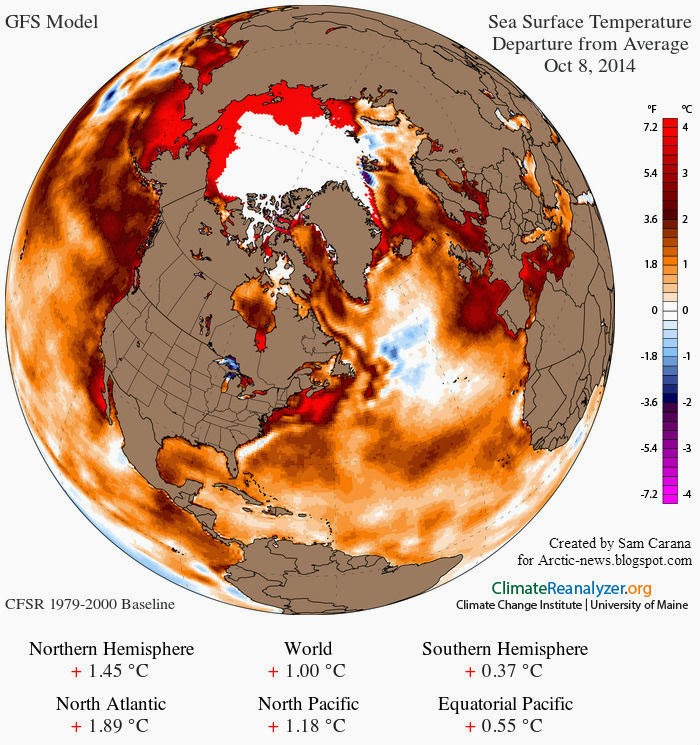
Where white, reflective ice existed before, now only dark blue heat-absorbing ocean water remains. During summer time, these newly ice-free waters absorb a far greater portion of the sun’s energy as it contacts the ocean surface. This higher heat absorption rate is enough to push local sea surface temperature anomalies into the range of 4-7 C above average.
Remnant Arctic sea surface heat
(Remnant extreme heat at Arctic Ocean surface on October 8, 2014. Extraordinary warmth in the range 0f 4-7 C above average is due to recent loss of summer sea ice in the Kara, Laptev, East Siberian and Beaufort Seas. Newly exposed dark surface waters absorb more of the sun’s rays which results in a highly visible temperature anomaly. Image source: Climate Reanalyzer. Image archived by: Arctic News.)
Some of the excess heat penetrates deep into the water column — telegraphing abnormal warmth to as far as 50 meters below the surface. The extra heat is enough to contact near-shore and shallow water deposits of frozen methane on the sea-bed. These deposits — weakened during the long warmth of the Holocene — are now delivered a dose of heat they haven’t experienced in hundreds of thousands or perhaps millions of years. Some of these deposits weaken, releasing a portion of their methane stores into the surrounding oceans which, in turn, disgorges a fraction of this load into the atmosphere.
The rate of release intensifies throughout summer. But during the Arctic Fall, it reaches a peak. Then, as sea ice begins to re-form over the surface waters, a kind of temperature inversion wedge develops. The surface cools and the ice solidifies — forming an insulating blanket, trapping heat. The insulating layer, in turn, pushes the anomalously hot mid level waters toward the bottom. This process delivers a final and powerful dose of heat to the Arctic Ocean bottom water and sea bed.
Methane release rates spike as the methane flooding up from the sea bed squeezes out through cracks in the newly forming ice or bubbles up through open waters just beyond the ice edge.
Observed Arctic Methane Over-Burden
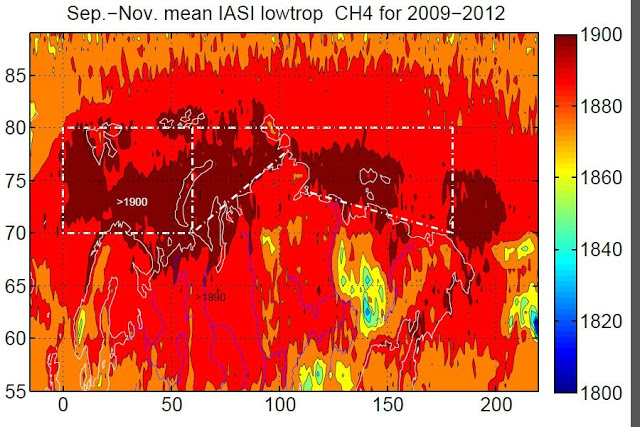
During recent years, a troubling methane over-burden has been observed in the atmosphere above these regions during the months of September through November. Dr. Leonid Yurganov — a researcher at the University of Maryland — has been using the IASI sensor to record these events. Last year, he developed this map of September through November methane readings for the 2009-2012 period:
Arctic methane concentrations Sep-Nov 2009-2012
(Highest lower troposphere global atmospheric methane readings were found in the region of the East Siberian, Laptev and Kara seas during September through November of 2009 through 2012. Data provided by IASI. Image source: Dr. Leonid Yerganov via Arctic News.)
The readings above show near-surface averages over a three month period in the regions of highest release. Note that highest methane levels occur over coastal Siberia and in the above ocean zones of near-Russia Arctic Ocean waters.
These measurements have been ramping higher in recent years with near-surface readings in the range of 1950 to 2000 ppb now common for the months of September through November in the areas affected (for comparison, global surface averages are now in the range of 1840 ppm).
By themselves, these measurements are evidence of a substantial Arctic methane release. But further up in the troposphere — at the mid cloud level — even higher levels of methane have been recorded.
For as methane releases from the sea and land surface, it becomes trapped in the mid-cloud layer. There, a sandwich of cloud and moisture form a cap beneath which methane tends to concentrate. In this layer, readings can be quite a bit higher than surface measurements. Recent years have shown numerous instances where methane readings in the mid-cloud layer spiked above 2300 parts per billion.
Last year during September, the now annual plume of methane emitting from the Arctic Oceanpushed readings as high as 2571 parts per billion at this level of the atmosphere. It was a reading more than 700 parts per billion above the global surface average. A spike fueled by the anomalously high rates of methane emission from the Arctic surface waters and Siberian tundra during the Fall of 2013.
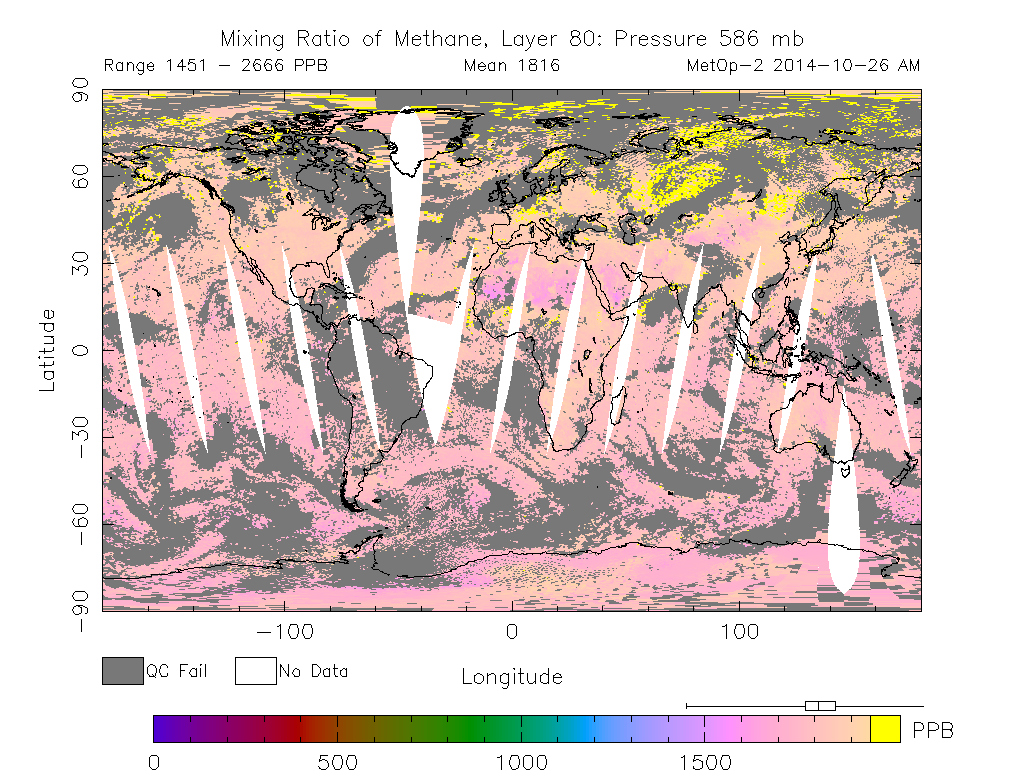
This year, despite extraordinarily spotty coverage due to cloud interference, the METOP sensor found Arctic methane concentrations in the range of 2666 parts per billion in the mid cloud layer. The spike occurred just this past Sunday and exceeds the September 2013 spike by 95 parts per billion — a level more than 800 parts per billion above current global surface averages.
Arctic methane spike 2666
(Arctic methane spikes to 2666 parts per billion in the mid-cloud layer on Sunday October 26. Image source: OSPO/METOP.)
In combination, observations of a rapidly warming Arctic Ocean and observations of Arctic methane readings between 6 and 60 percent above the global average in near surface regions and in the mid cloud layer are a clear signal that human-caused Arctic warming is forcing an ever-greater methane release. To a greater and greater extent, large carbon stores are being weakened and tapped by the various mechanisms that are an up-shot of human warming. The location of these large-scale releases, as observed in the satellite record, is confirmation of ground and ocean based observations conducted by Arctic researchers such as Dr. Semiletov and Shakhova. And the releases themselves may well be some validation of our more dire concerns.
This new spike is yet more evidence of a sizeable, anthropogenic-spurred, release that is impacting not only regional methane levels, but global levels as well. Whether this newly observed release is part of a slow global response to the initial human heat forcing — one that will take centuries to fully emerge — or is part of a much more rapid and dangerous response to an also very rapid human heat forcing is now unclear.
What is clear is that feedbacks to the human heat forcing are now starting to become plainly visible. That they are providing evidence of a stronger release from some sources on a yearly basis. A troubling amplifying feedback to the already dangerous and extraordinary human emission. One that should serve both as a warning and as a spur to reduce and eliminate human greenhouse gas emissions from all sources and to switch energy systems away from fossil fuels as swiftly as possible.
Links:
Labels: , , ,