Fortunate one
Some folks are born made to wave the flag
Ooh, they're red, white and blue
And when the band plays "Hail to the chief"
Ooh, they point the cannon at you, Lord
Ooh, they're red, white and blue
And when the band plays "Hail to the chief"
Ooh, they point the cannon at you, Lord
-Creedence Clearwater
Citizen ship we got mem'ries
Stateless, they got shame
Cast adrift from the citizen ship
Lifeline denied, exiled this castaway
Stateless, they got shame
Cast adrift from the citizen ship
Lifeline denied, exiled this castaway
-Patty Smith
Greetings
I hope you are enjoying this warm weather. Being out in the garden, makes me wonder about what gardening will be like in the future. Of course temperatures will rise. May of 2017 was the second hottest on record See here Check out this as you watch hardiness zones change from 1990 to 2006. Or this
But let's not forget variability . Higher temps are only one side of the problem. This paper from Hansen et al, shows that while the average temperature gets hotter, the range of possible temperature gets wider.
The width of the distribution has doubled since 1951-1980.

Thus, plants not only have to be able to endure hotter temperatures, but a much more variable temperature regime.
Eric Holhaus (weather nerd), reports on the drought in the upper midwest
"There's a quickly worsening drought right now in the upper Midwest. In just the last week, "extreme" drought expanded from 7.7 percent to 25.1 percent of North Dakota, the hardest-hit state. And next week, a multi-day heat wave is on the way. It's expected to reach as high as 107 degrees Fahrenheit in parts of the Dakotas, more than 20 degrees above normal.
Why does that matter? For one, it might seriously affect this year's wheat harvest there.Wheat is humanity's most important grain food source, the United States is the world's largest wheat exporter, and the Dakotas and Montana are now the most important wheat growing region of the United States. Wheat prices have already gone up more than 10 percent in just the past few weeks in response to the drought. This year's American wheat crop is currently rated the worst in 29 years. In large parts of the Dakotas and eastern Montana, spring rains have been less than half of normal. Although this is a worrying development, it doesn't yet directly equate to a major food crisis, though—we won't know that until the harvest is completed in the comping weeks. According to one wheat analyst, "It’s pretty likely that we’ll get high-protein wheat at harvest -- there just won’t be that much of it."
Or this article in Grist
Rain fall coming in extreme bursts instead of evened out and longer, hotter longer heat extremes will take a nasty toll on bushels per acre totals.A drought in the Dakotas spells trouble for the U.S. wheat harvest. Farmers in the Upper Midwest got a big dose of bad news Thursday: The extent of the region’s ongoing “extreme” drought has more than tripled in the past week.Temperatures are expected to reach as high as 107 degrees next week in parts of the Dakotas, more than 20 degrees above normal. In large swaths of the Dakotas and eastern Montana, spring rains have been less than half of normal. On Monday, North Dakota Governor Doug Burgum declared a statewide fire and drought emergency.
Here's an interesting article about how farmers are coping. It contains a rather odd sentence, I think
How much farmers will be affected will depend on how much the climate warms, Gepts says. If we stay within 1 to 2 degrees Celsius of current global averages, most farmers will likely be able to grow the same crops by changing their cultivation practices. But if global averages rise 3, 4 or 5 degrees, as many models predict, farmers will have to shift to entirely new crops.
It is interesting that the authors are able to consider the potential rise of 3, 4 or 5 degrees with such equanimity . It may be a little tricky for farmers, but things will be fine for the rest of us?
The author must not have read this report by the World Bank Why a 4 degree C World Must be Avoided
Or this from the Climate News Network
By 2060, around 1.4 bn people could be climate refugees, driven from low-lying coastal cities by sea level rise. By 2100, as the global population may have reached 11bn, there could be 2bn climate refugees
Or this from here
ROME, Jun 7 2017 (IPS) – By 2025 –that’s in less than 8 years from today– 1.8 billion people will experience absolute water scarcity, and two thirds of the world will be living under water-stressed conditions. Now it is feared that advancing drought and deserts, growing water scarcity and decreasing food security may provoke a huge ‘tsunami” of climate refugees and migrants.
No wonder then that a major United Nations Convention calls drought ‘one of the four horsemen of the apocalypse.’ See what the United Nations Convention to Combat Desertification (UNCCD) says in this regard.
Speaking of climate refugees, take a look at this map from the New York Times which should give you an idea of where people are going to me moving from, and where they will be moving to (hint: the PNW).
Interesting study by PSU on climate refugees moving to the Willamette Valley
Is this avoidable? Reduction in use of coal use is presumably good. As long as humans are still in the drivers seat. However, although CO2 emmisoons from fossil fules are flattening, this is not translating into reductions in concentrations. Scientists had thought it was merely an artifact of El Nino, and things would get into line once that was over. However , the problem has persisted in 2017, despite the end of the El Nino. see here
Peerhaps it is like a bathtub with two taps. The human burning of fossil fuels is one, while the natural impacts are another. While human emmsiosn slow, with other factors increase?
ill human emissions continue to stay flat? See this from the New York Times
When China halted plans for more than 100 new coal-fired power plants this year, even as President Trump vowed to “bring back coal” in America, the contrast seemed to confirm Beijing’s new role as a leader in the fight against climate change.
But new data on the world’s biggest developers of coal-fired power plants paints a very different picture: China’s energy companies will make up nearly half of the new coal generation expected to go online in the next decade.
These Chinese corporations are building or planning to build more than 700 new coal plants at home and around the world, some in countries that today burn little or no coal, according to tallies compiled by Urgewald, an environmental group based in Berlin. Many of the plants are in China, but by capacity, roughly a fifth of these new coal power stations are in other countries.
Crunch Time?
A recent letter in Nature suggest that we have three years to put emissions onto a negative slope.
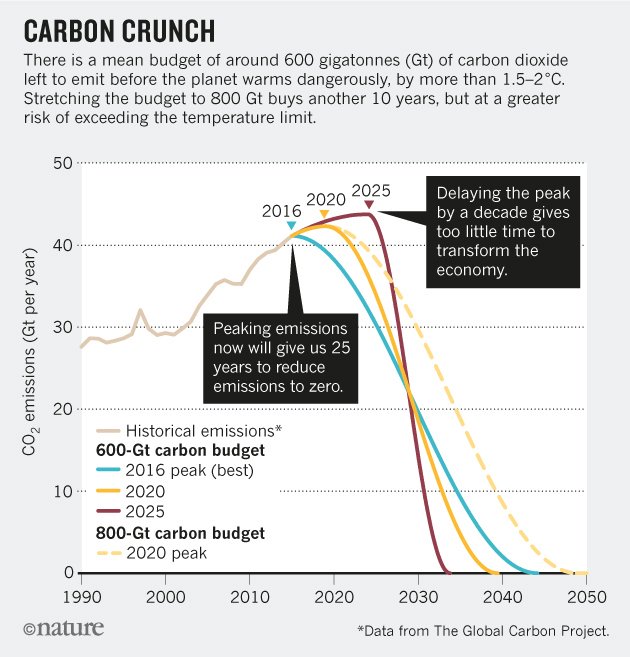
But the idea that there is really any carbon budget left is questionable. Many non-human sources of CO2 or heat have begun to play a more significant role in warming.See The Evidence Against the Existence of a Positive Carbon Budget
See for instance this article on subsea permafrost
new scientific paper published in Nature Communication Journal demonstrates that the mechanisms of destabilisation of subsea permafrost, contrary to previous claims, provide new insights into increased emissions from the worlds largest deposits of methane, that exists in the East Siberian Arctic Shelf (ESAS).
The subsea permafrost has for thousands of years acted as a seal, restricting the flow of gas through the water column to the atmosphere. This paper clearly shows that permafrost degradation and the occurrence of gas migration pathways are key factors in controlling the emissions.
Or this article on soil carbon
A new Yale-led study in the journal Nature finds that warming will drive the loss of at least 55 trillion kilograms of carbon from the soil by mid-century, or about 17% more than the projected emissions due to human-related activities during that period. That would be roughly the equivalent of adding to the planet another industrialized country the size of the United States.Critically, the researchers found that carbon losses will be greatest in the world’s colder places, at high latitudes, locations that had largely been missing from previous research. In those regions, massive stocks of carbon have built up over thousands of years and slow microbial activity has kept them relatively secure.
Something to think about as weatch the "bombs bursting in air"
Here's one opportunity help out those folks who have had to leave their homes
http://salemforrefugees.org/
Labels: agriculture, climate, drought, refugee
posted by Walter @ 9:49 AM
0 Comments