Monday, July 3, 2017

Fortunate one


Some folks are born made to wave the flag
Ooh, they're red, white and blue
And when the band plays "Hail to the chief"
Ooh, they point the cannon at you, Lord
       -Creedence  Clearwater


Citizen ship we got mem'ries
Stateless, they got shame
Cast adrift from the citizen ship
Lifeline denied, exiled this castaway
          -Patty Smith


Greetings

    I hope you are enjoying this warm weather.  Being out in the garden, makes me wonder about what gardening will be like in the future.   Of course temperatures will rise.  May of 2017 was the second hottest on record See here    Check out this as you watch hardiness zones change from 1990 to 2006.   Or this
But let's not  forget variability .    Higher temps are only one side of the problem.  This paper from Hansen et al, shows that while the average temperature gets hotter, the range of possible temperature gets wider.
The width of the distribution has doubled since 1951-1980. 
Thus, plants not only have to be able to endure hotter temperatures, but a much more variable temperature regime.      

Eric Holhaus (weather nerd), reports on the drought in the upper midwest
"There's a quickly worsening drought right now in the upper Midwest. In just the last week, "extreme" drought expanded from 7.7 percent to 25.1 percent of North Dakota, the hardest-hit state. And next week, a multi-day heat wave is on the way. It's expected to reach as high as 107 degrees Fahrenheit in parts of the Dakotas, more than 20 degrees above normal.
Why does that matter? For one, it might seriously affect this year's wheat harvest there.
Wheat is humanity's most important grain food source, the United States is the world's largest wheat exporter, and the Dakotas and Montana are now the most important wheat growing region of the United States. Wheat prices have already gone up more than 10 percent in just the past few weeks in response to the drought. This year's American wheat crop is currently rated the worst in 29 years. In large parts of the Dakotas and eastern Montana, spring rains have been less than half of normal. Although this is a worrying development, it doesn't yet directly equate to a major food crisis, though—we won't know that until the harvest is completed in the comping weeks. According to one wheat analyst, "It’s pretty likely that we’ll get high-protein wheat at harvest -- there just won’t be that much of it."
Or this article in Grist
Rain fall coming in extreme bursts instead of evened out and longer, hotter longer heat extremes will take a nasty toll on bushels per acre totals.
/
A drought in the Dakotas spells trouble for the U.S. wheat harvest. Farmers in the Upper Midwest got a big dose of bad news Thursday: The extent of the region’s ongoing “extreme” drought has more than tripled in the past week.
Temperatures are expected to reach as high as 107 degrees next week in parts of the Dakotas, more than 20 degrees above normal. In large swaths of the Dakotas and eastern Montana, spring rains have been less than half of normal. On Monday, North Dakota Governor Doug Burgum declared a statewide fire and drought emergency.

Here's an interesting article about how farmers are coping.  It contains a rather odd sentence, I think
How much farmers will be affected will depend on how much the climate warms, Gepts says. If we stay within 1 to 2 degrees Celsius of current global averages, most farmers will likely be able to grow the same crops by changing their cultivation practices. But if global averages rise 3, 4 or 5 degrees, as many models predict, farmers will have to shift to entirely new crops.
It is interesting that the authors are able to consider the potential rise of 3, 4 or 5 degrees with such equanimity .    It may be a little tricky for farmers, but things will be fine for the rest of us?
The author must not have read this report by the World Bank Why a 4 degree C World Must be Avoided
Or this from the Climate News Network

By 2060, around 1.4 bn people could be climate refugees, driven from low-lying coastal cities by sea level rise. By 2100, as the global population may have reached 11bn, there could be 2bn climate refugees

Or this from here
ROME, Jun 7 2017 (IPS) – By 2025 –that’s in less than 8 years from today– 1.8 billion people will experience absolute water scarcity, and two thirds of the world will be living under water-stressed conditions. Now it is feared that advancing drought and deserts, growing water scarcity and decreasing food security may provoke a huge ‘tsunami” of climate refugees and migrants.
No wonder then that a major United Nations Convention calls drought ‘one of the four horsemen of the apocalypse.’ See what the United Nations Convention to Combat Desertification (UNCCD) says in this regard.

Speaking of climate refugees,  take a look at this map from the New York Times   which should give you an idea of where people are going to me moving from, and where they will be moving to (hint:  the PNW).  
        Is this avoidable?    Reduction in use of coal use is presumably good.  As long as humans are still in the drivers seat.     However, although CO2 emmisoons from fossil fules are flattening,  this is not translating into reductions in concentrations.  Scientists had thought it was merely an artifact of El Nino, and things would get into line once that was over.  However , the problem has persisted in 2017, despite the end of the El Nino.  see here
    Peerhaps it is like a bathtub with two taps.  The human burning of fossil fuels is one, while the natural impacts are another.   While human emmsiosn slow, with other factors increase? 
ill human emissions continue to stay flat?   See this from the New York Times 
When China halted plans for more than 100 new coal-fired power plants this year, even as President Trump vowed to “bring back coal” in America, the contrast seemed to confirm Beijing’s new role as a leader in the fight against climate change.
But new data on the world’s biggest developers of coal-fired power plants paints a very different picture: China’s energy companies will make up nearly half of the new coal generation expected to go online in the next decade.
These Chinese corporations are building or planning to build more than 700 new coal plants at home and around the world, some in countries that today burn little or no coal, according to tallies compiled by Urgewald, an environmental group based in Berlin. Many of the plants are in China, but by capacity, roughly a fifth of these new coal power stations are in other countries.

Crunch Time?
        A recent letter in Nature suggest that we have three years to put emissions onto a negative slope.
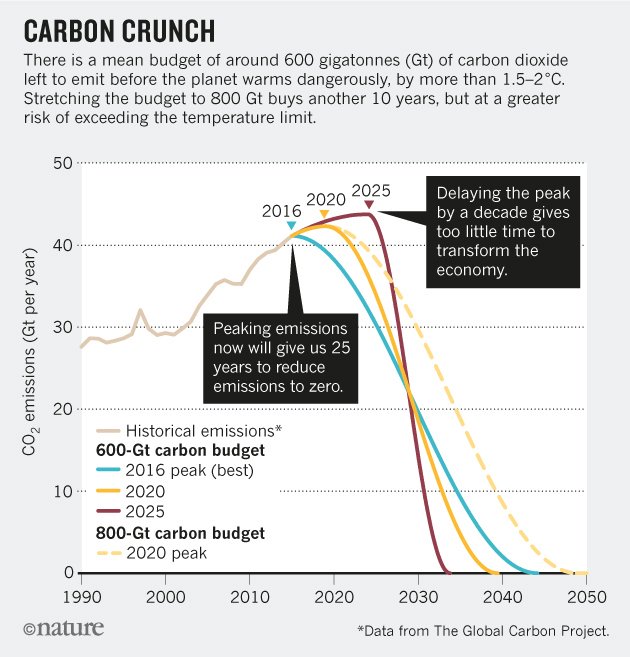

Embedded


But the idea that there is really any carbon budget left is  questionable.  Many non-human sources of CO2 or heat have begun  to play a more significant role in warming.See The Evidence Against the Existence of a Positive Carbon Budget

new scientific paper published in Nature Communication Journal demonstrates that the mechanisms of destabilisation of subsea permafrost, contrary to previous claims, provide new insights into increased emissions from the worlds largest deposits of methane, that exists in the East Siberian Arctic Shelf (ESAS).
The subsea permafrost has for thousands of years acted as a seal, restricting the flow of gas through the water column to the atmosphere. This paper clearly shows that permafrost degradation and the occurrence of gas migration pathways are key factors in controlling the emissions.  
Or this article on soil carbon 

A new Yale-led study in the journal Nature finds that warming will drive the loss of at least 55 trillion kilograms of carbon from the soil by mid-century, or about 17% more than the projected emissions due to human-related activities during that period. That would be roughly the equivalent of adding to the planet another industrialized country the size of the United States.
Critically, the researchers found that carbon losses will be greatest in the world’s colder places, at high latitudes, locations that had largely been missing from previous research. In those regions, massive stocks of carbon have built up over thousands of years and slow microbial activity has kept them relatively secure.


Something to think about as weatch the "bombs bursting in air"

Here's one opportunity help out those folks who have had to leave their homes
http://salemforrefugees.org/

Labels: , , ,

Monday, March 30, 2015

Dirt

You've to get behind the mule
in the moring and plow
   -Tom Waits

All we are is dust in the wind
   -Kansas

Greetings

    Well, it's interesting.  With all the focus on climate change we tend to ignore the fact that climate change is just one symptom of our general overshoot.  Our industrial lifestyle is causing so many insults - whether its the 6th great extinction,  the end of wild fishing, or the wild  climate , that we tend to ignore what's under our feet - soil.     As George Monbiot puts it

"Imagine a wonderful world, a planet on which there was no threat of climate breakdown, no loss of freshwater, no antibiotic resistance, no obesity crisis, no terrorism, no war. Surely, then, we would be out of major danger? Sorry. Even if everything else were miraculously fixed, we’re finished if we don’t address an issue considered so marginal and irrelevant that you can go for months without seeing it in a newspaper. "

       That issue is soil.  2015 is the year of soil, and the UN has a pretty stark message for us.   Soil, the basis of 95% of our food, is disappearing.  Its blowing away, and washing away.  Really pretty fast, too.  According to Scientific American

"Generating three centimeters of top soil takes 1,000 years, and if current rates of degradation continue all of the world's top soil could be gone within 60 years, a senior UN official said on Friday."

       Of course, we'll feel the impacts well before we run out.  As population continues to increase while soil productivity decreases, we'll hit the peak per capita food in the not too distant future.  According to soil scientist John Crawford

 "Under a business as usual scenario, degraded soil will mean that we will produce 30% less food over the next 20-50 years. This is against a background of projected demand requiring us to grow 50% more food, as the population grows and wealthier people in countries like China and India eat more meat, which takes more land to produce weight-for-weight than, say, rice."

          It's kind of interesting to think how we got into this situation.  After all we've been plowing for thousands of years.  It's a very effective method of weed control, as the plow breaks the weeds roots, and turns them under, leaving no competition for the seeds to be planted.  But, plowing also loosens the soil, allowing it to dry up and blow away.   The solution to the topsoil problem is a "no till" method, which doesn't solve the weed problem.  Typically that is solved with herbicides, which , of course has its own issues, like impacts to the health of soil, as well the encouragement of "super weeds",.  see more here.


        Time to get out there and make soil!
           
       How to compost

Labels: , , , , ,

Sunday, March 23, 2014

Giddy-up 409


My four speed dual quad posi-traction 409
-Beach boys


Well, the last thing I remember, Doc, I started to swerve
And then I saw the Jag slide into the curve
I know I'll never forget that horrible sight
I guess I found out for myself that everyone was right
Won't come back from Dead Man's Curve
_Jan and Dean

Greetings

  Isn't civilization great?  It gave us muscle cars and plenty of gas to run them..   Too bad we didn't know enough to avoid dead man's curve. 

    Michael Mann has a new article in Scientific American: Earth Will Cross Climate Danger Threshold in 2036.     See more below  

    He addresses the "pause', which he calls a "slow down".  Also he tries to get a grip on climate sensitivity.    If I am understanding his points, he says that climate sensitivity estimates range from 1.5 to 4.5.  He uses 3.   Once we reach 405, we will have locked in 2 degrees - but due to lags in the system , we won't hit 2 degrees until 2036.  (If sensitivity were 2.5 it would be 2046 - likewise if sensitivity were higher, presumably we would hit 2 degrees sooner) 
 
     Why 405?  And not 450?   In a word -  "aerosols"   So far, aerosols have been masking some of the impacts of coal burning.    Hanson calls this the "Faustian Bargain" 

"These findings have implications for what we all must do to prevent disaster. An ECS of three degrees C means that if we are to limit global warming to below two degrees C forever, we need to keep CO2 concentrations far below twice preindustrial levels, closer to 450 ppm. Ironically, if the world burns significantly less coal, that would lessen CO2 emissions but also reduce aerosols in the atmosphere that block the sun (such as sulfate particulates), so we would have to limit CO2 to below roughly 405 ppm."

    What are we make of this?    Consider food for instance.  While the FAO predicts that by 2050, world population will increase by 50%.  On the other hand  the IPCC predicts that food production will decrease by 2% per decade.  And recent studies suggest even with adaptation there may be more serious impacts to agriculture.   see here

The authors of both papers found that farming innovations could reduce the negative impact of climate change on yields, but that the impact was still negative.
“While just the climate change effects (result in) a 17% negative yield hit on average, the final yield hit is only 11%, again on average,” said the lead author of both papers, Gerald Nelson.
 
     When?   This paper asserts that the yields will begin to fall in the 2030's


------

Far Worse than Being Beaten with a Hockey Stick: Michael Mann, Our Terrifying Greenhouse Gas Overburden and Heating the Earth by + 2 C by 2036

I’m going to say something that will probably seem completely outrageous. But I want you to think about it, because it’s true.
You, where-ever you are now, are living through the first stages of a disaster in which there is nowhere to run, nowhere to hide, and no safe place on Earth for you to go to avoid it. The disaster you are now living through is a greenhouse emergency and with each ounce of CO2, methane and other greenhouse gasses you, I, or the rest of us, pump into the air, that emergency grows in the vast potential of damage and harm that it will inflict over the coming years, decades and centuries. The emergency is now unavoidable and the only thing we can hope to do through rational action is to reduce the degree of harm both short and long term, to rapidly stop making the problem worse, and to put human ingenuity toward solving the problem rather than continuing to intensify it.
But damage, severe, deadly and terrifying is unleashed, in effect and already happening, with more on the way.
*    *    *    *    *
Manns-hockey-stick
(Michael Mann’s famous Hockey Stick graph showing Northern Hemisphere temperatures over the past 1,000 years. The influences of human warming become readily apparent from the late 19th to early 21rst centuries. But human greenhouse gas forcing has much greater degrees of warming in store.)
This week, Michael Mann wrote an excellent piece describing the immediacy of our current emergency in the Scientific American. In typical, just the facts, fashion, he laid out a series of truths relevant to the current greenhouse catastrophe. These facts were told in a plain manner and, yet, in a way that laid out the problem but didn’t even begin to open the book on what that problem meant in broader context.
Michael Mann is an amazing scientist who has his hand on the pulse of human-caused climate change. He is a kind of modern Galileo of climate science in that he has born the brunt of some of the most severe and asinine attacks for simply telling the truth and for revealing the nature of our world as it stands. But though Mann’s facts are both brutal and hard-hitting for those of us who constantly read the climate science, who wade through the literature and analyze each new report. By simply stating the facts and not telling us what they mean he is hitting us with a somewhat nerfed version of his ground-breaking Hockey Stick. A pounding that may seem brutal when compared to the comfortable nonsense put out by climate change deniers and fossil fuel apologists but one that is still not yet a full revelation.
I will caveat what is a passionate interjection by simply saying that Michael Mann is one of my most beloved heroes. And so I will do my best to help him out by attempting to lend more potency to his already powerful message.
2 C by 2036 — Digging through the Ugly Guts of it
All that said, Michael Mann laid out some brutal, brutal facts in his Scientific American piece. Ones, that if you only take a few moments to think about are simply terrifying. For the simple truth is that the world has only a very, very slim hope of preventing a rapid warming to at least 2 C above 1880s levels in the near future and almost zero hope altogether of stopping such warming in the longer term.
The first set of figures Mann provides involves the current greenhouse gas forcing. Current CO2 levels are now at the very dangerous 400 parts per million threshold. Long term, and all by itself, this forcing is enough to raise global temperatures by between 2 and 3 degrees Celsius. But hold that thought you were just about to have, because we haven’t yet included all the other greenhouse gasses in that forcing.
Mann, in the supplemental material to his Scientific American paper, notes that the total forcing of all other greenhouse gasses currently in the atmosphere is about 20% of the total CO2 forcing. This gives us a total CO2 equivalent forcing of 480 ppm CO2e, which uncannily mirrors my own analysis here (the science may have under-counted a bit on the methane forcing, but this value is likely quite close to current reality for both the short and long term).
480 ppm CO2e is one hell of a forcing. It is nearly a 75% greater forcing than 1880s values and, all by itself, is enough to raise temperatures long-term by between 3.5 and 4.5 degrees Celsius.
And it is at this point that it becomes worthwhile talking a bit about different climate sensitivity measures. The measure I am using to determine this number is what is called the Earth Systems Sensitivity measure (ESS). It is the measure that describes long term warming once all the so called slow feedbacks like ice sheet response (think the giant glaciers of Greenland and West Antarctica) and environmental carbon release (think methane release from thawing tundra and sea bed clathrates) come into the equation. Mann, uses a shorter term estimate called Equilibrium Climate Sensitivity (ECS). It’s a measure that tracks the fast warming response time once the fast feedbacks such as water vapor response and sea ice response are taken into account. ECS warming, therefore, is about half of ESS warming. But the catch is that ECS hits you much sooner.
At 480 ppm CO2e, we can expect between 1.75 and 2.25 degrees C of warming from ECS. In essence, we’ve locked about 2 C worth of short term warming in now. And this is kind of a big deal. I’d call it a BFD, but that would be swearing. And if there is ever an occasion for swearing then it would be now. So deal with it.
Mann, in his article, takes note of the immediacy of the problem by simply stating that we hit 2 C of shorter term ECS warming once we hit 405 ppm CO2 (485 CO2e), in about two to three years. And it’s important for us to know that this is the kind of heat forcing that is now hanging over our heads. That there’s enough greenhouse gas loading in the atmosphere to push warming 2 C higher almost immediately and 4 C higher long term. And that, all by itself, is a disaster unlike anything humans have ever encountered.
Global Fossil Fuel Emission
(Global annual fossil fuel emission is currently tracking faster than the worst-case IPCC scenario. Aerosols mask some of the heating effect of this enormous emission, what James Hansen calls ‘a Faustian Bargain.’ Image source: Hansen Paper.)
But there is a wrinkle to this equation. One that Dr. James Hansen likes to call the Faustian Bargain. And that wrinkle involves human produced aerosols. For by burning coal, humans pump fine particles into the atmosphere that reflect sunlight thereby masking the total effect of the greenhouse gasses we have already put into the atmosphere. The nasty little trick here is that if you stop burning coal, the aerosols fall out in only a few years and you then end up with the full heat forcing. Even worse, continuing to burn coal produces prodigious volumes of CO2 while mining coal pumps volatile methane into the atmosphere. It’s like taking a kind of poison that will eventually kill you but makes you feel better as you’re taking it. Kind of like the greenhouse gas version of heroine.
So the ghg heroine/coal has injected particles into the air that mask the total warming. And as a result we end up with a delayed effect with an extraordinarily severe hit at the end when we finally stop burning coal. Never stop burning coal and you end up reaching the same place eventually anyway. So it’s a rigged game that you either lose now or you lose in a far worse way later.
Mann wraps coal and other human aerosol emissions into his equation and, under business as usual, finds that we hit 2 C of ECS warming by 2036 as global CO2 levels approach 450 ppmv and global CO2e values approach 540 ppmv. At that point, were the aerosols to fall out we end up with an actual short term warming (ECS) response of 2.5 to 3 C and a long term response (ESS) of about 5 to 6 C. (Don’t believe me? Plug in the numbers for yourself in Mann’s climate model here.)
So ripping the bandaid off and looking at the nasty thing underneath, we find that even my earlier estimates were probably a bit too conservative and Mann, though we didn’t quite realize it at first, is hitting us very hard with his hockey stick.
What does a World That Warms So Rapidly to 2 C Look Like?
OK. That was rough. But what I am about to do is much worse. I’m going to take a look at actual effects of what, to this point, has simply been a clinical analysis of the numbers. I’m going to do my best to answer the question — what does a world rapidly warming by 2 C over the next 22 years look like?
Ugly. Even more ugly than the numbers, in fact.
First, let’s take a look at rates of evaporation and precipitation. We know that, based on past research, the hydrological cycle increases by about 6% for each degree Celsius of temperature increase. So far, with about .8 C worth of warming, we’ve had about a 5% increase in the hydrological cycle. What this means is that evaporation rates increase by 5% and precipitation events, on average, increase by about 5%. But because weather is uneven, what this does is radically increase the frequency and amplitude of extreme weather. Droughts are more frequent and more severe. Deluges are more frequent and more severe.
(Program in which top climate scientists explain how global warming increases the intensity of evaporation and precipitation all while causing dangerous changes to the Jet Stream.)
At 2 C warming we can change this loading from a 5% increase in the hydrological cycle of evaporation and precipitation to a 12% increase. You think the droughts and deluges are bad now? Just imagine what would happen if the driver of that intensity more than doubled. What do you end up with then?
Now let’s look at something that is directly related to extreme weather — sea ice loss. In the current world, about .8 C worth of warming has resulted in about 3.2 C worth of warming in the polar regions. And this warming has resulted in a massive and visible decline of sea ice in which end summer volume values are up to 80% less than those seen during the late 1970s. This loss of sea ice has had severe effects on the Northern Hemisphere Jet Stream, both pulling it more toward the pole and resulting in high amplitude Jet Stream waves and local severe intensification of storm tracks. At 2 C worth of global warming, the Arctic heats up by around 7 C and the result is extended periods of ice free conditions during the summer and fall that last for weeks and months.
stroeve-barret-p-10-plus-2012
(Actual rate of sea ice loss vs IPCC model predictions. The most recent record low value achieved in 2012 is indicated by the dot. Image source: Assessment of Arctic Sea Ice/UCAR Report.)
The impacts to the Northern Hemisphere Jet Stream are ever more severe as are the impacts to Greenland ice sheet melt. Under such a situation we rapidly get into a weather scenario where screaming temperature differentials between the North Atlantic near Greenland and the warming tropics generate storms the likes of which we have never seen. Add in a 12% boost to the hydrological cycle and we get the potential for what Dr. James Hansen describes as “frontal storms the size of continents with the intensity of hurricanes.”
Greenland melt itself is much faster under 2 C of added heat and the ice sheets are in dangerous and rapid destabilization. It’s possible that the kick will be enough to double, triple, quadruple or more the current pace of sea level rise. Half foot or more per decade sea level rise rapidly becomes possible.
All this severe weather, the intense rain, the powerful wind storms and the intense droughts aren’t kind to crops. IPCC projects a 2% net loss in crop yields each decade going forward. But this is likely to be the lower bound of a more realistic 2-10 percent figure. Modern agriculture is hit very, very hard in the context of a rapidly changing climate, increasing rates of moisture loss from soil and moisture delivery through brief and epically intense storms.
The rapid jump to 2 C is also enough to put at risk a growing list of horrors including rapid ocean stratification and anoxia (essentially initiating a mass die off in the oceans), large methane and additional CO2 release from carbon stores in the Arctic, and the unlocking of dangerous ancient microbes from thawing ice, microbes for which current plants and animals do not have adequate immune defenses.
How do we avoid this?
In short, it might not be possible to avoid some or even all of these effects. But we may as well try. And this is what trying would look like.
First, we would rapidly reduce human greenhouse gas emissions to near zero. As this happens, we would probably want a global fleet of aircraft that spray sulfate particles into the lower atmosphere to make up for the loss of aerosols once produced by coal plants. Finally, we would need an array of atmospheric carbon capture techniques including forest growth and cutting, then sequestration of the carbon stored by wood in lakes or in underground repositories, chemical atmospheric carbon capture, and carbon capture of biomass emissions.
For safety, we would need to eventually reduce CO2 to less than 350 ppm, methane to less than 1,000 ppb, and eliminate emissions from other greenhouse gasses. A very tall order that would require the sharing of resources, heroic sacrifices by every human being on this Earth, and a global coordination and cooperation of nations not yet before seen. Something that is possible in theory but has not yet been witnessed in practice. A test to see if humankind is mature enough to ensure its own survival and the continuation of life and diversity on the only world we know. A tall order, indeed, but one we must at least attempt.
Links:

Labels: , , , ,

Sunday, June 23, 2013

Belief in Global Warming Drops After Cold Winter

Greetings

So, while 99% of the climate scientists are on board, only 63% of the citizens do.

Meanwhile:

We are at 0.8°C (1.5°F) and are committed to another 0.8-1.2°C from atmospheric dimming, 1.0°C from lagging equilibrium heat, and 1.5°C from positive carbon feedback (permafrost melt and arctic albedo loss).
Crop yields begin to collapse at 1.5°C
see here

-----------------------------------------------

Re: Belief in Global Warming Drops After Cold Winter

After an especially cold winter across much of the United States, the American public was slightly less convinced that the planet is heating up, a new survey shows.
A majority of Americans, or 63 percent, still believe there is solid evidence that global warming is real, according to the latest poll from the National Surveys on Energy and Environment (NSEE). That number is down, however, from 67 percent who said the same in the fall.
"The fairly cold winter and slow arriving spring weather this year appears to have contributed to a slight decline in the number of Americans that think global warming is happening," said Chris Borick, director of the Muhlenberg Institute, which conducts the NSEE in partnership with the University of Michigan.
Previous research has shown that public opinion on climate change often shifts in response toweather events that seem to support or refute a warming trend.
Following a summer of record heat and the historically damaging Hurricane Sandy, a fall 2012 poll found that Americans' belief in global warming was at its highest since 2008, according to the NSEE. In that poll, Americans were more likely to cite weather events as the primary reason behind their acceptance of the reality of climate change. But after the chilly winter of 2013, Americans who believe warming is real were less likely to say that weather had influenced their opinion. [The Reality of Climate Change: 10 Myths Busted]
The inverse pattern was observed in the 22 percent of Americans who don't believe there is solid evidence of climate change. Among them, just 18 percent cited weather-related factors in their skepticism last fall. But after the cold temperatures and snowy conditions in the winter of 2013, 31 percent of those doubters held up weather events as proof the planet isn't warming, the poll found.
Climate describes weather that occurs over long periods, such as decades, centuries or millennia. Scientists say no individual storm, heat wave or other weather event can be directly pinned on climate change, and despite an overall warning trend, there will always be cold snaps that make an area unusually chilly for days, weeks or even a month.
Global warming can, however, make some events, on average, more severe than they would have been in the past. Higher sea levels, for example, are thought to have set the stage for the devastating storm surge Hurricane Sandy unleashed on the East Coast last year.
The NSEE also found that religion may be increasing doubt in the reality of global warming. Among those who expressed disbelief in climate change, 16 percent cited religious factors in their skepticism, compared with less than 1 percent inthe fall 2008. Some examples of these religious-minded skeptics included an elderly Alabama man who said "the Lord controls everything," and a middle-age Arkansas woman who said "the good Lord makes the weather," according to the survey.
The poll was conducted among 852 Americans between April 1 and April 14. It had a margin of error of 3.5 percentage points.


The NSEE also found that religion may be increasing doubt in the reality of global warming. Among those who expressed disbelief in climate change, 16 percent cited religious factors in their skepticism, compared with less than 1 percent in the fall 2008. Some examples of these religious-minded skeptics included an elderly Alabama man who said "the Lord controls everything," and a middle-age Arkansas woman who said "the good Lord makes the weather," according to the survey.

Labels: , ,