Thursday, June 1, 2017

I read the news today, oh boy

A man hears what he wants to hear
And disregards the rest
     -Paul Simon

It can't happen here
      -Frank Zappa

Greetings


      Well Mr T, seems to have permanent spot on the front page.  Which as far as I can tell suits him just fine.

       Fake news, real news, it doesn't seem to matter.

       Here's a funny piece by Dave Roberts, about Mr T and a denialist meme - "crying wolf"  -i.e. "scientists keep changing their story - just a few years ago they were worried about global cooling, now warming, whats next"? .    This little bit of fake news even comes with its own fake over of Time magazine!

        But, even the "paper of record "the old lady lady, The New York times, has got some trouble telling the truth and the whole truth.  This article dissects the "cognitive dissonance " that is inherent in the opinion page.  Yes, it's fine to say that climate change is a serious problem , but when it comes to "taking your medicine"  , they prefer is with "a spoonful of sugar".   The sugar, of course, is that there is no need to disrupt economic growth , there is plenty of time for a gradual change .


This all has a tendency to treat climate change like an unpleasant chore, perhaps like getting a new roof.   "Something must be done, no doubt, but not right now "


This is probably not the wisest course.  First of all, the stakes are very high - an out of control climate could make life very unpleasant  - and could in fact kill a lot of people.  Secondly, the window of opportunity to deal with it is closing fast.


Consider  this article, which points out that the people who know the most about climate science are very worried , about the effects, not in  100 years - but in the very near future,  within the lifetime of their children or grand children.


"Civilization was made possible by the emergence about 12,000 years ago of the "Holocene" epoch, which turned out to be the Goldilocks zone - not too hot, not too cold. But now, says physicist Stefan Rahmstorf, "We are catapulting ourselves way out of the Holocene."

This catapult is dangerous, because we have no evidence civilization can long survive with significantly higher temperatures. And yet, the world is on a trajectory that would lead to an increase of 4C (7F) in this century. In the opinion of many scientists and the World Bank, this could happen as early as the 2060s.

What would "a 4C world" be like? According to Kevin Anderson of the Tyndall Centre for Climate Change Research (at the University of East Anglia), "during New York's summer heat waves the warmest days would be around 10-12C (18-21.6F) hotter [than today's]." Moreover, he has said, above an increase of 4C only about 10% of the human population will survive."

The main reason for pessimism is the fear that the planet's temperature may be close to a tipping point that would initiate a "low-end runaway greenhouse," involving "out-of-control amplifying feedbacks." This condition would result, says Hansen, if all fossil fuels are burned (which is the intention of all fossil-fuel corporations and many governments). This result "would make most of the planet uninhabitable by humans."

Moreover, many scientists believe that runaway global warming could occur much more quickly, because the rising temperature caused by CO2 could release massive amounts of methane (CH4), which is, during its first 20 years, 86 times more powerful than CO2. Warmer weather induces this release from carbon that has been stored in methane hydrates, in which enormous amounts of carbon -- four times as much as that emitted from fossil fuels since 1850 -- has been frozen in the Arctic's permafrost. And yet now the Arctic's temperature is warmer than it had been for 120,000 years -- in other words, more than 10 times longer than civilization has existed.

According to Joe Romm, a physicist who created the Climate Progress website, methane release from thawing permafrost in the Arctic "is the most dangerous amplifying feedback in the entire carbon cycle." The amplifying feedback works like this: The warmer temperature releases millions of tons of methane, which then further raise the temperature, which in turn releases more methane.
The resulting threat of runaway global warming may not be merely theoretical. Scientists have long been convinced that methane was central to the fastest period of global warming in geological history, which occurred 55 million years ago. Now a group of scientists have accumulated evidence that methane was also central to the greatest extinction of life thus far: the end-Permian extinction about 252 million years ago.

Worse yet, whereas it was previously thought that significant amounts of permafrost would not melt, releasing its methane, until the planet's temperature has risen several degrees Celsius, recent studies indicate that a rise of 1.5 degrees would be enough to start the melting".


But some of 'us" won't have to wait for 2060.  As this article makes clear.  Based on this study


"According to this study, the tropics, which are the near-equatorial region of this planet that’s almost 100% impoverished, and that has thus contributed virtually nothing to global warming, will begin the period of permanent catastrophe starting in approximately 2020; but the (cooler) moderate-latitude countries, such as in North America and Europe, will begin this catastrophic period in or around 2047.
This isn’t to say that things won’t continue to get worse after then; it’s only to say that this is, as the article will be titled, “The projected timing of climate departure from recent variability.”
This landmark article was co-authored by a team of 14 climate-scientists. It says: “Unprecedented climates will occur earliest in the tropics and among low-income countries.” It explains that the reason for this is that the countries near the equator have far less variability in their weather than do the moderate-climate countries, and so the species that constitute the ecosystems there cannot tolerate temperatures outside their narrow range, which has existed within that narrow range for thousands of years. Consequently, species-extinctions will soar there much faster and earlier than here. The existing impoverished economies, within around 2,500 miles of the equator (where average per-capita incomes are less than 10% of the average in the moderate-latitude countries such as ours), will become unlivable."

 This "cognitive dissonance is nicely summed up in this piece from the Guardian,   


Our best scientists tell us insistently that a calamity is unfolding, that the life-support systems of the Earth are being damaged in ways that threaten our survival. Yet in the face of these facts we carry on as usual.”


Most citizens ignore or downplay the warnings; many of our intellectuals indulge in wishful thinking; and some influential voices declare that nothing at all is happening, that the scientists are deceiving us. Yet the evidence tells us that so powerful have humans become that we have entered this new and dangerous geological epoch, which is defined by the fact that the human imprint on the global environment has now become so large and active that it rivals some of the great forces of nature in its impact on the functioning of the Earth system.


Many intellectuals in the social sciences and humanities do not concede that Earth scientists have anything to say that could impinge on their understanding of the world, because the “world” consists only of humans engaging with humans, with nature no more than a passive backdrop to draw on as we please.
The “humans-only” orientation of the social sciences and humanities is reinforced by our total absorption in representations of reality derived from media, encouraging us to view the ecological crisis as a spectacle that takes place outside the bubble of our existence.


Labels: , , , ,

Tuesday, March 24, 2015

Meadows at the Smithsonian


Well its all right
we're going to the end of the line
       -Travelling Willburys

Everybody talks about how badly they were shocked
Me. I expected it to happen,
I knew he'd lost control
       -Bob Dylan 


Greetings

      In 2012, there was a  colloquium celebrating the 40th anniversary of the release of Limits to a Growth.  The videos were apparently released in 2014, but I just stumbled upon them.   It includes speeches by a Meadows, and Randers, two of the authors as well as a few others.   It  is worth watching, even at this late date.. Meadows speech is here   Slides here
       
      At one point Meadows distinguishes between technological solutions and social ones.  He points out that we are willing to make changes in our technology by making machines more efficient, or less carbon producing.  But we are unwilling to make the social changes - i.e. population, and lifestyle.  he suggests that the technological changes will be swamped by the continued population and wealth growth.  (see also. Heinberg Only Less Will Do)

    ( See also Ugo Bardi's recent post comparing the climate problem with the problem of world hunger - the hunger problem has been addressed by technological means - turning fossil files into food - which is only a temporary "solution"  and one which leads to a bigger problem later.  Similarly the "solution" to climate change is likely to be technical - geoengineering  - e.g. screening the sun -  without addressing CO2 -  See "How to make a problem bigger"
 
       Meadows notes that in 1972, the world was not yet in Overshoot, according to the ecological footprint analysis.  Thus, we needed merely to slow down, in order to achieve a sustainable arrangement with the biosphere.  However,by  now, we have thoroughly overshot our long term carrying capacity, and in the process have damaged that capacity, so that as we return to an equilibrium, we will experience a serious decline.   A collapse.  

     Randers is somewhat more optimistic.  He believes, for instance that we could still address climate change through technical means.  He suggest building lots of wind farms in the midwest and lots of electric cars.  But he's not as optimistic about actually doing that.  He suggests that action is impossible in a capitalistic democracy.  He suggests a benign dictatorship, a suggest that our only hope is the Chinese communist party!

         One way to look at the Limits model is in terms of inputs and outputs.  Inputs are the various resources, and outputs would be the various pollutants are their ramifications.   The trends continue to grow until there is some feedback.   The feedback runs through agricultural production to human population.   One of Meadow's slides shows the original BAU curves, to which he adds dates.  2012 appears to be very near the inflection point of the curve for per capita food production.    So perhaps that is a good indicator to watch.   Arguably it could be affected by a resource problems - oil, or water.  Or by pollution - climate change caused drought or floods.  However, this has not yet occurred.  The FAO shows per capita food production continuing to rise.   Food production needs to grow by 60+%, by 2050.   

    Of note:  One of Meadows slides refers to a report by the Netherlands Assessment Agency, called "Growing Within Limits.  It was  issued in 2009 which he shows that we remain on the BAU path projected by the Limits in 1972.    It cites a 2008 study, as follows


"...the ‘standard’ scenario(without policy changes) in the publication showed global collapse in the middle of
the 21st century. Almost four decades since the publication of Limits to Growth in 1972,
Turner (2008) compared the historic trends with the original projections.
This comparison showed the ‘standard’ scenario to be very close to the actual trends
for many variables, such as total population levels, birth and death rates, industrial
output, and per-capita food consumption. For more complicated indices, such as
resource depletion and persistent pollution, the results were more difficult to check.

Using data on energy resources and CO2 concentration for comparison, Turner concluded
that, also for these variables, the Limits to Growth projections reflected past
trends reasonable well. For instance, the report indicated an increase in global CO2
concentrations, from 320 ppm in 1970 to 380 ppm in 2000; in reality the concentration
in 2000 was 369 ppm. In contrast, alternative scenarios presented in Limits to Growth
showed emission projections that lie below the actually observed trend."

Labels: , , , ,

Thursday, December 4, 2014

What then, should be done?


"It's the end of the world
as we know it
      - REM


"What can a poor boy do
Except to sing in a rock and roll band?"
     -Rolling Stones (Street Fighting man)


Greetings


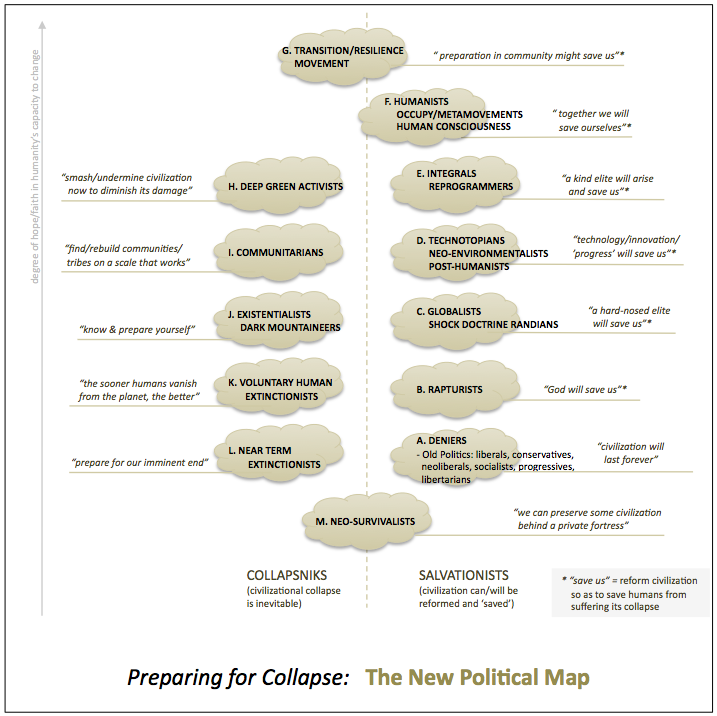
Dave Pollard offers some insight into arguments about "What, then should be done?"

        These disputes may be caused by differing underlying viewpoints about the nature of the problem.  I find Pollards chart to be very interesting. (see below)  and here   Basically the one one axis is the how bad you think things are, and on the other axis, is the amount of hope you have that things can be turned around.   He does a nice job of plotting various groups and people in that matrix.    

See if you can find yourself on his chart. 

Or, if you don't like charts , here is a nice  thumbnail sketch of the terrain.

"Humanists, for example, tend to have a worldview that suggests humans are essentially good. Hence by sheer force of numbers (say, 99%?) we can accomplish anything we put our collective minds to – even at this late date. Reform the systems by popular demand, and save the world. Others argue that the 1% don’t have nearly the power that is commonly presumed, and that their conversion or demise will not prevent the juggernaut of industrial civilization from accelerating off the collapse cliff. Still others argue that the so-called 1% are doing their best, like the rest of us, and that the enemy is all of us (leading to a wide variety of prescriptions on what that realization might lead us to do, if anything). And others argue that the 1% are psychopaths, and that the only option is to smash the systems that they lead (hoping, perhaps improbably, that whatever fills the resultant vacuum will be significantly better)."

     
           I found Pollard's essay itself a little disappointing.   He doesn't really answer the questions posed in the introduction, except maybe indirectly.   Perhaps that is because he comes from a "collapsitarian" position, and therefore  doesn't bother to address  options such as political action, working within the system, or even revolution.

           But he does hit some of the high points of the philosophical issues:  Human nature, the existence of evil, determinism,and  hope.  He ends up in a "sort of optimistic" view.  Humans aren't innately evil, or even innately destructive.... but it just looks that way because they are reacting to stress.   The stress?  Civilization itself!    Once that is gone, things will get better

"And though it may be wishful thinking or faith, rather than profound instinct, I believe that we were once well and that, after the dust of collapse has settled, humans again will be good to each other and to the world.
I’d like to believe that’s a pragmatic and rational perspective, a healthy one. But I may be deluding myself. Those who believe the Earth will be better off without humans may well be right. Those who believe the Earth will be without humans within a short few decades, centuries or millennia (an instant in the planet’s long history) may well also be right.
But I don’t believe they are. I can’t believe they are. My worldview can’t accommodate such beliefs. And therein lies our quandary, fellow collapsniks. We need to open our minds and hearts to a much broader range of possibilities, including those that we may in our quiet moments think are ‘impossible’, if we are going to be able to prepare, together, for anything."

        It's interesting to compare this view with a recent paper by Professor Brad Werner, a geophysicist , who presented a paper at the Geophysical Union meeting entitled "Is  Earth Fucked?'  In his paper he suggested that the basic problem is the nature of capitalism, with its short term view.  He also suggested that because of regulator capture, even governmental action is doomed to failure.  The only possible out, he suggests would be some sort of large scale "resistance".  Although this view has been endorsed by "progressives" , such as Naomi Klien, and Bill Moyers, I'm not sure that they really understand what he is saying.  He is not saying that we would end up with a new  industrial system, one that is more just, and more eco friendly.   He is talking about the end of industrial civilization   - collapse.   As noted here

"So, to sum up: even our best efforts at environmental management are doomed to fail, unless massive scale resistance movements start springing up and send our cultural personality back toward a pre-technological era. " 

November 29, 2014

See No Evil: The Morality of Collapse

Filed under: Preparing for Civilization's End — Dave Pollard @ 21:20
My latest article, See No Evil: The Morality of Collapse, is up at SHIFT magazine as part of its sixth edition. Check out the whole magazine! And if you like what you read, or prefer to read hard copy, please get this issue as a digital download (beautiful magazine layout) or sign up for an annual subscription (6 issues).
In this article, I ask the reader to consider these questions:
  • Is it acceptable to use violence when pacifism seems inadequate to confront the most devastating aspects of industrial civilization?
  • Are large public protests a means of raising awareness and political pressure, or are they a useless distraction from preparing for economic and political collapse?
  • Are social justice and equality essential preconditions for collectively addressing issues such as climate change, or would that be just rearranging the deckchairs on the Titanic?
  • Would it be a great service or a great disservice to deliberately provoke a collapse of markets and the economy in order to reduce consumption and energy use?
  • Is giving up on environmentalism and large-scale attempts in response to climate change, and instead focusing on local initiatives and personal and community preparedness, a realistic and pragmatic strategy, or dangerous, irresponsible defeatism?
Here’s the start of the article, and a link to the rest:
~~~~~
new political map 2014
As we wade into discussions about the consequences of collapse, and the most effective ways to become resilient in face of it, most of us avoid discussions about morals (personal standards of ‘right’ and ‘wrong’) and ethics (collective standards of ‘just’ and ‘unjust’ behaviours). As an example, it doesn’t matter whether climate change is human-caused, we assert, we need to focus on how to deal with it, not who to blame for it.
Alas, it is not so easy to avoid the issue, because our worldviews are inevitably rooted in our beliefs, including our moral and ethical ones. So when it comes to preparing for collapse, the different groups who accept that the near-term collapse of industrial civilization is inevitable (or at least requiring immediate and drastic action to avert) possess worldviews that are rooted in different, and I would argue, almost irreconcilable moral and ethical standards. This makes collaboration, or even agreement on what to do, fraught with difficulty, if not impossible.

Labels: , , , ,

Sunday, March 16, 2014

I'll fly away

And I feel fine

     REM

Fall mountains fall
Just don't fall on me

     Hendrix
------

Greetings

     The other day I had a conversation with a fellow peakster, and we wondered about the psychology of the elites. The other day,  25 Senators stood up and  75 didn't.    What are the other Senators thinking?   Surely they can see the reality of of climate change and resource limits.  What's their plan for the kids and grandkids?     How will this play out?   Perhaps there is an answer in the science of collapse. 

      The "science" of collapse is still pretty primitive.  But here is a modeling exercise that gets us one step closer.  Most of us are familiar with the idea that some societies grow and flourish, until they have resource problems, and  have troubles with either sources or sinks.  Limits to Growth modelling deals with this sort of approach

      But what effect does income inequality have on the process?     Here is  modelling exercise that tries to incorporates the impact of the 'Elites".  They find :

"In sum, results of our experiments, discussed in section 6, indicate that either one of the two features apparent in historical societal collapses (over-exploitation of natural resources and strong economic strati fication) can independently result in a complete collapse. Given economic stratifi cation, collapse is very diffi cult to avoid and requires major policy changes, including major reductions in inequality and population growth rates. Even in the absence of economic strati cation,collapse can still occur if depletion per capita is too high. However, collapse can be avoided and population can reach equilibrium if the per capita rate of depletion of nature is reduced to a sustainable level, and if resources are distributed in a reasonably equitable fashion."

   The elites act as a sort of accelerant.   They drive society past the carrying capacity into collapse.   Being buffered by their wealth, they are not  sensitive to the situation.  They last longer than the rest, but also fall.

 The authors note:

"It is important to note that in both of these scenarios, the Elites ,due to their wealth, 
do not suff er the detrimental eff ects of the environmental collapse until much later than the Commoners.
We could posit that this buff er of wealth, as well as the initial apparently sustainable
trajectory, allows Elites to continue "business as usual" despite the impending catastrophe. It is
likely that this is an important mechanism that would help explain how historical collapses were
allowed to occur by seemingly oblivious elites (most clearly apparent in the Roman and Mayan
cases)..    

    Let's look at the current situation.  Thanks to globalization, it probably makes sense to treat the world as one unit.   Oxfam just published a report on global inequality summarized here.  Here's one tidbit: 


 "Our estimates suggest that the lower half of the global population possesses barely 1% of global wealth, while the richest 10% **of adults own 86% of all wealth, and the top 1% ** account for 46% of the total. "

--------
** ( Assets of more than $75,000 put you in the top 10 percent. Assets of more than $753,000 put you in the top 1 percent.)  
--------------


  So, what about those Senators?  Where do they fit in?  The average (median) wealth for US Senators is about $2.5 million, for representatives about $600 thousand.  open secrets

Below  Nafeez Ahmed's suggests that collapse is not too far off.  He suggest that 15 years is optimistic.   He reviews a later version of this study (which hasn't been published yet)

-------
http://www.theguardian.com/environment/earth-insight/2014/mar/14/nasa-civilisation-irreversible-collapse-study-scientists

Nasa-funded study: industrial civilisation headed for 'irreversible collapse'?

Natural and social scientists develop new model of how 'perfect storm' of crises could unravel global system
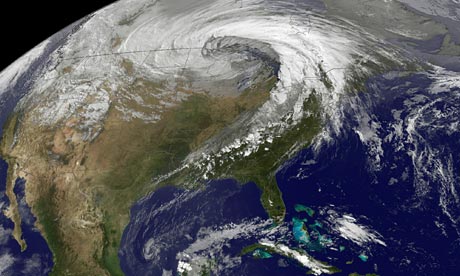
This NASA Earth Observatory released on
This Nasa Earth Observatory image shows a storm system circling around an area of extreme low pressure in 2010, which many scientists attribute to climate change. Photograph: AFP/Getty Images
A new study sponsored by Nasa's Goddard Space Flight Center has highlighted the prospect that global industrial civilisation could collapse in coming decades due to unsustainable resource exploitation and increasingly unequal wealth distribution.
Noting that warnings of 'collapse' are often seen to be fringe or controversial, the study attempts to make sense of compelling historical data showing that "the process of rise-and-collapse is actually a recurrent cycle found throughout history." Cases of severe civilisational disruption due to "precipitous collapse - often lasting centuries - have been quite common."
The research project is based on a new cross-disciplinary 'Human And Nature DYnamical' (HANDY) model, led by applied mathematician Safa Motesharri of the US National Science Foundation-supported National Socio-Environmental Synthesis Center, in association with a team of natural and social scientists. The study based on the HANDY model has been accepted for publication in the peer-reviewed Elsevier journal, Ecological Economics.
It finds that according to the historical record even advanced, complex civilisations are susceptible to collapse, raising questions about the sustainability of modern civilisation:
"The fall of the Roman Empire, and the equally (if not more) advanced Han, Mauryan, and Gupta Empires, as well as so many advanced Mesopotamian Empires, are all testimony to the fact that advanced, sophisticated, complex, and creative civilizations can be both fragile and impermanent."
By investigating the human-nature dynamics of these past cases of collapse, the project identifies the most salient interrelated factors which explain civilisational decline, and which may help determine the risk of collapse today: namely, Population, Climate, Water, Agriculture, andEnergy.
These factors can lead to collapse when they converge to generate two crucial social features: "the stretching of resources due to the strain placed on the ecological carrying capacity"; and "the economic stratification of society into Elites [rich] and Masses (or "Commoners") [poor]" These social phenomena have played "a central role in the character or in the process of the collapse," in all such cases over "the last five thousand years."
Currently, high levels of economic stratification are linked directly to overconsumption of resources, with "Elites" based largely in industrialised countries responsible for both:
"... accumulated surplus is not evenly distributed throughout society, but rather has been controlled by an elite. The mass of the population, while producing the wealth, is only allocated a small portion of it by elites, usually at or just above subsistence levels."
The study challenges those who argue that technology will resolve these challenges by increasing efficiency:
"Technological change can raise the efficiency of resource use, but it also tends to raise both per capita resource consumption and the scale of resource extraction, so that, absent policy effects, the increases in consumption often compensate for the increased efficiency of resource use."
Productivity increases in agriculture and industry over the last two centuries has come from "increased (rather than decreased) resource throughput," despite dramatic efficiency gains over the same period.
Modelling a range of different scenarios, Motesharri and his colleagues conclude that under conditions "closely reflecting the reality of the world today... we find that collapse is difficult to avoid." In the first of these scenarios, civilisation:
".... appears to be on a sustainable path for quite a long time, but even using an optimal depletion rate and starting with a very small number of Elites, the Elites eventually consume too much, resulting in a famine among Commoners that eventually causes the collapse of society. It is important to note that this Type-L collapse is due to an inequality-induced famine that causes a loss of workers, rather than a collapse of Nature."
Another scenario focuses on the role of continued resource exploitation, finding that "with a larger depletion rate, the decline of the Commoners occurs faster, while the Elites are still thriving, but eventually the Commoners collapse completely, followed by the Elites."
In both scenarios, Elite wealth monopolies mean that they are buffered from the most "detrimental effects of the environmental collapse until much later than the Commoners", allowing them to "continue 'business as usual' despite the impending catastrophe." The same mechanism, they argue, could explain how "historical collapses were allowed to occur by elites who appear to be oblivious to the catastrophic trajectory (most clearly apparent in the Roman and Mayan cases)."
Applying this lesson to our contemporary predicament, the study warns that:
"While some members of society might raise the alarm that the system is moving towards an impending collapse and therefore advocate structural changes to society in order to avoid it, Elites and their supporters, who opposed making these changes, could point to the long sustainable trajectory 'so far' in support of doing nothing."
However, the scientists point out that the worst-case scenarios are by no means inevitable, and suggest that appropriate policy and structural changes could avoid collapse, if not pave the way toward a more stable civilisation.
The two key solutions are to reduce economic inequality so as to ensure fairer distribution of resources, and to dramatically reduce resource consumption by relying on less intensive renewable resources and reducing population growth:
"Collapse can be avoided and population can reach equilibrium if the per capita rate of depletion of nature is reduced to a sustainable level, and if resources are distributed in a reasonably equitable fashion."
The NASA-funded HANDY model offers a highly credible wake-up call to governments, corporations and business - and consumers - to recognise that 'business as usual' cannot be sustained, and that policy and structural changes are required immediately.
Although the study is largely theoretical, a number of other more empirically-focused studies - by KPMG and the UK Government Office of Science for instance - have warned that the convergence of food, water and energy crises could create a 'perfect storm' within about fifteen years. But these 'business as usual' forecasts could be very conservative.
Dr Nafeez Ahmed is executive director of the Institute for Policy Research & Development and author of A User's Guide to the Crisis of Civilisation: And How to Save It among other books. Follow him on Twitter @nafeezahmed

Labels: , , ,

Wednesday, January 15, 2014

Play along at home

Who do you think you are?
-The Who


Greetings

    Here's a fun idea.  Come up with visual way to chart the views of the folks "in the know".  You know who I mean - James Hanson, Richard Heinerg, Kevin Anderson, James Lovelock,   Bill McKibben, and the rest.   Sure, they all agree that we are in a mess,  but there are differences, which can be charted along two axis - How Bad Is It? , and What will it take?

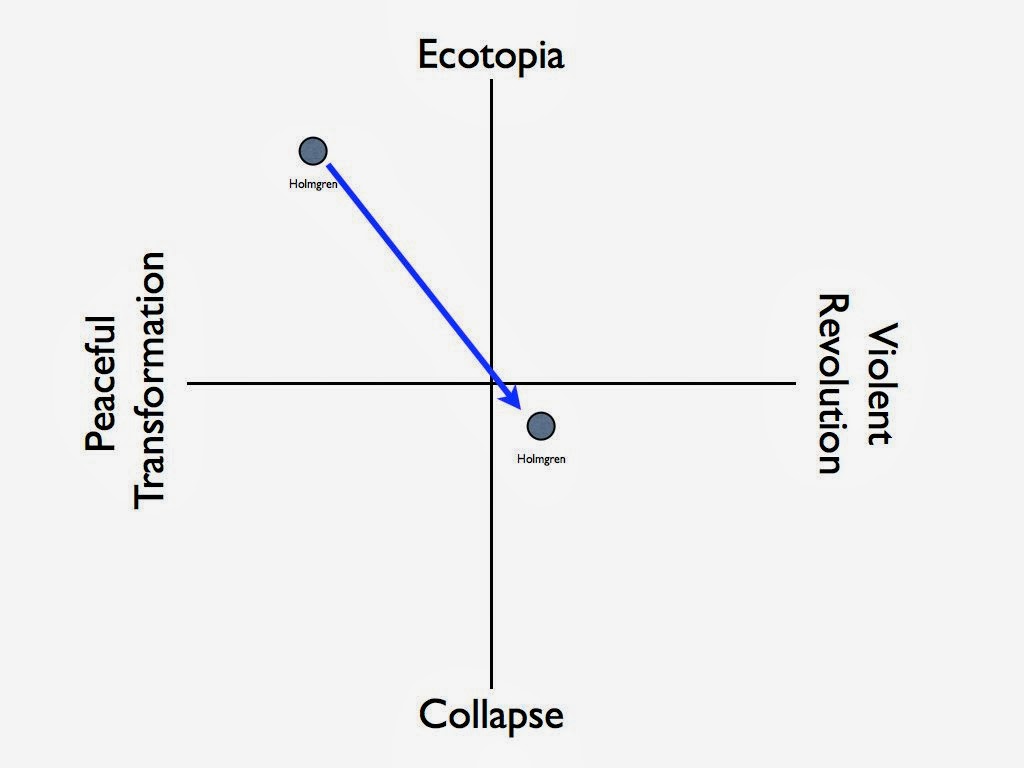
      Below Albert Bates, a veteran in all this, takes a shot.  He takes as his starting point the recent change in the view of David Holmgren, discussed in an earlier post.  

     Its kind of a fun exercise, though I have a little trouble doing it to myself.  The right and left axis I understand, although it all depends on the question.  Is it "what the right way to go?' - or is it "What way would have the best chance of working?'    For me, the answers are - The right way to go is peaceful actions, democracy etc.  However, as to whether that will work, I'm not to sanguine.   What's that make me, a peace loving pessimist?

    Similarly on the vertical axis.  Maybe the question is "How will it end?'     or maybe its "How close are we to a tipping point which will determine the need?'  I see  Guy Mcpherson  holding the extreme position - i.e. that we have already passed the point of no return.    Happily ,  I'm not there yet.   But the clock is ticking.  So put me below the line.   

      (Bates himself, is an optimists as he believes that he has a found a simple cure - Biochar, which he hopes to convince people to start burying.   I honestly haven't given it much thought.  Anyone have any opinions on this?  I see that The Land Institute is not persuaded.)


------------
From : The Great Change


Charting Collapseniks

"Rather than spurning financial system terrorists, Holmgren urges activists to become “terra-ists”; to directly bring down the system by thousands of acts of economic disobedience."

A ferment in the environmental movement, brewing for many years, has now bubbled up into the blogosphere. We are dipping our ladle in here to take a little taste of it, even though we are quite certain it is not done fermenting.

Bill McKibben has been stirring the wort of whether social activism can save us for many years. InEaarth: Making Life on a Tough New Planet, as in The End of Nature a quarter century earlier, he poignantly waffled, in elegant prose, between hope and despair. Since launching 350.org — “the first political action with a number for a name” — he has urged those of us with any remaining shred of hope for our children’s future, given what we now know about climate change, to step up and lay our lives on the line. Get arrested. Risk lengthy jail terms and even death to stop this atrocity. Do not go gentle into that good night.

Words to this effect we have heard much longer and louder from Derrick Jensen, another eloquent writer, the difference being that McKibben advocates for non-violence in the mold of Gandhi and King, while Jensen has no qualms about advocating violence. Naomi Klein, another stirring writer with an arrest record, calls for acts of resistance large and small. McKibben is tepid about taking on capitalism’s growth imperative, as though it were not a major contributing factor, while neither Holmgren, Klein nor Jensen have any such reservations.

Thus we are tasting many different flavors of leadership, or literary guidance, in the shaping of the nascent climate resistance movement.

Scientists themselves have been growing politically more active and radicalized, as Klein described in her October New Statesman essay. If you go back enough years you’ll find scientists like Dennis Meadows, Howard Odum and James Lovelock, all of whom correctly foresaw the impending collision between consumer civilizations and natural systems. Lovelock made a series of climate-and-society predictions that went unheeded for 20 years but hold up well in retrospect.

Joining the chorus of climate Cassandras with more structured harmonies are the peak-oilers and financial collapsarians. These thoughtful writers straddle a continuum that is both time-sensitive (near-term, middle term, long-term) and outcome ambivalent — they are undecided as to whether the future they foresee will be a good thing, a bad thing, or even survivable.

Guy MacPherson has staked out the lonely position for near-term human extinction, which might be a good thing or a bad thing, depending on how you look at it. Richard Heinberg, Nicole Foss and Steve Keen all see financial constraints as the leading edge of whatever storm is forming, and are not making predictions about how or when, but are planting gardens and putting up canned goods nonetheless.

Michael Ruppert, James Howard Kunstler and Dmitry Orlov are also decoupling from whatever economic grids they may be attached to, but do not foresee a particularly happy outcome in all this. Social unraveling is not a pretty picture, as Orlov describes in his Five Stages of Collapse.

Still clinging to the possibility of some salvageable human prospect are cultural and technical optimists like Amory Lovins, David Orr and Rob Hopkins. We personally would also favor this idea of an ecotopian future, and have been working to bring it about it for half a century now, but our own position is that collapse is likely unstoppable now, given, as Nicole Foss puts it “the excess claims on underlying real wealth.”

What suddenly bubbled up from the blog vat at the start of 2014 was a white paper authored by David Holmgren, one of the founders of permaculture, reversing a position he had long espoused. Instead of associating himself with peaceful change by calling for restraint on overconsumption and gradual adoption of the degrowth economic paradigm, extending it ever outward until it became the mainstream culture, Holmgren abruptly called for “Crash on Demand
 or a strategic decoupling by masses of youth (and elders) from the economic system that is the crashing the planet’s ecological stasis, by simply walking away.

“Rather than spurning financial system terrorists [a.k.a. banksters or the 1/10th-percent],” Holmgren urged activists to become “terra-ists”; to directly bring down the system by thousands of acts of economic disobedience. “The urgency for more radical action to build parallel systems and disconnect from the increasingly centralized destructive mainstream is a logical and ethical necessity whether or not it contributes to a financial collapse,” he wrote provocatively.

This immediately inspired a flurry of thoughtful responses, as might be expected. One of the most impassioned came from one whose positions Holmgren had just abandoned. Writing forTransition Culture January 13, Rob Hopkins responded, “to state that we need to deliberately, and explicitly, crash the global economy feels to me naive and dangerous, especially as nothing in between growth and collapse is explored at all.”

Hopkins main truck with Holmgren is his readiness to toss away all notions of mainstreaming permaculture and transition towns. “I may be naive,” he writes, “but I still think it is possible to mobilise that in a way that, as the Bristol Pound illustrates, gets the support and buy-in of the 'City/State' level, and begins to really put pressure and influence on 'National' thinking.  I may be naive, but it's preferable to economic collapse in my book, and I think we can still do it.”

Concerned that a hard line position would expose social change agents to the full weight of state security as well as to the blame cascading from an angry populace, and that sewing the seeds of civil discord is always dangerous, Nicole Foss wrote on The Automatic Earth January 9 that financial collapse is already well underway and there is no need to expedite the process. “While I understand why Holmgren would open a discussion on this front, given what is at stake, it is indeed dangerous to ‘grasp the third rail’ in this way. This approach has some aspects in common with Deep Green Resistance, which also advocates bringing down the existing system, although in their case in a more overtly destructive manner.”

“Decentralization initiatives already face opposition, but this could become significantly worse if perceived to be even more of a direct threat to the establishment,” Foss concluded.

Having these positions staked out was useful for the discussion of strategy that change agents need to be more engaged with. Klein and McKibben seem to think that if we just have enough “Battles for Seattle,” the economic system of global civilization will be radically restructured. Our own experience in joining dozens of massive marches and actions of civil disobedience but nonetheless failing to end the Vietnam War has perhaps jaundiced our views in this regard. Moreover, Holmgren and Foss make clear that that’s not going to happen.

Even the recently unveiled strategy of fossil fuel divestment, as promising as it is, and as grounded in investment reality of the stranded, overvalued assets unable to ever be burnt, stands little chance of being able to arrest climate tipping points that may have been triggered decades ago.

Foss is not especially concerned for the climate, apparently clinging to the position Holmgren had some years ago, that collapse of energy and economics will augur in a low-carbon future, although she does acknowledge the lurking unknowns from reversed global dimming. “We need to get down to the business of doing the things on the ground that matter, and to look after our own local reality. We can expect considerable opposition from those who have long benefited from the status quo, but if enough people are involved, change can become unstoppable. It won’t solve our problems in the sense of allowing us to continue any kind of business as usual scenario, and it won’t prevent us from having to address the consequences of overshoot, but a goal to move us through the coming bottleneck with a minimum amount of suffering is worth striving for.”

Our own view is that the likelihood that a runaway greenhouse effect is now underway is greater than it has ever been, and to call what is coming a bottleneck is a poor choice of words except perhaps in the sense of the genetic bottleneck experienced 70-80 thousand years ago in connection with a supervolcano that reduced our hereditary lines to fewer than 5000 individuals worldwide. While we understand the concern she raises about unduly politicizing the issue, we’d say that cat has left its bag and keeping silent for fear of numbing the population makes no more sense for climate change than it does for Ponzi economics. Indeed, the parallels between the overdraft on Earth’s atmosphere and the excess claims on fictional central bank assets are striking — neither is going to go away simply by ignoring them. In both cases, the cake already baked.

This prompts us to make a new grid to categorize the range of opinions amongst peakists, collapseniks, politicos and anarchists. It goes something like this, at first drawing, and we welcome corrections, especially from those named.

Holmgren’s change of position can be charted this way:


If we plot the respective positions of other change strategists, they look something like this:


This is revision #6 since the original post

Our own position in this matrix, outlined in two books since 2006, is off to the left and centered on the line, meaning that while we are adamant in our advocacy for peaceful transformation, we are doubtful as to whether ecotopia is possible without collapse. Those seem to us to be a coupled pair. Likewise, McKibben is in favor of a new green economy but stuck vacillating between more peaceful and less peaceful means of getting there, while MacPherson is deeply wedded to inevitable collapse without caring any more about social responses.

Not surprising, given what they know, scientists like Lovelock, Ken Anderson, and Howard Odum all fall below the line dividing Ecotopia from Collapse. Odum, we suspect, would have been in favor of peaceful transformation, while the others would like us to push harder and force the issue.

Naturally those most concerned with Holmgren’s shift would be those closest to his former position, including Rob Hopkins. Those closest to him now — Kunstler, Anderson, Hansen and Klein — would be the most likely to approve.

What is missing from Holmgren’s paper are the advances in terrestrial carbon sequestration — as opposed to Ponzi geoengineering — in no small measure reaching fruition by dint of permaculture design. While permaculturists like Rob Hopkins, Declan Kennedy and Max Lindegger pursued innovations in social structures — transition towns, complimentary currencies and ecovillages — other permaculturists — Darren Doherty, Richard Perkins, Joel Salatin and Ethan Roland, to name just some — have pushed the envelope to see how much carbon can actually be returned to the soil. This revolution is the subject of Courtney White’s new book, Grass, Soil, Hope: A Journey Through Carbon Country, scheduled for release in June.

Would we have ever learned that a mere 2% increase in the carbon content of the planet’s soils could offset 100% of all greenhouse gas emissions going into the atmosphere if we had not been so frightened of climate change by Al Gore and other scaremongers? Speaking as one who wandered deep into Amazonian history to discover this new paradigm, we reply: probably not.

We’ve added some color coding and sector analysis with this third iteration:

This is revision #6 since the original post


Now lets step back and add a whole ‘nother layer to this.

There is a really good cultural transformation going on, with ecovillagers, ecological restorationists, soil remineralizers and post-empire econometricists. Simultaneously, there is a really negative übertrend of banksters and purchased or annointed politicians enriching themselves off oil, nuke and the wealth of nature, then turning all that surplus into the worst kinds of pollution – the kinds that take millennia to degrade and even then impair gene pools for untold generations.

These two conflicting transformations coexist against the backdrop of almost immeasurably immense climatic and biosystemic change that will severely affect, if not drive, our world in the future. We all exist in the context of ecosystems and yet these familiar norms are being utterly destroyed while we write this. The tiny little good ecovillagers, permaculturists and transition towners do pales in comparison to the scale of damage of unrestrained growthaholism that seems almost a genetic imperative of our species — and we are the keystone species in ecosystem Earth. Holmgren has this right, and it is undeniably frightening.

We’re sure there may be more thoughtful readers who can add to this analysis and produce more insights than we have, but as we say, we’re just grateful to be having this kind of discussion.  


After co-teaching a permaculture course in Belize with Nicole Foss next month, we will be vetting this analysis with Dmitry Orlov, Dennis Meadows, John Michael Greer, Gail Tverberg, KMO and others at the Age of Limits conference in Pennsylvania in May.  

Labels: , , , , ,

Friday, October 11, 2013

Is this it?


Just gettin' high on gettin' bys my stock in trade
Living it day to day
Pickin' up the pieces wherever they fall
Just letting it roll, letting the high times carry the low
I'm just living my life easy come, easy go

-Jerry Jeff Walker

Greetings

   The trifecta of crises - economy, energy and ecology is well underway.   But until something dramatic happens we feel that we can just keep our heads down and ignore it.

  Below Heinberg wonders whether the current budgetary impasse could be the snow flake that triggers the avalanche.  

   Collapse watchers may find it useful to use the taxonomy identified by Dmitri Orlov in his "Five Stages of Collapse."  (review below)

"He proposed that societies that have been pushed beyond the point of sustainability tend to move through a set sequence of collapse stages. He identified these as financial, commercial, political, social and cultural collapse." 

He suggests that we may need to adopt some different skills to deal with what comes next.

Above all, he emphasizes that adapting to the difficult future ahead will require rejecting everything we’ve been schooled and socialized to believe about the world and our place in it. It will also necessitate “learning to be poor,” something that Orlov says takes practice, since people who are suddenly thrust into destitution have neither the skills nor the psychological preparation for a life of subsistence and bartering. 

Notions are getting "a job", investing, and protecting a "nest egg" may also change.

"One of the core assumptions that this book challenges is the belief that notional wealth, in the form of paper currency or numbers in a computer, makes one rich. Having witnessed the Soviet Union destroy its currency by hyperinflating away its debts, Orlov knows better. He realizes that real wealth exists within hard assets like the precious metals in jewelry or the lead ballast in a sailboat, which hold their value over time regardless of what happens in the specious realm of finance. Another theme repeatedly visited by Orlov is the importance of family. Orlov shows how the dereliction of family ties by people living in today’s industrial nations is both unhealthy and at odds with the role that families have played throughout most of history. He believes that the societies in which family has been neglected the most will fare the worst in times to come."

Many people are starting to adopt new skills and views.  Gardening, gleaning,  canning, drying, networking, free lancing, , hustling, bartering, re-purposing, making, mending, garage sale-ing, and don't forget  - good old dumpster diving.
--------

Shutdown and default: the worst-case scenario

by Richard Heinberg, originally published by Resilience  | OCT 10, 2013

I’m not saying the worst is going to happen. But if it does, matters could get depressingly bad, disturbingly fast.

How bad? Start with Treasury Secretary Jack Lew’s estimate of the potential damage from a failure by Congress to increase the nation’s borrowing limit. On Sunday morning’s TV talk shows, he pointed out that credit markets could freeze, the value of the dollar could plummet, and US interest rates could skyrocket. Think 2008 all over again. [http://www.csmonitor.com/USA/DC-Decoder/2013/1006/Congress-playing-with-fire-on-debt-limit-warns-Treasury-Secretary-Jack-Lew-video]

The Lincoln Memorial closed during the United States federal government shutdown of 2013. (Source: Flickr user reivax via Wikimedia Commons)

But it’s actually much worse than that. Almost nobody in the commentariat mentions that the US economy is currently being held together by deficit spending and quantitative easing. Rapid economic growth as experienced during the mid-20th century is over and done with. [www.ted.com/talks/robert_gordon_the_death_of_innovation_the_end_of_growth.html] However, our financial system is set up to require constant growth. This is a serious problem, and the only solution anybody has come up with so far is for the Federal government and the Federal Reserve to purchase a few more years of ersatz growth with borrowed money. Financial markets would crash without a constant injection of quantitative easing (QE), and Main Street would wither without monthly deficit-funded infusions from Washington. Absent ongoing stimulus (which is admittedly not a permanent solution), we would be hurtled back to the deflationary hell of five years ago. It’s hard to see how a US government debt default could fail to get us there.

That’s just the potential economic fallout from default. The possible political consequences are almost as unfathomable. According to Jonathan Chait, writing in New York Magazine, the current Democrat-Republican impasse is actually a foreseeable, if not inevitable, outgrowth of the American political system, with its division of power between a separately elected President and Congress. [http://nymag.com/news/politics/nationalinterest/government-shutdown-2013-10/] Chait cites the opinion of the late Spanish political scientist Juan Linz that “All such systems are based on dual democratic legitimacy: No democratic principle exists to resolve disputes between the executive and the legislature about which of the two actually represents the will of the people.” The current standoff, in which both sides believe they have an enormous amount to lose by compromising, could—again, in the worst instance—come to represent the most serous constitutional crisis since the Civil War.

There are also looming geopolitical repercussions. If the United States defaults, other nations may ditch the US dollar as reserve currency. That would have serious ongoing consequences for the American economy, but it would also reduce the nation’s international political clout. Last week, President Obama had to cancel a key Asian trip to deal with the domestic shutdown crisis. Chinese leader Xi Jinping did show up as scheduled, looking confident and in charge. The US empire has been fraying for the past decade anyway; default could speed that process dramatically.

In the worst case, the United States could emerge from the current political crisis in a way that renders it, only months from now, economically and politically unrecognizable.

Again, none of this is inevitable. Cooler heads may prevail. But the worst-case scenario is hardly far-fetched. Look at the incentives.

Congressional Republicans have boxed themselves into a corner. By taking the nation’s government and economy hostage and making heavy demands, they incur high political risks. They stand to lose power and legitimacy unless they come away from the confrontation with some tangible gain they can trumpet to their base. (Indiana Republican Congressman Marlin Stutzman: “We have to get something out of this. And I don’t know what that even is.” [http://talkingpointsmemo.com/livewire/gop-congressman-says-he-doesn-t-know-what-republicans-want-in-shutdown-fight]) The higher the price the country pays for the standoff, the greater the Republicans’ need for some reason to say it was all worthwhile.

Meanwhile Mr. Obama believes that if he gives in to Congress, a precedent will have been welded into place. Every time the debt ceiling needs to be raised, there will be opportunity for Congress to make further demands. Elections will cease to matter. Obama probably regrets his negotiations with Congress in a similar standoff in 2011, which resulted in the Sequester. The current dispute is not just about Obamacare. It is about maintaining the scope of presidential power in the face of a congressional effort to dramatically reduce it. Obama’s historic legacy is at stake.

In a better-case scenario, and a more likely one, the standoff is resolved before the nation defaults. The Tea Party’s big-business backers are already yanking its leash. [http://maddowblog.msnbc.com/_news/2013/10/09/20886987-gop-losing-powerful-allies-in-hostage-crises?lite] President Obama has offered House Republicans the possibility of a short-term debt-cap increase and funding of the government to make time for negotiations; while House Speaker Boehner initially rejected this, it is probably the best face-saving measure available.

However, if both sides hold firm and the nation defaults, we’re headed into uncharted territory. And only an understanding of ecology (as well as politics and economics) reveals the true dangers ahead.

Back in the early 1970s a famous computer-assisted study of the physical systems that support economic growth (agriculture, natural resources, and the ability of the environment to absorb pollution) concluded that world industrial output would likely peak and decline in the early 21st century. [http://en.wikipedia.org/wiki/The_Limits_to_Growth] That study, which has been validated by recent research, [www.csiro.au/files/files/plje.pdf] did not consider the roles of financial or political systems.

At first economists scoffed at the idea that economic growth might not continue forever. But today, one by one, economists are beginning to recognize that, as Stephen B. King, chief economist at HSBC wrote in a recent New York Times op-ed, “We are reaching end times for Western affluence.” [www.nytimes.com/2013/10/07/opinion/when-wealth-disappears.html?pagewanted=1&_r=0]

In 2008 it became clear that, as limits to growth are encountered, the inherent instability of financial systems can precipitate a much faster crash than would otherwise be the case. It also became clear that governments and central banks will undertake extraordinary measures to avert a fast-crash scenario. The rapid expansion of household debt, which had kept the growth balloon inflated since 1980, effectively ceased with the advent of the Great Recession. The balance sheet of the Fed stretched dramatically, and the Federal Government’s debt levels soared, as policy makers strove to keep the economy from imploding.

But government debt quickly became a political hot potato, and that helped lead us to the present impasse.

In 2013 we are learning that the US political system is rigged in such a way that backstops against a fast financial crash may fail.

Some aspects of our 21st century dilemma are inevitable: you can’t run an ever-growing economy on non-renewable resources without eventually facing symptoms of depletion and scarcity (e.g., high oil prices). Some aspects are slowly cumulative, like the buildup of greenhouse gases in Earth’s atmosphere and the consequences for ecosystems that support life on our planet. But we also face looming crises brought on by the design of our political institutions, and by the personalities and tactics of specific leaders. One would hope that these latter crises could be more easily averted than those tied to the very sinews of our industrial way of life.

We can’t prevent some unfortunate results of processes that humanity set in motion decades ago: we’re already committed to a certain amount of climate change, given past greenhouse gas emissions; we’ve already unleashed a mass extinction event and made a wasteland of the oceans. But we can avoid the worst-case scenario. Here’s what to do: Release the hostages. Pass a new debt limit and re-open the government, no conditions attached. Then get to work designing a post-growth, post-fossil fuel economy that protects people and planet. Do it in that order. Simple. Go to it. Hello, Washington, anybody listening?


http://www.resilience.org/stories/2013-10-10/shutdown-and-default-the-worst-case-scenario

------

Review: The Five Stages of Collapse by Dmitry Orlov

by Frank Kaminski, originally published by Resilience.org  | OCT 9, 2013
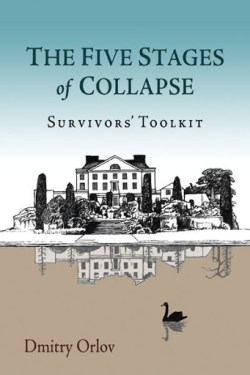
The Five Stages of Collapse: Survivors' Toolkit
By Dmitry Orlov
281 pp. New Society Publishers – May 2013. $19.95.
At some point, those of us who accept the inevitability of a complete societal collapse, driven by resource depletion and rapid climate change, have to wonder what more can be gained by our continued attempts to persuade the masses.
Granted, our efforts do succeed in enlisting a steady trickle of new recruits into the ranks of the “walking worried”—to quote a term used by collapsitarian Julian Darley—but the public at large still dismisses our appeals out of hand. What reason is there to believe that further efforts at spreading the truth will bring different results? More and more, it’s starting to seem like the sensible approach is to get out of the awareness-raising business entirely and focus our energies instead on providing practical guidance to those who are willing to hear it.
This is certainly the view of collapse thinker and writer Dmitry Orlov, whose latest book, The Five Stages of Collapse: Survivors' Toolkit, was released by New Society Publishers in May. As indicated by its subtitle, this much-anticipated offering from one of the best authors on the subject seeks not to convince readers that a collapse is imminent, but to suggest approaches and strategies for managing it when it comes. “[T]his is not a ‘We must...’ book or an ‘Unless we...’ book, or even a ‘We should...’ book," writes Orlov. “There is no agenda here—just the assumption that collapse will happen, the conjecture that it can be analyzed as unfolding in five distinct phases and, based on quite a bit of research, the conclusion that each phase will require a different set of adaptations from those who wish to survive it.”
The idea of a five-stage taxonomy of collapse first suggested itself to Orlov in early 2008. It came to him as he noticed that a number of commentators were aptly using Elisabeth Kübler-Ross' five stages of grief to describe the process of coming to terms with humanity’s ecological predicament. In February of that year, he posted a piece on his blog, ClubOrlov, titled “The Five Stages of Collapse,” which became the germ for the book. In it, he proposed that societies that have been pushed beyond the point of sustainability tend to move through a set sequence of collapse stages. He identified these as financial, commercial, political, social and cultural collapse. And he argued that the United States, with its grave crises related to energy, runaway military spending, foreign debt and a worsening foreign trade deficit, seems poised to bring about its own hasty descent through the five stages.
An émigré from Russia, Orlov had already seen one collapse firsthand. He witnessed the Soviet Union's fall during the early-to-mid 1990s, and in the process accumulated a vast store of wisdom on collapses in general and how best to proceed when caught in one. It didn't take him long after that to see that America was headed for a similar, if more severe, crash of its own. However, he kept his observations to himself for years, sensing that there was not yet enough of a receptive audience. While he bided his time, he settled with his wife in Boston, where he earned a living as an engineer, made his way around by bicycle and, in his spare time, pursued a love of sailing that was more than mere pastime. (Indeed, he would go on to explore the potential of sail as a mode of transporting food and other cargo in a fossil fuel-depleted future.)
Financial collapse, writes Orlov in Five Stages, is invariably the first and most sudden to occur, because finance represents a mere concept rather than tangible wealth. It can be kept up for only as long as growth and the expectation of future growth are maintained, and when these falter, it fails catastrophically. Right now we’re seeing an end to the growth of just about every essential industrial input that has fueled our civilization. The widespread realization that growth is over spells death for global finance, meaning that the nations of the developed world are poised on the brink of financial collapse. (Orlov points out that one country, Greece, is already well past the brink and is mired in financial, commercial and political collapse all at once.) The author sees each of the Western nations headed for a deflationary spiral followed by “a quick but painful bout of hyperinflation thrown in at the very end.”
The next phase, commercial collapse, occurs when a country’s physical flows of consumer products and services become disrupted. The mass bank failures brought about by financial collapse cause international trade to stop, which in turn halts global supply chains. People find themselves facing shortages of basic goods, while manufacturers run short on materials needed for their processes. It doesn’t take long for the global economy to pass “a point of no return,” in Orlov’s words, beyond which recovery is impossible because all the requisite supply networks and trading relationships have been lost. In short, people cease believing in the notion that “the market shall provide.”
As a society passes through the final three phases in the cycle, people progressively lose faith in its remaining institutions. During political collapse, national governments become irrelevant as they prove incapable of providing for their citizens. Local forms of governance spontaneously spring up, often in partnership with organized crime, to fill the void. As for social and cultural collapse, Orlov writes that they’re mostly preventable, and indeed that the Soviet Union managed to stop short of both of them. When they do occur, they’re characterized by a loss of trust in one's fellows and in the goodness of humanity, respectively.
This book includes case studies to illustrate the different collapse stages, each one emphasizing a particular set of skills and attitudes most conducive to survival. Iceland following the financial crisis of 2008 is presented as an exemplar of successful financial crash mitigation. The main lesson to be learned from its experience, writes Orlov vehemently, is “Let The Banks Fail.” As for weathering commercial collapse, Orlov points to the Russian mafia, which, despite its reputation, actually observes a strict ethic of honest dealing and restraint in the use of violence. For his example of successful adaptation to political collapse, Orlov considers an even more uncomfortable case: the Pashtun people of Afghanistan and Pakistan, who accounted for most of the Taliban’s membership. There’s also a fascinating study of gypsies, and how they can thrive in times of social collapse because they’ve mastered the art of conning to the point of a high art.
By far the most disturbing portrait is that of an African tribe called the Ik. Orlov uses their experience to show how humans can endure even after they've been stripped of the very virtues that are assumed to be prerequisites for humanity, such as love and compassion. The Ik were driven off their native land in Uganda 55 years ago when it became a game reserve. The only land left to them was desolate mountainside that was difficult to farm, and the result was chronic famine. Survival didn’t mean merely putting one's own needs above those of others, it meant making oneself a ruthless adversary of everyone else in sight. The Ik were shockingly cruel to one another, and no bonds—not even those between mother and child—were sacred. The anthropologist who first studied the Ik, Colin Turnbull, seemed traumatized by the experience. His book about it, The Mountain People, was deemed by one reviewer to be “a terrifying book, a quick but well-illuminated look under the sewercovers of the human psyche.”*
Orlov views the story of the Ik as a cautionary tale, one that forces us to “confront the uncomfortable notion that survival at all costs may be a fate worse than death.” Regarding the subjects of his other case studies, however, he offers in-depth discussions of how their approaches could be useful to people in today’s doomed industrial societies. Above all, he emphasizes that adapting to the difficult future ahead will require rejecting everything we’ve been schooled and socialized to believe about the world and our place in it. It will also necessitate “learning to be poor,” something that Orlov says takes practice, since people who are suddenly thrust into destitution have neither the skills nor the psychological preparation for a life of subsistence and bartering.
One of the core assumptions that this book challenges is the belief that notional wealth, in the form of paper currency or numbers in a computer, makes one rich. Having witnessed the Soviet Union destroy its currency by hyperinflating away its debts, Orlov knows better. He realizes that real wealth exists within hard assets like the precious metals in jewelry or the lead ballast in a sailboat, which hold their value over time regardless of what happens in the specious realm of finance. Another theme repeatedly visited by Orlov is the importance of family. Orlov shows how the dereliction of family ties by people living in today’s industrial nations is both unhealthy and at odds with the role that families have played throughout most of history. He believes that the societies in which family has been neglected the most will fare the worst in times to come.
It was in December 2006 that Orlov began making a name for himself as a writer on collapse. His breakout article, “Closing the 'Collapse Gap': The USSR was better prepared for collapse than the US,” ran on the energy news site Energy Bulletin (now Resilience) on December 4, and it rapidly became one of the site's all-time most popular posts. His first book, Reinventing Collapse, came two years later.  Both the article and the book brimmed with intelligence, worldly experience and a droll, clever wit that has been Orlov’s trademark ever since. Though he still has his day job as an engineer—now in the field of software engineering—Orlov continues to actively blog and speak on collapse. As he recounts in the new book, “[s]topping, beyond a certain point, would have disappointed far too many people.” Well, I think I speak for all his fans when I express my wish that he not stop anytime soon.
* Mary Daniels, "The Ik; a study of The Loveless People," Chicago Tribune, Nov. 5, 1972: M3, http://pqasb.pqarchiver.com/chicagotribune/doc/170334387.html (accessed Oct. 1, 2013).

Labels: , ,