Is this it?
Just gettin' high on gettin' bys my stock in trade
Living it day to day
Pickin' up the pieces wherever they fall
Just letting it roll, letting the high times carry the low
I'm just living my life easy come, easy go
Living it day to day
Pickin' up the pieces wherever they fall
Just letting it roll, letting the high times carry the low
I'm just living my life easy come, easy go
-Jerry Jeff Walker
The trifecta of crises - economy, energy and ecology is well underway. But until something dramatic happens we feel that we can just keep our heads down and ignore it.
Below Heinberg wonders whether the current budgetary impasse could be the snow flake that triggers the avalanche.
Collapse watchers may find it useful to use the taxonomy identified by Dmitri Orlov in his "Five Stages of Collapse." (review below)
"He proposed that societies that have been pushed beyond the point of sustainability tend to move through a set sequence of collapse stages. He identified these as financial, commercial, political, social and cultural collapse."
Notions are getting "a job", investing, and protecting a "nest egg" may also change.Above all, he emphasizes that adapting to the difficult future ahead will require rejecting everything we’ve been schooled and socialized to believe about the world and our place in it. It will also necessitate “learning to be poor,” something that Orlov says takes practice, since people who are suddenly thrust into destitution have neither the skills nor the psychological preparation for a life of subsistence and bartering.
"One of the core assumptions that this book challenges is the belief that notional wealth, in the form of paper currency or numbers in a computer, makes one rich. Having witnessed the Soviet Union destroy its currency by hyperinflating away its debts, Orlov knows better. He realizes that real wealth exists within hard assets like the precious metals in jewelry or the lead ballast in a sailboat, which hold their value over time regardless of what happens in the specious realm of finance. Another theme repeatedly visited by Orlov is the importance of family. Orlov shows how the dereliction of family ties by people living in today’s industrial nations is both unhealthy and at odds with the role that families have played throughout most of history. He believes that the societies in which family has been neglected the most will fare the worst in times to come."
Many people are starting to adopt new skills and views. Gardening, gleaning, canning, drying, networking, free lancing, , hustling, bartering, re-purposing, making, mending, garage sale-ing, and don't forget - good old dumpster diving.
--------
Shutdown and default: the worst-case scenario
by Richard Heinberg, originally published by Resilience | OCT 10, 2013
I’m not saying the worst is going to happen. But if it does, matters could get depressingly bad, disturbingly fast.
How bad? Start with Treasury Secretary Jack Lew’s estimate of the potential damage from a failure by Congress to increase the nation’s borrowing limit. On Sunday morning’s TV talk shows, he pointed out that credit markets could freeze, the value of the dollar could plummet, and US interest rates could skyrocket. Think 2008 all over again. [http://www.csmonitor.com/USA/DC-Decoder/2013/1006/Congress-playing-with-fire-on-debt-limit-warns-Treasury-Secretary-Jack-Lew-video]
The Lincoln Memorial closed during the United States federal government shutdown of 2013. (Source: Flickr user reivax via Wikimedia Commons)
But it’s actually much worse than that. Almost nobody in the commentariat mentions that the US economy is currently being held together by deficit spending and quantitative easing. Rapid economic growth as experienced during the mid-20th century is over and done with. [www.ted.com/talks/robert_gordon_the_death_of_innovation_the_end_of_growth.html] However, our financial system is set up to require constant growth. This is a serious problem, and the only solution anybody has come up with so far is for the Federal government and the Federal Reserve to purchase a few more years of ersatz growth with borrowed money. Financial markets would crash without a constant injection of quantitative easing (QE), and Main Street would wither without monthly deficit-funded infusions from Washington. Absent ongoing stimulus (which is admittedly not a permanent solution), we would be hurtled back to the deflationary hell of five years ago. It’s hard to see how a US government debt default could fail to get us there.
That’s just the potential economic fallout from default. The possible political consequences are almost as unfathomable. According to Jonathan Chait, writing in New York Magazine, the current Democrat-Republican impasse is actually a foreseeable, if not inevitable, outgrowth of the American political system, with its division of power between a separately elected President and Congress. [http://nymag.com/news/politics/nationalinterest/government-shutdown-2013-10/] Chait cites the opinion of the late Spanish political scientist Juan Linz that “All such systems are based on dual democratic legitimacy: No democratic principle exists to resolve disputes between the executive and the legislature about which of the two actually represents the will of the people.” The current standoff, in which both sides believe they have an enormous amount to lose by compromising, could—again, in the worst instance—come to represent the most serous constitutional crisis since the Civil War.
There are also looming geopolitical repercussions. If the United States defaults, other nations may ditch the US dollar as reserve currency. That would have serious ongoing consequences for the American economy, but it would also reduce the nation’s international political clout. Last week, President Obama had to cancel a key Asian trip to deal with the domestic shutdown crisis. Chinese leader Xi Jinping did show up as scheduled, looking confident and in charge. The US empire has been fraying for the past decade anyway; default could speed that process dramatically.
In the worst case, the United States could emerge from the current political crisis in a way that renders it, only months from now, economically and politically unrecognizable.
Again, none of this is inevitable. Cooler heads may prevail. But the worst-case scenario is hardly far-fetched. Look at the incentives.
Congressional Republicans have boxed themselves into a corner. By taking the nation’s government and economy hostage and making heavy demands, they incur high political risks. They stand to lose power and legitimacy unless they come away from the confrontation with some tangible gain they can trumpet to their base. (Indiana Republican Congressman Marlin Stutzman: “We have to get something out of this. And I don’t know what that even is.” [http://talkingpointsmemo.com/livewire/gop-congressman-says-he-doesn-t-know-what-republicans-want-in-shutdown-fight]) The higher the price the country pays for the standoff, the greater the Republicans’ need for some reason to say it was all worthwhile.
Meanwhile Mr. Obama believes that if he gives in to Congress, a precedent will have been welded into place. Every time the debt ceiling needs to be raised, there will be opportunity for Congress to make further demands. Elections will cease to matter. Obama probably regrets his negotiations with Congress in a similar standoff in 2011, which resulted in the Sequester. The current dispute is not just about Obamacare. It is about maintaining the scope of presidential power in the face of a congressional effort to dramatically reduce it. Obama’s historic legacy is at stake.
In a better-case scenario, and a more likely one, the standoff is resolved before the nation defaults. The Tea Party’s big-business backers are already yanking its leash. [http://maddowblog.msnbc.com/_news/2013/10/09/20886987-gop-losing-powerful-allies-in-hostage-crises?lite] President Obama has offered House Republicans the possibility of a short-term debt-cap increase and funding of the government to make time for negotiations; while House Speaker Boehner initially rejected this, it is probably the best face-saving measure available.
However, if both sides hold firm and the nation defaults, we’re headed into uncharted territory. And only an understanding of ecology (as well as politics and economics) reveals the true dangers ahead.
Back in the early 1970s a famous computer-assisted study of the physical systems that support economic growth (agriculture, natural resources, and the ability of the environment to absorb pollution) concluded that world industrial output would likely peak and decline in the early 21st century. [http://en.wikipedia.org/wiki/The_Limits_to_Growth] That study, which has been validated by recent research, [www.csiro.au/files/files/plje.pdf] did not consider the roles of financial or political systems.
At first economists scoffed at the idea that economic growth might not continue forever. But today, one by one, economists are beginning to recognize that, as Stephen B. King, chief economist at HSBC wrote in a recent New York Times op-ed, “We are reaching end times for Western affluence.” [www.nytimes.com/2013/10/07/opinion/when-wealth-disappears.html?pagewanted=1&_r=0]
In 2008 it became clear that, as limits to growth are encountered, the inherent instability of financial systems can precipitate a much faster crash than would otherwise be the case. It also became clear that governments and central banks will undertake extraordinary measures to avert a fast-crash scenario. The rapid expansion of household debt, which had kept the growth balloon inflated since 1980, effectively ceased with the advent of the Great Recession. The balance sheet of the Fed stretched dramatically, and the Federal Government’s debt levels soared, as policy makers strove to keep the economy from imploding.
But government debt quickly became a political hot potato, and that helped lead us to the present impasse.
In 2013 we are learning that the US political system is rigged in such a way that backstops against a fast financial crash may fail.
Some aspects of our 21st century dilemma are inevitable: you can’t run an ever-growing economy on non-renewable resources without eventually facing symptoms of depletion and scarcity (e.g., high oil prices). Some aspects are slowly cumulative, like the buildup of greenhouse gases in Earth’s atmosphere and the consequences for ecosystems that support life on our planet. But we also face looming crises brought on by the design of our political institutions, and by the personalities and tactics of specific leaders. One would hope that these latter crises could be more easily averted than those tied to the very sinews of our industrial way of life.
We can’t prevent some unfortunate results of processes that humanity set in motion decades ago: we’re already committed to a certain amount of climate change, given past greenhouse gas emissions; we’ve already unleashed a mass extinction event and made a wasteland of the oceans. But we can avoid the worst-case scenario. Here’s what to do: Release the hostages. Pass a new debt limit and re-open the government, no conditions attached. Then get to work designing a post-growth, post-fossil fuel economy that protects people and planet. Do it in that order. Simple. Go to it. Hello, Washington, anybody listening?
http://www.resilience.org/stories/2013-10-10/shutdown-and-default-the-worst-case-scenario
--------
Shutdown and default: the worst-case scenario
by Richard Heinberg, originally published by Resilience | OCT 10, 2013
I’m not saying the worst is going to happen. But if it does, matters could get depressingly bad, disturbingly fast.
How bad? Start with Treasury Secretary Jack Lew’s estimate of the potential damage from a failure by Congress to increase the nation’s borrowing limit. On Sunday morning’s TV talk shows, he pointed out that credit markets could freeze, the value of the dollar could plummet, and US interest rates could skyrocket. Think 2008 all over again. [http://www.csmonitor.com/USA/DC-Decoder/2013/1006/Congress-playing-with-fire-on-debt-limit-warns-Treasury-Secretary-Jack-Lew-video]
The Lincoln Memorial closed during the United States federal government shutdown of 2013. (Source: Flickr user reivax via Wikimedia Commons)
But it’s actually much worse than that. Almost nobody in the commentariat mentions that the US economy is currently being held together by deficit spending and quantitative easing. Rapid economic growth as experienced during the mid-20th century is over and done with. [www.ted.com/talks/robert_gordon_the_death_of_innovation_the_end_of_growth.html] However, our financial system is set up to require constant growth. This is a serious problem, and the only solution anybody has come up with so far is for the Federal government and the Federal Reserve to purchase a few more years of ersatz growth with borrowed money. Financial markets would crash without a constant injection of quantitative easing (QE), and Main Street would wither without monthly deficit-funded infusions from Washington. Absent ongoing stimulus (which is admittedly not a permanent solution), we would be hurtled back to the deflationary hell of five years ago. It’s hard to see how a US government debt default could fail to get us there.
That’s just the potential economic fallout from default. The possible political consequences are almost as unfathomable. According to Jonathan Chait, writing in New York Magazine, the current Democrat-Republican impasse is actually a foreseeable, if not inevitable, outgrowth of the American political system, with its division of power between a separately elected President and Congress. [http://nymag.com/news/politics/nationalinterest/government-shutdown-2013-10/] Chait cites the opinion of the late Spanish political scientist Juan Linz that “All such systems are based on dual democratic legitimacy: No democratic principle exists to resolve disputes between the executive and the legislature about which of the two actually represents the will of the people.” The current standoff, in which both sides believe they have an enormous amount to lose by compromising, could—again, in the worst instance—come to represent the most serous constitutional crisis since the Civil War.
There are also looming geopolitical repercussions. If the United States defaults, other nations may ditch the US dollar as reserve currency. That would have serious ongoing consequences for the American economy, but it would also reduce the nation’s international political clout. Last week, President Obama had to cancel a key Asian trip to deal with the domestic shutdown crisis. Chinese leader Xi Jinping did show up as scheduled, looking confident and in charge. The US empire has been fraying for the past decade anyway; default could speed that process dramatically.
In the worst case, the United States could emerge from the current political crisis in a way that renders it, only months from now, economically and politically unrecognizable.
Again, none of this is inevitable. Cooler heads may prevail. But the worst-case scenario is hardly far-fetched. Look at the incentives.
Congressional Republicans have boxed themselves into a corner. By taking the nation’s government and economy hostage and making heavy demands, they incur high political risks. They stand to lose power and legitimacy unless they come away from the confrontation with some tangible gain they can trumpet to their base. (Indiana Republican Congressman Marlin Stutzman: “We have to get something out of this. And I don’t know what that even is.” [http://talkingpointsmemo.com/livewire/gop-congressman-says-he-doesn-t-know-what-republicans-want-in-shutdown-fight]) The higher the price the country pays for the standoff, the greater the Republicans’ need for some reason to say it was all worthwhile.
Meanwhile Mr. Obama believes that if he gives in to Congress, a precedent will have been welded into place. Every time the debt ceiling needs to be raised, there will be opportunity for Congress to make further demands. Elections will cease to matter. Obama probably regrets his negotiations with Congress in a similar standoff in 2011, which resulted in the Sequester. The current dispute is not just about Obamacare. It is about maintaining the scope of presidential power in the face of a congressional effort to dramatically reduce it. Obama’s historic legacy is at stake.
In a better-case scenario, and a more likely one, the standoff is resolved before the nation defaults. The Tea Party’s big-business backers are already yanking its leash. [http://maddowblog.msnbc.com/_news/2013/10/09/20886987-gop-losing-powerful-allies-in-hostage-crises?lite] President Obama has offered House Republicans the possibility of a short-term debt-cap increase and funding of the government to make time for negotiations; while House Speaker Boehner initially rejected this, it is probably the best face-saving measure available.
However, if both sides hold firm and the nation defaults, we’re headed into uncharted territory. And only an understanding of ecology (as well as politics and economics) reveals the true dangers ahead.
Back in the early 1970s a famous computer-assisted study of the physical systems that support economic growth (agriculture, natural resources, and the ability of the environment to absorb pollution) concluded that world industrial output would likely peak and decline in the early 21st century. [http://en.wikipedia.org/wiki/The_Limits_to_Growth] That study, which has been validated by recent research, [www.csiro.au/files/files/plje.pdf] did not consider the roles of financial or political systems.
At first economists scoffed at the idea that economic growth might not continue forever. But today, one by one, economists are beginning to recognize that, as Stephen B. King, chief economist at HSBC wrote in a recent New York Times op-ed, “We are reaching end times for Western affluence.” [www.nytimes.com/2013/10/07/opinion/when-wealth-disappears.html?pagewanted=1&_r=0]
In 2008 it became clear that, as limits to growth are encountered, the inherent instability of financial systems can precipitate a much faster crash than would otherwise be the case. It also became clear that governments and central banks will undertake extraordinary measures to avert a fast-crash scenario. The rapid expansion of household debt, which had kept the growth balloon inflated since 1980, effectively ceased with the advent of the Great Recession. The balance sheet of the Fed stretched dramatically, and the Federal Government’s debt levels soared, as policy makers strove to keep the economy from imploding.
But government debt quickly became a political hot potato, and that helped lead us to the present impasse.
In 2013 we are learning that the US political system is rigged in such a way that backstops against a fast financial crash may fail.
Some aspects of our 21st century dilemma are inevitable: you can’t run an ever-growing economy on non-renewable resources without eventually facing symptoms of depletion and scarcity (e.g., high oil prices). Some aspects are slowly cumulative, like the buildup of greenhouse gases in Earth’s atmosphere and the consequences for ecosystems that support life on our planet. But we also face looming crises brought on by the design of our political institutions, and by the personalities and tactics of specific leaders. One would hope that these latter crises could be more easily averted than those tied to the very sinews of our industrial way of life.
We can’t prevent some unfortunate results of processes that humanity set in motion decades ago: we’re already committed to a certain amount of climate change, given past greenhouse gas emissions; we’ve already unleashed a mass extinction event and made a wasteland of the oceans. But we can avoid the worst-case scenario. Here’s what to do: Release the hostages. Pass a new debt limit and re-open the government, no conditions attached. Then get to work designing a post-growth, post-fossil fuel economy that protects people and planet. Do it in that order. Simple. Go to it. Hello, Washington, anybody listening?
http://www.resilience.org/stories/2013-10-10/shutdown-and-default-the-worst-case-scenario
------
Review: The Five Stages of Collapse by Dmitry Orlov
by Frank Kaminski, originally published by Resilience.org | OCT 9, 2013
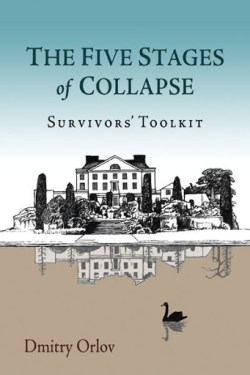
The Five Stages of Collapse: Survivors' Toolkit
By Dmitry Orlov
281 pp. New Society Publishers – May 2013. $19.95.
By Dmitry Orlov
281 pp. New Society Publishers – May 2013. $19.95.
 At some point, those of us who accept the inevitability of a complete societal collapse, driven by resource depletion and rapid climate change, have to wonder what more can be gained by our continued attempts to persuade the masses.
Granted, our efforts do succeed in enlisting a steady trickle of new recruits into the ranks of the “walking worried”—to quote a term used by collapsitarian Julian Darley—but the public at large still dismisses our appeals out of hand. What reason is there to believe that further efforts at spreading the truth will bring different results? More and more, it’s starting to seem like the sensible approach is to get out of the awareness-raising business entirely and focus our energies instead on providing practical guidance to those who are willing to hear it.
This is certainly the view of collapse thinker and writer Dmitry Orlov, whose latest book, The Five Stages of Collapse: Survivors' Toolkit, was released by New Society Publishers in May. As indicated by its subtitle, this much-anticipated offering from one of the best authors on the subject seeks not to convince readers that a collapse is imminent, but to suggest approaches and strategies for managing it when it comes. “[T]his is not a ‘We must...’ book or an ‘Unless we...’ book, or even a ‘We should...’ book," writes Orlov. “There is no agenda here—just the assumption that collapse will happen, the conjecture that it can be analyzed as unfolding in five distinct phases and, based on quite a bit of research, the conclusion that each phase will require a different set of adaptations from those who wish to survive it.”
The idea of a five-stage taxonomy of collapse first suggested itself to Orlov in early 2008. It came to him as he noticed that a number of commentators were aptly using Elisabeth Kübler-Ross' five stages of grief to describe the process of coming to terms with humanity’s ecological predicament. In February of that year, he posted a piece on his blog, ClubOrlov, titled “The Five Stages of Collapse,” which became the germ for the book. In it, he proposed that societies that have been pushed beyond the point of sustainability tend to move through a set sequence of collapse stages. He identified these as financial, commercial, political, social and cultural collapse. And he argued that the United States, with its grave crises related to energy, runaway military spending, foreign debt and a worsening foreign trade deficit, seems poised to bring about its own hasty descent through the five stages.
An émigré from Russia, Orlov had already seen one collapse firsthand. He witnessed the Soviet Union's fall during the early-to-mid 1990s, and in the process accumulated a vast store of wisdom on collapses in general and how best to proceed when caught in one. It didn't take him long after that to see that America was headed for a similar, if more severe, crash of its own. However, he kept his observations to himself for years, sensing that there was not yet enough of a receptive audience. While he bided his time, he settled with his wife in Boston, where he earned a living as an engineer, made his way around by bicycle and, in his spare time, pursued a love of sailing that was more than mere pastime. (Indeed, he would go on to explore the potential of sail as a mode of transporting food and other cargo in a fossil fuel-depleted future.)
Financial collapse, writes Orlov in Five Stages, is invariably the first and most sudden to occur, because finance represents a mere concept rather than tangible wealth. It can be kept up for only as long as growth and the expectation of future growth are maintained, and when these falter, it fails catastrophically. Right now we’re seeing an end to the growth of just about every essential industrial input that has fueled our civilization. The widespread realization that growth is over spells death for global finance, meaning that the nations of the developed world are poised on the brink of financial collapse. (Orlov points out that one country, Greece, is already well past the brink and is mired in financial, commercial and political collapse all at once.) The author sees each of the Western nations headed for a deflationary spiral followed by “a quick but painful bout of hyperinflation thrown in at the very end.”
The next phase, commercial collapse, occurs when a country’s physical flows of consumer products and services become disrupted. The mass bank failures brought about by financial collapse cause international trade to stop, which in turn halts global supply chains. People find themselves facing shortages of basic goods, while manufacturers run short on materials needed for their processes. It doesn’t take long for the global economy to pass “a point of no return,” in Orlov’s words, beyond which recovery is impossible because all the requisite supply networks and trading relationships have been lost. In short, people cease believing in the notion that “the market shall provide.”
As a society passes through the final three phases in the cycle, people progressively lose faith in its remaining institutions. During political collapse, national governments become irrelevant as they prove incapable of providing for their citizens. Local forms of governance spontaneously spring up, often in partnership with organized crime, to fill the void. As for social and cultural collapse, Orlov writes that they’re mostly preventable, and indeed that the Soviet Union managed to stop short of both of them. When they do occur, they’re characterized by a loss of trust in one's fellows and in the goodness of humanity, respectively.
This book includes case studies to illustrate the different collapse stages, each one emphasizing a particular set of skills and attitudes most conducive to survival. Iceland following the financial crisis of 2008 is presented as an exemplar of successful financial crash mitigation. The main lesson to be learned from its experience, writes Orlov vehemently, is “Let The Banks Fail.” As for weathering commercial collapse, Orlov points to the Russian mafia, which, despite its reputation, actually observes a strict ethic of honest dealing and restraint in the use of violence. For his example of successful adaptation to political collapse, Orlov considers an even more uncomfortable case: the Pashtun people of Afghanistan and Pakistan, who accounted for most of the Taliban’s membership. There’s also a fascinating study of gypsies, and how they can thrive in times of social collapse because they’ve mastered the art of conning to the point of a high art.
By far the most disturbing portrait is that of an African tribe called the Ik. Orlov uses their experience to show how humans can endure even after they've been stripped of the very virtues that are assumed to be prerequisites for humanity, such as love and compassion. The Ik were driven off their native land in Uganda 55 years ago when it became a game reserve. The only land left to them was desolate mountainside that was difficult to farm, and the result was chronic famine. Survival didn’t mean merely putting one's own needs above those of others, it meant making oneself a ruthless adversary of everyone else in sight. The Ik were shockingly cruel to one another, and no bonds—not even those between mother and child—were sacred. The anthropologist who first studied the Ik, Colin Turnbull, seemed traumatized by the experience. His book about it, The Mountain People, was deemed by one reviewer to be “a terrifying book, a quick but well-illuminated look under the sewercovers of the human psyche.”*
Orlov views the story of the Ik as a cautionary tale, one that forces us to “confront the uncomfortable notion that survival at all costs may be a fate worse than death.” Regarding the subjects of his other case studies, however, he offers in-depth discussions of how their approaches could be useful to people in today’s doomed industrial societies. Above all, he emphasizes that adapting to the difficult future ahead will require rejecting everything we’ve been schooled and socialized to believe about the world and our place in it. It will also necessitate “learning to be poor,” something that Orlov says takes practice, since people who are suddenly thrust into destitution have neither the skills nor the psychological preparation for a life of subsistence and bartering.
One of the core assumptions that this book challenges is the belief that notional wealth, in the form of paper currency or numbers in a computer, makes one rich. Having witnessed the Soviet Union destroy its currency by hyperinflating away its debts, Orlov knows better. He realizes that real wealth exists within hard assets like the precious metals in jewelry or the lead ballast in a sailboat, which hold their value over time regardless of what happens in the specious realm of finance. Another theme repeatedly visited by Orlov is the importance of family. Orlov shows how the dereliction of family ties by people living in today’s industrial nations is both unhealthy and at odds with the role that families have played throughout most of history. He believes that the societies in which family has been neglected the most will fare the worst in times to come.
It was in December 2006 that Orlov began making a name for himself as a writer on collapse. His breakout article, “Closing the 'Collapse Gap': The USSR was better prepared for collapse than the US,” ran on the energy news site Energy Bulletin (now Resilience) on December 4, and it rapidly became one of the site's all-time most popular posts. His first book, Reinventing Collapse, came two years later. Both the article and the book brimmed with intelligence, worldly experience and a droll, clever wit that has been Orlov’s trademark ever since. Though he still has his day job as an engineer—now in the field of software engineering—Orlov continues to actively blog and speak on collapse. As he recounts in the new book, “[s]topping, beyond a certain point, would have disappointed far too many people.” Well, I think I speak for all his fans when I express my wish that he not stop anytime soon.
* Mary Daniels, "The Ik; a study of The Loveless People," Chicago Tribune, Nov. 5, 1972: M3, http://pqasb.pqarchiver.com/chicagotribune/doc/170334387.html (accessed Oct. 1, 2013).
Labels: collapse, Dmitri Orlov, heinberg
posted by Walter @ 10:02 AM
0 Comments


