Somebody get me a cheeseburger!
That soup was so thin
You could read a magazine through it
-Woody Guthrie
I don't want a pickle
I just want to ride my motorcycle
-Arlo Guthrie
PSA
Next meeting of the Joint Comitte on Carbon Reduction 5/17/2019
350.org publishes reports on "climate recovery without economic hardship"
Greetings
Perhaps you've heard that OAC, and the New Green Deal, want to take away your car and your hamburger. Shocking!
The New York Times. put out a special section on why you should become a vegan, and how to do it.
Speaking of food, Bill McKibben, normally a pretty optimistic guy, suggests that we may accept the reality of climate change where it starts to affect the food supply
'... a 2017 study in Australia, home to some of the world’s highest-tech farming, found that “wheat productivity has flatlined as a direct result of climate change.” After tripling between 1900 and 1990, wheat yields had stagnated since, as temperatures increased a degree and rainfall declined by nearly a third. “The chance of that just being variable climate without the underlying factor [of climate change] is less than one in a hundred billion,” the researchers said, and it meant that despite all the expensive new technology farmers kept introducing, “they have succeeded only in standing still, not in moving forward.” Assuming the same trends continued, yields would actually start to decline inside of two decades, they reported. In June 2018, researchers found that a two-degree Celsius rise in temperature — which, recall, is what the Paris accords are now aiming for — could cut U.S. corn yields by 18 percent. A four-degree increase — which is where our current trajectory will take us — would cut the crop almost in half. The United States is the world’s largest producer of corn, which in turn is the planet’s most widely grown crop.Corn is vulnerable because even a week of high temperatures at the key moment can keep it from fertilizing. (“You only get one chance to pollinate a quadrillion kernels of corn,” the head of a commodity consulting firm explained.) But even the hardiest crops are susceptible. Sorghum, for instance, which is a staple for half a billion humans, is particularly hardy in dry conditions because it has big, fibrous roots that reach far down into the earth. Even it has limits, though, and they are being reached. Thirty years of data from the American Midwest show that heat waves affect the “vapor pressure deficit,” the difference between the water vapor in the sorghum leaf’s interior and that in the surrounding air. Hotter weather means the sorghum releases more moisture into the atmosphere. Warm the planet’s temperature by two degrees Celsius — which is, again, now the world’s goal — and sorghum yields drop 17 percent. Warm it five degrees Celsius (nine degrees Fahrenheit), and yields drop almost 60 percent.It’s hard to imagine a topic duller than sorghum yields. It’s the precise opposite of clickbait. But people have to eat; in the human game, the single most important question is probably “What’s for dinner?” And when the answer is “Not much,” things deteriorate fast. In 2010 a severe heat wave hit Russia, and it wrecked the grain harvest, which led the Kremlin to ban exports. The global price of wheat spiked, and that helped trigger the Arab Spring — Egypt at the time was the largest wheat importer on the planet. That experience set academics and insurers to work gaming out what the next food shock might look like. In 2017 one team imagined a vigorous El Niño, with the attendant floods and droughts — for a season, in their scenario, corn, and soy yields declined by 10 percent, and wheat and rice by 7 percent. The result was chaos: “quadrupled commodity prices, civil unrest, significant negative humanitarian consequences . . . Food riots break out in urban areas across the Middle East, North Africa, and Latin America. The euro weakens and the main European stock markets lose ten percent.”
The New York Times explains how this is already playing out in the US
"Drop a pin anywhere on a map of the United States and you’ll find disruption in the fields. Warmer temperatures are extending growing seasons in some areas and sending a host of new pests into others. Some fields are parched with drought, others so flooded that they swallow tractors.Decades-long patterns of frost, heat and rain — never entirely predictable but once reliable enough — have broken down. In regions where the term climate change still meets with skepticism, some simply call the weather extreme or erratic. But most agree that something unusual is happening.
I find this interesting, and I recall that the original limits to growth predicted that in the end growth would occur when pollution began to limit food.
Food is pretty basic stuff. You might think that would inspire some action. However the recent report from the IEA shows otherwise. Basically, despite all the pledges, investment in renewables has leveled off, while coal has increased. Here is why
"Closer up, we see opposing trends in the world’s largest economies: the efforts and announcements of the majority of countries that are phasing out the use of coal to produce electricity are being undermined by a number of countries that are increasing the share of coal in their power mix.This is the case particularly for major coal-producing countries such as Indonesia (58% of electricity produced from coal, 18 percentage points increase from 2010 to 2017), Turkey (33%, +7 points) and India (75%, +7 points, as shown in Figure 1, above). India is the second largest coal producer in the world after China with significant coal reserves. The development of renewables and the commissioning of more efficient coal-fired power plants in India are not sufficient to absorb the growth in electricity demand, which has averaged 7% per year since 2005.Other countries are seeking to diversify their energy mix and are increasingly using coal to produce their electricity: Malaysia (45%, +10 points), Chile (37%, +9 points), South Korea (46%, +2 points) and Japan (33%, +6 points). These countries rely on coal for several reasons: in addition to often being a cheaper source of electricity, coal limits their dependence on oil- and gas-producing countries, and in turn, limits the effect of hydrocarbon price volatility on their economies. Due to a lack of domestic fossil fuel resources, Japan is one of the largest oil-, natural gas- and coal-importing countries. Between 2011 and 2015, the share of coal in Japanese electricity production increased significantly to cope with the closure of nuclear power plants following the Fukushima disaster.
And the Keeling curve keeps on rising. Now it's last 415. The last time co2 was this high, there were palm trees at the South Pole. Welcome to the Pliocene
Another recent report showed that the last time there was this much CO2 in the atmosphere (412 ppm), in the Pliocene Epoch 5.3 to 2.6 million years ago, sea levels were 20 meters higher than they are right now, trees were growing at the South Pole, and average global temperatures were 3 to 4 degrees Centigrade (3°-4° C) warmer, and even 10°C warmer in some areas. NASA echoed the report’s findings.
Meanwhile, the UN keeps putting out scary reports about extinctions . This one seems to say that even if we turned things around on climate change, we'd still have a lot of work to do to stop the sixth great extinction.
U.N. Report Finds 1 Million Species At Risk of ExtinctionA landmark report finds species are being pushed to the brink of extinction at a rate ‘tens to hundreds of times higher than it has been, on average, over the last 10 million years.’The report found that more than 40% of amphibians, 33% of coral reefs and over one-third of all marine species are threatened with extinction.Three-quarters of land environments and two-thirds of marine environments have been “significantly” altered by humans, according to the report.“Ecosystems, species, wild populations, local varieties and breeds of domesticated plants and animals are shrinking, deteriorating or vanishing. The essential, interconnected web of life on Earth is getting smaller and increasingly frayed,” said Josef Settele, who co-chaired the assessment. “This loss is a direct result of human activity and constitutes a direct threat to human well-being in all regions of the world.”While the report’s findings predict a dismal future, Watson said there is still time to make a difference if work begins now. It would require a “fundamental, system-wide reorganization across technological, economic and social factors, including paradigms, goals, and values,” he said.
"To keep nearly eight billion people fed, not to mention housed, clothed, and hooked on YouTube, humans have transformed most of the earth’s surface. Seventy-five percent of the land is “significantly altered,” the I.P.B.E.S. noted in a summary of its report, which was released last week in Paris. In addition, “66 percent of the ocean area is experiencing increasing cumulative impacts, and over 85 percent of wetlands (area) has been lost.” Approximately half the world’s coral cover is gone. In the past ten years alone, at least seventy-five million acres of “primary or recovering forest” has been destroyed.Habitat destruction and overfishing are, for now, the main causes of biodiversity declines, according to the I.P.B.E.S., but climate change is emerging as a “direct driver” and is “increasingly exacerbating the impact of other drivers.” Its effects, the report notes, “are accelerating.” Watson wrote last week, in the Guardian, that “we cannot solve the threats of human-induced climate change and loss of biodiversity in isolation. We either solve both or we solve neither.”
(With all this bad news Jared Diamond give civilization only a 50 % chance after 2050.)
One might think that the situation is an "existential threat" to the human species . But its worse! . It could wreck the sales of sneakers!
Nike, the sports equipment maker, for instance, has become a sizable player in renewables. Among Nike’s recent deals: an agreement with Iberdrola, a large Spanish utility, to take power from a wind farm being built in Spain that will offset the electricity used in its European operations.
Noel Kinder, chief sustainability officer at Nike, explained that the company saw climate change as not only an “existential threat” to humanity but also a potential wrecker of the company’s sales of goods like shoes and sweatshirts. Focusing the company’s resources to strike a blow against this problem makes sense on many levels. If extreme weather and pollution increases, he explained, “people can’t do sports, and they can’t buy our products
"T
The problem itself is obvious enough: people generally don’t like to sacrifice now in order to avoid some kind of disaster later. The urge that prompts us to eat a cookie even though it will eventually make us fat is the exact same one that prompts fossil-fuel companies to deny global warming even though it will eventually put all their refineries underwater. We call the former “hyperbolic discounting” and the latter “free market capitalism,” but it’s all the same thing.
His suggestion is pretty straightforward. Live simply.
"Let me put this in concrete terms. If you truly believe that climate change will broil the planet in the next 50 years or so, the very least you should do is immediately get rid of your car and adopt a vegan diet. How many of you have done that? How many of you have even considered it? Virtually none of you.² And like I said, that’s just a start. If you’re really serious, you should also toss out your air conditioning; only heat your house if temps are down in the 40s; never travel anywhere by plane; buy local food, and install rooftop solar. I’m going to let you keep your too-big house, but only because I’m a nice guy.
Labels: climate, Elizabeth Kolbert, extinction, Kevin Drum, Nike
posted by Walter @ 2:15 PM
0 Comments

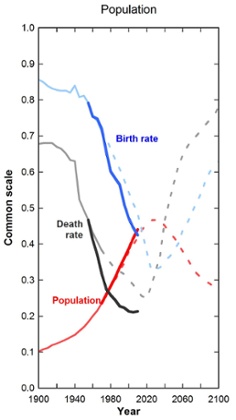 Solid line: MIT, with new research in bold. Dotted line: Limits to Growth ‘business-as-usual’ scenario.
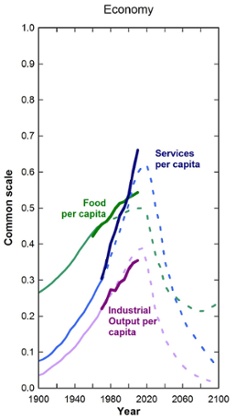 Solid line: MIT, with new research in bold. Dotted line: Limits to Growth ‘business-as-usual’ scenario. Photograph: Supplied
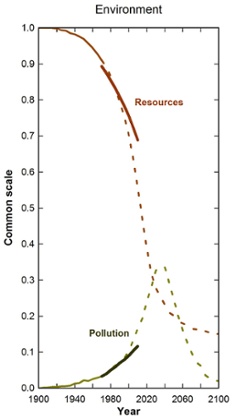 Solid line: MIT, and research in bold. Dotted line: Limits to Growth ‘business-as-usual’ scenario. Photograph: Supplied