Monday, December 10, 2018


Torn between two lovers
Feeling like a fool

     -Mary MacGregor

I know what I want
but I just don't know
how to go about getting it

    -Jimi Hendrix


Public Service Announcement 

Joint Interim Committee on Carbon Reduction meeting December 13


Greetings

Is it just me, or does it seem like things are accelerating?   It's been as busy couple of weeks 


The Washington Post sums it up better than I can

"In October, a top U.N.-backed scientific panel found that nations have barely a decade to take “unprecedented” actions and cut their emissions in half by 2030 to prevent the worst consequences of climate change. The panel’s report found “no documented historic precedent” for the rapid changes to the infrastructure of society that would be needed to hold warming to 1.5 degrees Celsius (2.7 degrees Fahrenheit) above preindustrial levels.
The day after Thanksgiving, the Trump administration released a nearly 1,700-page report co-written by hundreds of scientists finding that climate change is already causing increasing damage to the United States. That was followed by another report detailing the growing gap between the commitments made at earlier U.N. conferences and what is needed to steer the planet off its calamitous path.

Then, we learned that 2018 was a record year for emissions.  from the New York Times


"Worldwide, carbon emissions are expected to increase by 2.7 percent in 2018according to the new research, which was published by the Global Carbon Project, a group of 100 scientists from more than 50 academic and research institutions and one of the few organizations to comprehensively examine global emissions numbers. Emissions rose 1.6 percent last year, the researchers said, ending a three-year plateau

And that temperatures are not rising in as straight line, but are accelerating. from Nature


"Three trends — rising emissions, declining air pollution, and natural climate cycles — will combine over the next 20 years to make climate change faster and more furious than anticipated. In our view, there’s a good chance that we could breach the 1.5 °C level by 2030, not by 2040 as projected in the special report (see ‘Accelerated warming’). The climate-modeling community has not grappled enough with the rapid changes that policymakers care most about, preferring to focus on longer-term trends and equilibria.
Sources: Ref. 1/GISTEMP/IPCC Fifth Assessment Report (2014)


We know we need to have a carbon emissions peak by 2020. Washington Post
Everyone recognized that the national plans, when you add everything up, will take us way beyond 3, potentially 4 degrees Celsius warming," said Johan Rockstrom, the incoming director of the Potsdam Institute for Climate Impact Research.
"We know that we're moving in the wrong direction," Rockstrom told the AP. "We need to bend the global carbon emissions no later than 2020 - in two years' time - to stand a chance to stay under 2 degrees Celsius."
But, currently, it looks like we might not have a carbon emissions peak until 2030.  The UN Gap Report says 
Concerns about the current level of both ambition 
and action are thus amplified compared to 
previous Emissions Gap Reports. According to 
the current policy and NDC scenarios, global 
emissions are not estimated to peak by 2030, let 
alone by 2020

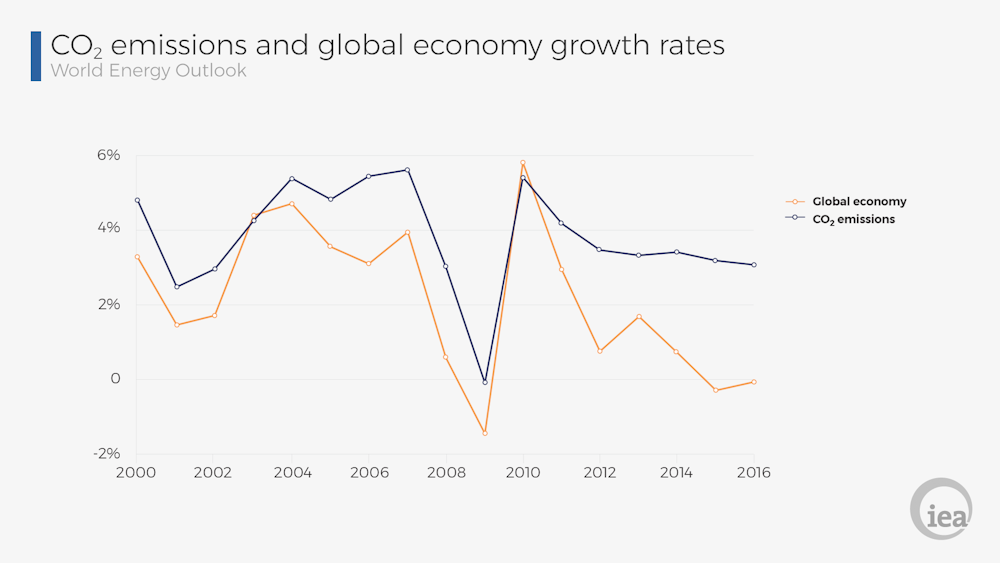
The problem?  The monkey trap.  We can't let go of economic growth. From Resilience  

Economic growth measures the increase in the number of goods and services produced by an economy over time, and it has historically been tightly coupled with CO₂ emissions. Decoupling these two factors is not impossible, and indeed many leading academics argue that the power of human ingenuity will solve the climate crisis. However, this is certainly unlikely in the timescales needed to tackle climate change in a just and equitable way.
So, we now enter a new phase .   Harvard scientists have started experimenting with solar geoengineering. from Vox


And while solar geoengineering helps address the temperature issues related to global warming, that’s hardly the only concern with climate change. As Irfan notes, geoengineering could threaten crop yields by reducing crops’ access to sunlight, and it does not address ocean acidification, a significant environmental threat associated with climate change.
But if the world continues on its current emissions path, we might have to choose, in 2030 or 2040 or 2050, between the (quite bad) option of geoengineering and the (also quite bad) option of enduring and adapting to the effects of large-scale global warming. And the Harvard experiment could help us understand which of those two bad options would be worse.

Labels: , ,

Friday, April 3, 2015

water


There is water flowing under rock
    -Talking heads

Cool clear water
    -Hank Williams


Greetings

   Well the big news is that Gov Brown of California has imposed water saving measures on some California users.   (It's probably worth noting that although 80% of California's water use is for agriculture, but Gov Brown's  measures don't address agricultural use, so its unlikely to have   a big impact  see e.g.  How Ag Gamed Cal's drought)

        Here are some charts which show how bad it is there.  The situation is pretty severe .  Here's what the senior water specialist at NASA, and professor at Caltech said:

"Right now the state has only about one year of water supply left in its reservoirs, and our strategic backup supply, groundwater, is rapidly disappearing. California has no contingency plan for a persistent drought like this one (let alone a 20-plus-year mega-drought), except, apparently, staying in emergency mode and praying for rain."

   California agriculture provides a lot of stuff on our supermarket shelves such as over 90% of almonds, walnuts, broccoli, tomatoes, and strawberries.  Groundwater is the "plan B"  for many farmers, and although, it is widely known that pumping is at an unsustainable rate, groundwater pumping is largely unregulated.  The LA times notes

"The Central Valley aquifer extends for about 400 miles under the Sacramento and San Joaquin valleys. The subterranean water, some of which seeped into the ground 10,000 to 20,000 years ago, is California's biggest reservoir. Yet it has been largely unregulated and unmonitored. Most of the more than 100,000 wells that pierce the valley floor are unmetered and landowners have taken what they wanted."


    Perhaps we should put this in historical context.  Here is an interesting article, analyzing the climate variation over the last 1000 or so years.  I didn't realize that what we consider "norrmal" for California i.e. the 20th century, , is actually an unusually wet period.   The author notes

"Consider what happened in the American West in the early 20th century, when population grew roughly 50% from decade-to-decade, the largest regional growth spurt in post-colonial American history. People were lured by warm temperatures and abundant moisture. For much of that period, believe it or not, the West was a green paradise. Abundant moisture was so much du jour that allocation rights for Colorado River water, which have been contended ever since, were based upon what turns out to be the wettest period in nearly 1200 years. Had early 20th century planners had modern climatological analyses in their hands, it’s doubtful they would have been so profligate with water distribution from what really is the only big river in the Pacific Southwest."
   
For more analysis of the pre historic record, see also Nation Geographic : Could California's Drought last 200 years?, and this paper on the 9th -14th centuries - "medieval climate anomaly".

     We are naturally concerned about the problems here in the US, but we should probably also be aware of similar problems elsewhere.  For instance Sao Paulo, the largest city in South America, is also suffering from a historic drought.   The local reservoir has enough water to last until June.  The rainy season doesn't start until November.   Here is one report from PRI

"The region is in its worst drought in 80 years. The reservoir that supplies half the city is just over 10 percent full. The government has begun rationing water, though haphazardly.
Many people in São Paulo are worried their future may look a lot like what happened last year in the small, nearby city of Itu.

Last August, without warning, the city's homes had their water supplies shut off. Residents had to use public taps, and neighbors fought neighbors as dozens of people swarmed around the faucet. The outage went on for weeks, stretching into September. Itu resident Alexandre Oliveira remembers it as “a water war."
Oliveira volunteered as a water carrier for homebound neighbors, but others charged for the service and became known as “water traffickers.”
Emergency water trucks were eventually called in, but there weren’t enough. When they did arrive, some residents blocked the trucks with flaming barricades to make sure they didn’t leave before every house on the street got water.
But in some low-income neighborhoods, the water trucks never came at all. Elsa Barbosa, who lives in the favela of Chácaras Reunidas Ypê on the edge of Itu, eventually started to use water from a disused old well. “We had to boil it a lot,” she says. “There were stomach aches and vomiting.”
       
How about the future?  Well, according to a recent  UN Report, at current usage rates, the world will have 40% less fresh water than it needs in 15 years.   see .. Why fresh water shortages will cause the next great global crisis   What are some likely consequences?  Check out this site "World Water Conflict" for an in depth look at the history and future of water conflicts around the globe.

Labels: , , , , ,