Tuesday, March 17, 2015

Happy Motoring!


He blew his mind out in  acr
He didn't notice that the light had changed
     -Beatles

Turn and face the strange
 ch- ch- changes
          David Bowie
             

Greetings

    I've been reading an interesting article America, you have three more years to drive normally.   The author notes  

   "Easy driving remains basic to American lifestyle and social identity. For now, Americans are still managing to drive nearly as much as they did a decade ago. But what happens in a few years, when gasoline prices keep going up as wages remain flat, when drivers bid for the same oil needed to heat homes in New England. Who gets the oil and who gets the blame? Will the loss of mainstream driving ability finally create a political tipping point that could lead us to broadly confront and accept natural limits to growth?


The article does a good job of analyzing the geologic and economic situtaion .  Based on that I wonder if perhaps we can break peak oil into three phases..
 
   Phase one (2005-2008) features a steady rise in prices, which brings out more investment, and more oil. 

   Phase two  kicks in when the price gets  higher than the economy can afford. (2008)    It features  price oscillation, and successive recessions.   Since 2008 we've gone through two such cycles - from $147 , to $30, then $100, and now $50. 
 
   Perhaps phase three starts when we hit peak liquids, perhaps now, or perhaps once the shale oil runs out. 2016-2017?   No amount of additional investment brings out any increase in total production.  Prices rise.further and the long recession becomes permanent 

Here's the general idea of phase three from  Tom Whipple.   (See also this Ministry of Defence -(UK)  Report summarized here 


If we step back and acknowledge that the shale oil phenomenon will be over in a couple of years and that oil production is dropping in the rest of the world, then we have to expect that the remainder of the peak oil story will play out shortly. The impact of shrinking global oil production, which has been on hold for nearly a decade, will appear. Prices will go much higher, this time with lowered expectations that more oil will be produced as prices go higher. The great recession, which has never really gone away for most, will return with renewed vigor and all that it implies…
 
All this is telling us that the peak oil crisis we have been watching for the last ten years has not gone away, but is turning out to be a more prolonged event than previous believed. Many do not believe that peak oil is really happening as they read daily of surging oil production and falling oil prices. Rarely do they hear that another shoe has yet to drop and that much worse in terms of oil shortages, higher prices and interrupted economic growth is just ahead. We are sitting in the eye of the peak oil crisis and few recognize it. Five years from now, it should be apparent to all.


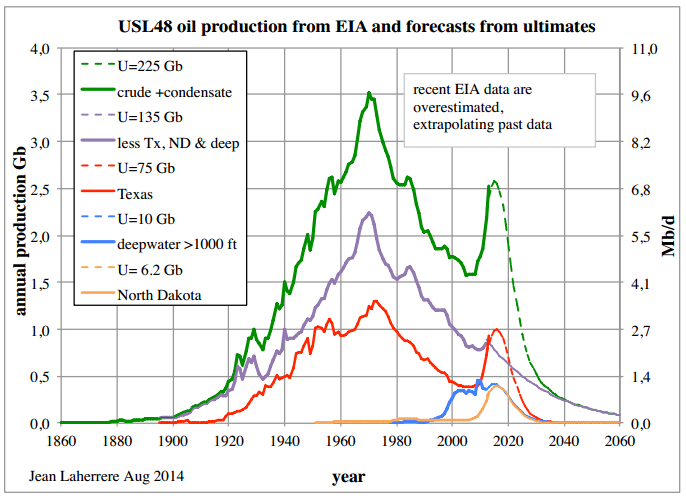
      Once the shale "retirement party" is over, the decline takes over - and the decline rate for fracked wells is extraordinary.  Given that shale is currently 55% of total US production, the decline could be very steep.   Here' s a recent projection from Jean Laherre   
.
 
roger graphic 5
As we see in Figure 4 (above), Laherrere predicts a very rapid drop in tight oil production after 2017, leading also to a fast decline in total oil from the lower 48 states, in contrast to the EIA.


          Michael Klare has a nice piece about big oil's broken business model.   He notes that the the majors had ten years of gradually rising prices, and naturally thought it would continue.  They invested heavily in high cost projects, confident that they would pay off.    But these projects need the price to average $80 to $100.   While we can expect prices spikes to those prices, what about average prices?   Klare notes that 

"... the IEA believes that oil prices will only average about $55 per barrel in 2015 and not reach $73 again until 2020.  Such figures fall far below what would be needed to justify continued investment in and exploitation of tough-oil options like Canadian tar sands, Arctic oil, and many shale projects.  Indeed, the financial press is now full of reports on stalled or cancelled mega-energy projects.  Shell, for example, announced in January that it had abandoned plans for a $6.5 billion petrochemical plant in Qatar, citing “the current economic climate prevailing in the energy industry.”  At the same time, Chevron shelved its plan to drill in the Arctic waters of the Beaufort Sea, while Norway’s Statoil turned its back on drilling in Greenland."


What about the shorter term?   Between now and 2017, we might have time for one more price spike and drop.    When will the next price spike happen?  This depends on how you see supply and demand changing.  Kopits thinks that low prices will spur demand, and that production in both unconventional, and conventional areas (but not OPEC) , will decline rapidly.  Therefore he sees  a spike but this summer.

The Balance
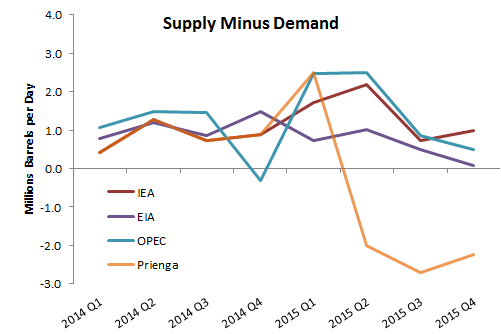
World Oil Supply MINUS DEMAND (All Petroleum Liquids) Source: Respective monthly reports of the agenciesIn the view of the agencies, supply runs ahead of demand for the balance of the year.  On the other hand, if we apply the Lessons of '86, this surplus evaporates around mid-year, setting the stage for major reversal of outlook heading into 2016.  Were this scenario to be realized, the world would be heading into an oil shock in the first half of next year.

Labels: , , ,

Wednesday, February 26, 2014

These are not the droids you're looking for


Businessmen, they drink my wine
Plowmen dig my earth
None of them along the line
Know what any of it is worth
-Bob Dylan

Give me money
That's what I want
-The Beatles


Greetings


      What's it like to be in the oil biz at the end of the oil era?     For a while it was pretty nice.  When the price you get for your product rises from $20 to $100, how bad can it be?   Profits rose, stock value rose.  Investors were happy.  There was plenty of cash for new projects.   Ahhh....

      But that was then.   Now things look a little different.   Now its hard to make a buck.  What happened?

     I just watched an hour long video of Steve Kopits, who is an energy consultant, with Douglas Westwood. Their clients are oil service companies and hedge fund.  They want to know whats next  for oil.   He puts together an interesting picture of the last ten years, which is quite different from the spin we hear from BP and IEA.

       The message we get from the oil companies is pretty straight forward:  "Nothing to see here, move along".   There is no reason to get off oil.   High oil prices are not a problem, they are the solution - the create more supply.  My favorite is " peak demand".   The reason that the US oil consumption dropped, had nothing to do with oil prices.  People just changed their habits, like their hairstyles.  "Its those zany kids with their I phones.  They all moved to the city and are rising around on light rail!"    Or "they don't even like to move around, they just text each other, they move around in cyber space"

       That's a very soothing narrative.  And it means there is no reason to do anything differently.  No reason to invest in mass transit, or improved rail service. The suburbs will be fine.  No reason to expect further economic disruptions.

         Kopits pokes a few holes in that story.  And it is worth watching. One aspect that is interesting is what we used to call  "demand destruction".   Oil use in the US dropped a lot .   The question is,  who is no longer using the oil?  Gas usage  was only down by 4% and diesel was slightly up .  Most of the drop was industrial oil  , and heating oil.  (down 35%)  The fact is, we love our cars!  And we won't give them up, till they pry them from our cold dead hands!    Why?  As, Kopits points out - in this country if you don't drive, you don't work.
   
          So, what happens next?    

       Since conventional oil production peaking in 2005, oil companies have been spending wildly to keep conventional production on a plateau.    But, the cost of the next barrel has been rising steadily.  Unfortunately, the price they can charge has gotten stuck.   Everyone thought it would be about  $150 dollars by now.    But its stuck around $100.     And this is too low!
.
       According to Kopits half of the companies need a price of $120 , and 1/4 need  $130.  But, investors are saying "Show me the money!   Don't invest in money losing projects.  Send us dividends.   Stock buy backs".    Shell had to borrow money to pay dividends.  (!!)   Other companies are selling assets to raise money.

      So, now  comes "capex compression" i. .e  spending less on developing new wells.   Shell investments down 20%, Hess down 30%.     And less investment leads to less production.   At some point conventional production falls off the plateau

     Note that the above discussion relates solely to conventional production.  As we are all aware, unconventional has its own problems.  see e.g.  Chesapeake to sell Oilfield Services?    


'Rapid well declines threaten to spoil that promise. The average flow from a shale gas well drops by about 50 percent to 75 percent in the first year, and up to 78 percent for oil, said Pete Stark, senior research director at IHS Inc.
"The decline rate is a potential show stopper after a while," said Stark, a geologist with almost six decades in the oil patch. "You just can’t keep up with it."
The industry has so far been able to live with the decline curve problem because operators have been able to scratch out better initial production in wells, Stark said. "If you don't have that improvement, then you get stuck after a while and have to drill more and more wells just to stay even," Stark said.

----  

Below a nice summary from Gail Tverberg.


------------------


Beginning of the End? Oil Companies Cut Back on Spending

Steve Kopits recently gave a presentation explaining our current predicament: the cost of oil extraction has been rising rapidly (10.9% per year) but oil prices have been flat. Major oil companies are finding their profits squeezed, and have recently announced plans to sell off part of their assets in order to have funds to pay their dividends. Such an approach is likely to lead to an eventual drop in oil production. I have talked about similar points previously (here and here), but Kopits adds some additional perspectives which he has given me permission to share with my readers. I encourage readers to watch the original hour-long presentation at Columbia University, if they have the time.
Controversy: Does Oil Extraction Depend on “Supply Growth” or “Demand Growth”?
The first section of the presentation is devoted the connection of GDP Growth to Oil Supply Growth vs Oil Demand Growth. I omit a considerable part of this discussion in this write-up.
Economists and oil companies, when making their projections, nearly always make their projections depend on “Demand Growth”–the amount people and businesses want. This demand growth is seen to be rising indefinitely in the future. It has nothing to do with affordability or with whether the potential consumers actually have jobs to purchase the oil products.
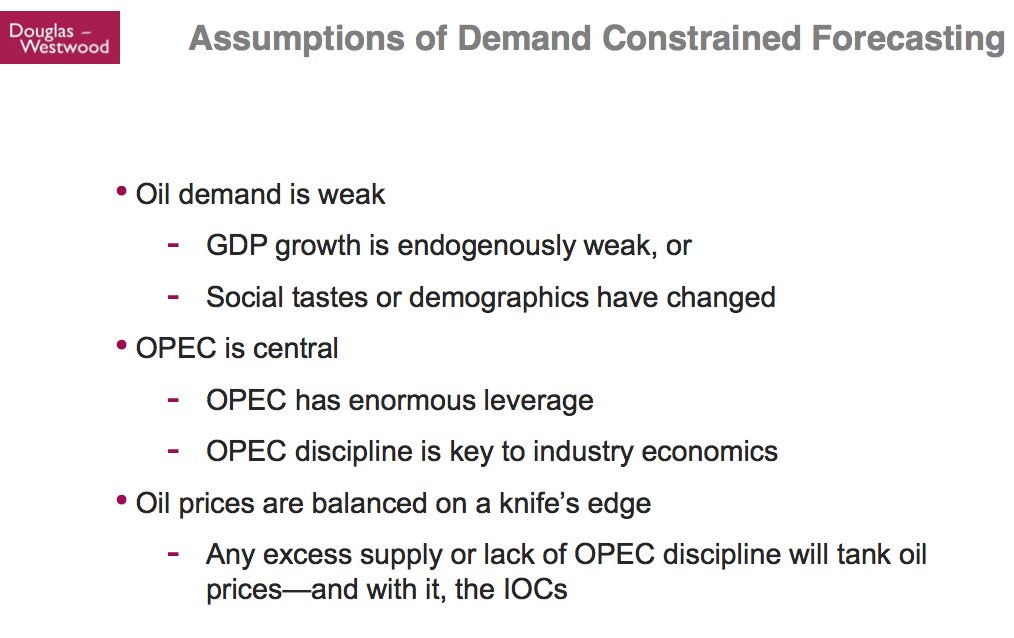
Kopits presents the following list of assumptions of demand constrained forecasting. (IOC’s are “Independent Oil Companies” like Shell and Exxon Mobil, as contrasted with government owned companies that are prevalent among oil exporters.)
Kopits 10 Assumptions of Demand Constrained ForecastingThus, it is the demand constrained view of forecasting that gives rise to the view that OPEC (Organization of Petroleum Exporting Nations) has enormous leverage. The assumption is made that OPEC can add or subtract as much supply as much as it chooses. Kopits provides evidence that in fact the Demand view is no longer applicable today, so this whole story is wrong. 
One piece of evidence that the Demand Model is wrong is the fact that world crude oil (including lease condensate) production has been nearly flat since 2004, in a period when China and other growing Eastern economies have been trying to motorize. In comparison, there was a rise of 2.7% per year, when the West, with a similar population, was trying to motorize.
Kopits 20 Motorization and Oil in Historical Context
Kopits points out that China’s big source of oil supply has been US main street: China bids oil supply away from United States, to satisfy its needs. This is the way that markets have made oil available to China, when world supply is not rising much. It is part of the reason that oil prices have risen.
Another piece of evidence that the Demand Model is wrong relates to the assumption thatsocial tastes have simply changed, leading to a drop in US oil consumption. Kopits shows the following chart, indicating that the major reason that young people don’t have cars is because they don’t have full-time jobs.
Kopits 35 Driving and Employment
Kopits makes a comparison of the role of oil in GDP growth to the role of water in plant growth in the desert. Without oil, there is less GDP growth, just as without water, a desert is starved for the element it needs for plant growth. Lack of oil can considered a binding constraint on GDP growth. (Labor availability might be a constraint, but it wouldn’t be a binding constraint, because there are plenty of unemployed people who might work if demand ramped up.) When more oil is available at a slightly lower price, it is quickly absorbed by markets.
“Supply Growth” is the limiting factor in recent years, because the amount of extraction is rising only slowly due to geological constraints and the number of users has risen to the point that there is a shortage.
Experience of Major Oil Producing Companies
Kopits presents data showing how badly the big, publicly traded oil companies are doing. He looks at two pieces of information:
  • “Capex” – “Capital expenditures” – How much companies are spending on things like exploration, drilling, and making of new offshore oil platforms
  • “Crude oil production” -
A person would normally expect that crude oil production would rise as Capex rises, but Kopits shows that in fact since 2006, Capex has continued to rise, but crude oil production has fallen.
Kopits 40 Oil majors capex and production
The above information is worldwide, not just for the US.  At some point a person might expect companies to start getting frustrated–they are spending more and more, but not getting very far in extracting oil.
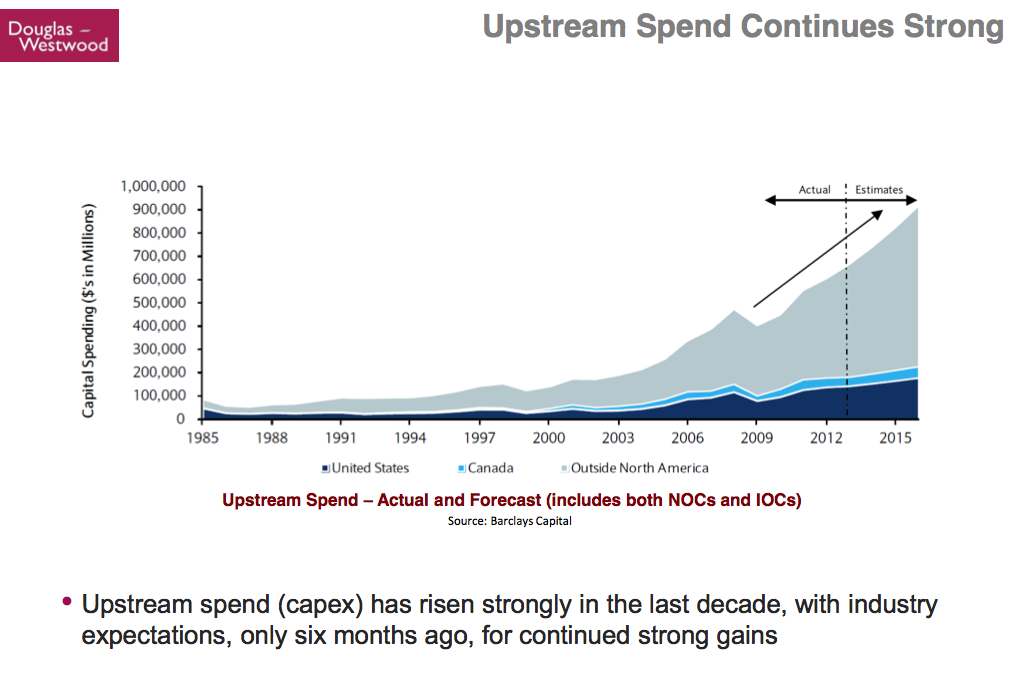
Kopits then shows another version of Capex history plus a forecast. (This time the amounts are labeled “Upstream,” so the expenditures are clearly on the exploration and drilling side, rather than related to refineries or pipelines.)
Kopits 41 Upstream Spend continues Strong
The amounts this time are for the industry as a whole, including “NOCs” which are government owned (national) oil companies as well as IOCs (Independent Oil Companies), both large and small. Kopits remarks that the forecasts shown were made only six months ago. When talking about the above slide Koptis says,
People in the industry thought, “Capex has been going up and up. It will continue to do very well. We have been on this trajectory forever, and we are just going to get more and more money out of this.”
Now why is that? The reason is that in a Demand constrained model for those of you who took economics–price equals marginal cost. Right? So if my costs are going up, the price will also go up. Right? That is a Demand constrained model. So if it costs me more to get oil, it is no big deal, the market will recognize that at some point, in a Demand constrained model.
Not in a Supply constrained model! In a Supply constrained model, the price goes up to a price that is very similar to the monopoly price, after which you really can’t raise it, because that marginal consumer would rather do with less than pay more. They will not recognize [pay] your marginal cost. In that model, you get to a price, and after that price, there is significant resistance from the consumer to moving up off of that price. That is the “Supply Constrained Price.” If your costs continue to come up underneath you, the consumer won’t recognize it.
The rapidly growing Capex forecast is implicitly a Demand constrained forecast. It says, sure Capex can go up to a trillion dollars a year. We can spend a trillion dollars a year looking for oil and gas. The global economy will accept that.
I quote this because I am not sure I have explained the situation exactly that way. I perhaps have said that demand had to be connected to what consumers could afford. Wages don’t magically go up by themselves (even though economists think they can).
According to Koptis, the cost of oil extraction has in recent years been rising at 10.9% per year since 1999. (CAGR means “compound annual growth rate”).
Kopits 43 Costs are Rising Fast
Oil prices have been flat at the same time. On the above chart, “E&P Capex per barrel” is pretty much the same type of expenses as shown on the previous two charts. E&P means Exploration and Production.
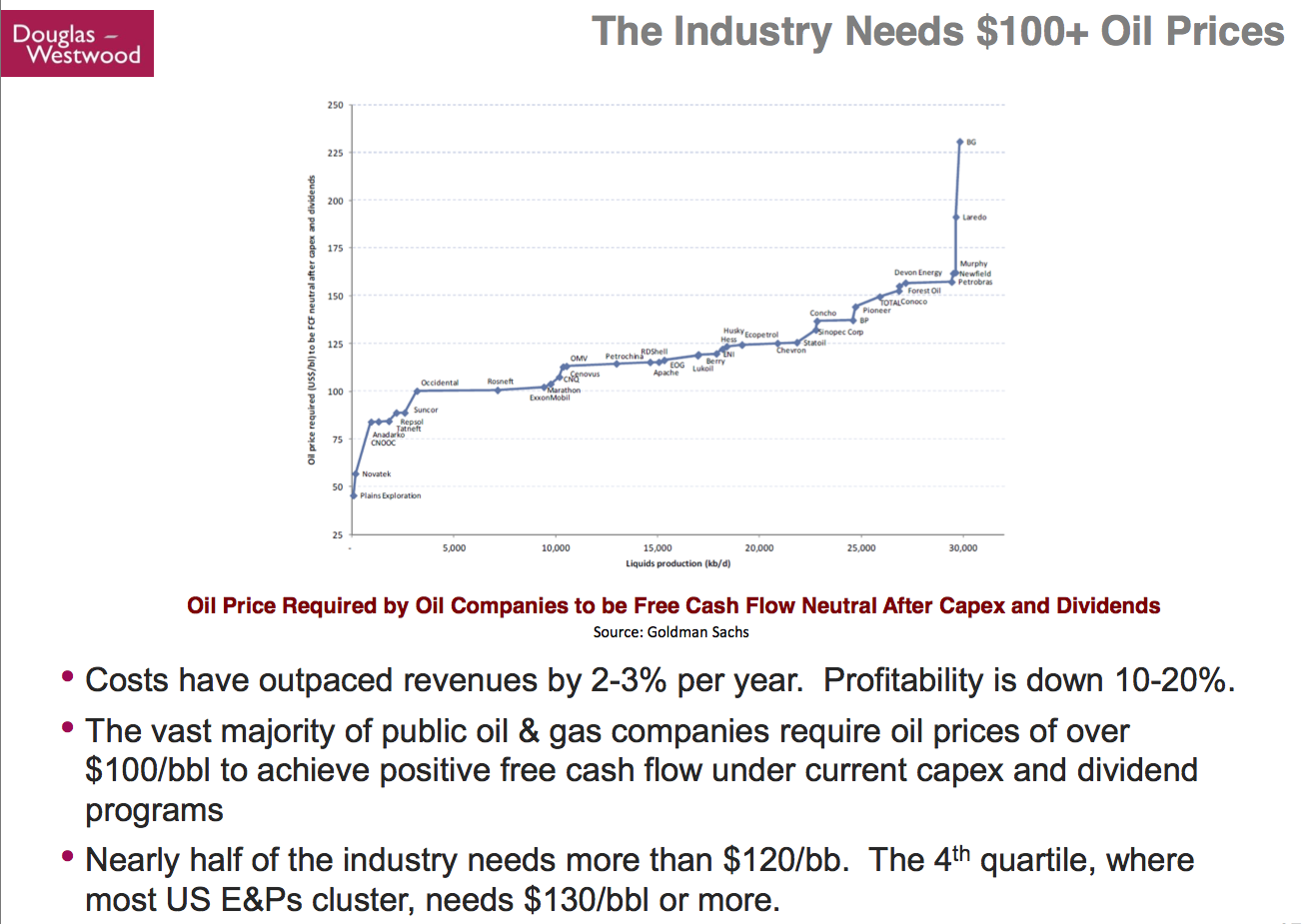
Kopits explains that the industry needs prices of over $100 barrel.
Kopits 45 Industry needs oil prices over 100
The version of the chart I have up is too small to read the names of individual companies.  If you would like a chart with bigger names, you can download the original presentation.
Historically, oil companies have used a discounted cash flow approach to figure out whether over the long term, pricing for a particular field will be profitable. Unfortunately, this “standard” approach has not been working well recently. Expenses have been escalating too rapidly, and there have been too many new drilling sites producing below expectation. What Kopits shows on the above slide is the prices that companies need on different basis–a “cash flow” basis–so that each year companies have enough money to pay today’s capital expenditures, plus today’s expenses, plus today’s dividends.
The reason for using the cash flow approach is because companies have found themselves coming up short: they find that after they have paid capital expenditures and other expenditures such as taxes, they don’t have enough money left to pay dividends, unless they borrow money or sell off assets. Oil companies need to pay dividends because pension plans and other buyers of oil company stocks expect to receive regular dividends in payment for their equity investment. The dividends are important to pension plans.
In the last bullet point on the slide, Kopits is telling us that on this basis, most US oil companies need a price of $130 barrel or more. I noticed that Brazil’s Petrobas needs  a price of over $150 barrel. (OSX, Brazil’s number two oil company, recently went bankrupt.)
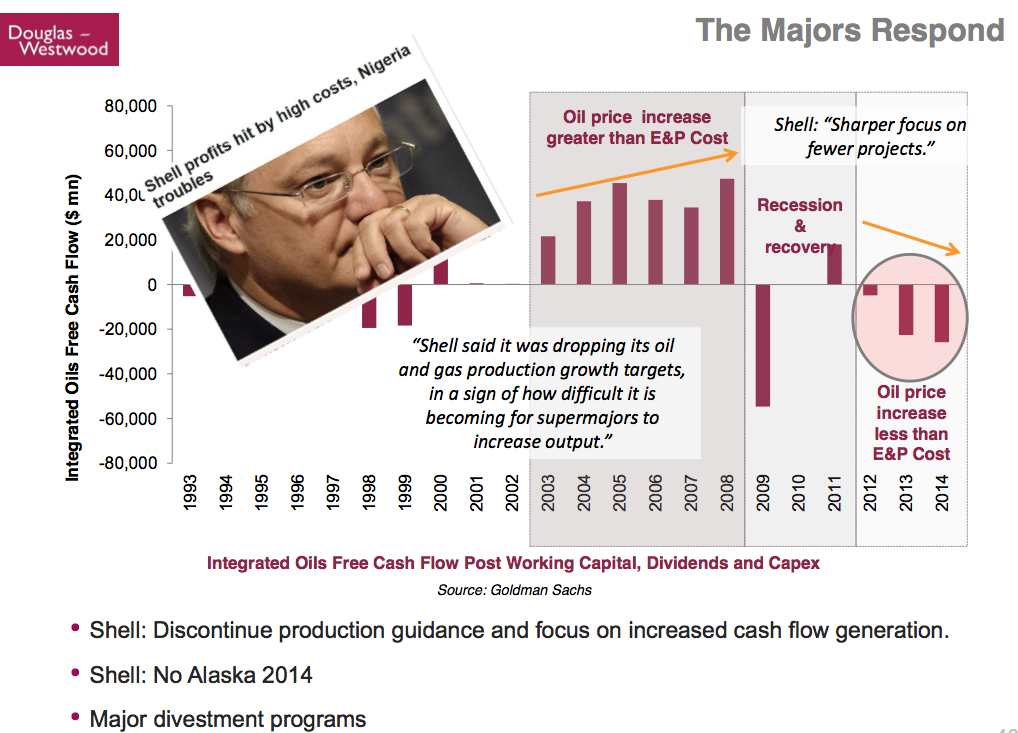
In the slide below, Kopits shows how Shell oil is responding to the poor cash flow situation of the major oil companies, based on recent announcements.
Kopits 46 The Majors Respond
Basically, Shell is cutting back. It no longer is going to tell investors how much it plans to produce in the future. Instead, it will focus on generating cash flow, at least partly by selling off existing programs.
In fact, Kopits reports that all of the major oil companies are reporting divestment programs. Does selling assets really solve the oil companies’ problems? What the oil companies would really like to do is raise their prices, but they can’t do that, because they don’t set prices, the market does–and the prices aren’t high enough. And the oil companies really can’t cut costs. So instead, they sell assets to pay dividends, or perhaps just to get out of the business. But is this sustainable?
Kopits 48 conventional oil production
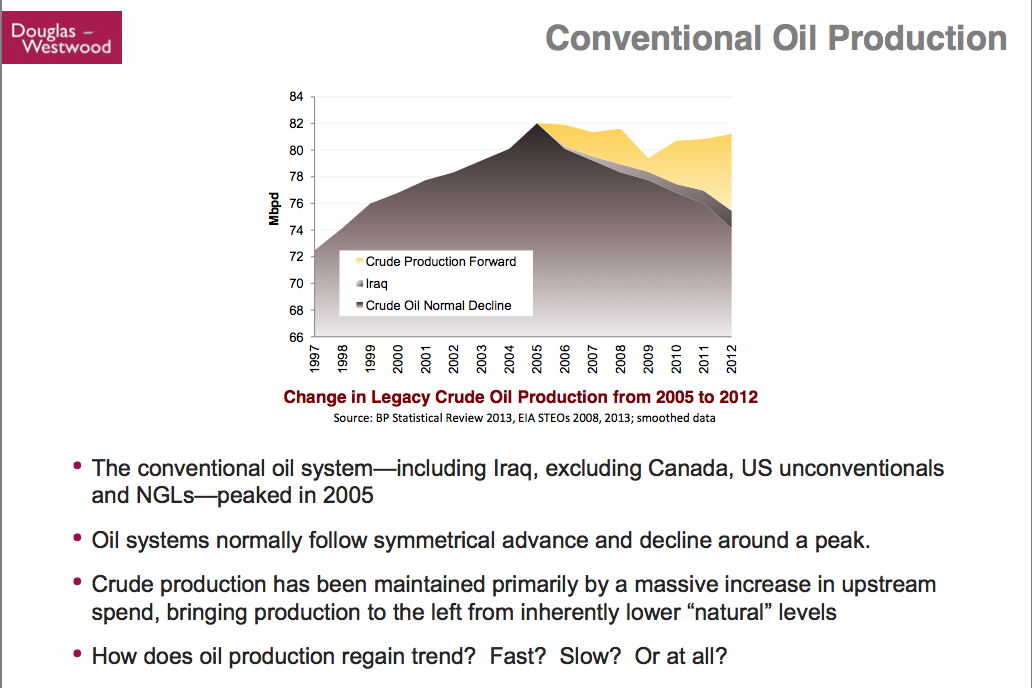
The above slide shows that conventional oil production peaked in 2005. The top line is total conventional oil  production (calculated as world oil production, less natural gas liquids, and less US shale and other unconventional, and less Canadian oil sands). To get his estimate of “Crude Oil Normal Decline,” Kopits uses the mirror image of the rise in conventional oil production prior to 2005. He also shows a separate item for the rise in oil production from Iraq since 2005. The yellow portion called “crude production forward” is then the top line, less the other two items. It has taken $2.5 trillion to add this new yellow block. Now this strategy has run its course (based on the bad results companies are reporting from recent drilling), so what will oil companies do now?
Kopits 49 -Oil Majors Cut Capital Expenditures
Above, Kopits shows evidence that many companies in recent months have been cutting back budgets. These are big reductions–billions and billions of dollars.
Kopits 50 Majors Capex
On the above chart, Kopits tries to estimate the shape of the downslope in capital expenditures. This chart isn’t for all companies. It excludes the smaller companies, and it excludes the National oil companies, so it is about one-third of the market. The gray horizontal line at the top is the industry consensus back in October. The other lines represent more recent estimates of how Capex is declining. The steepest decline is the forecast based on Hess’s announcement. The next steepest (the dotted gray line) is the forecast based on Shell’s cutback.  The cutback for the part of the market not shown in the chart is likely to be different.
Oil and Economic Growth
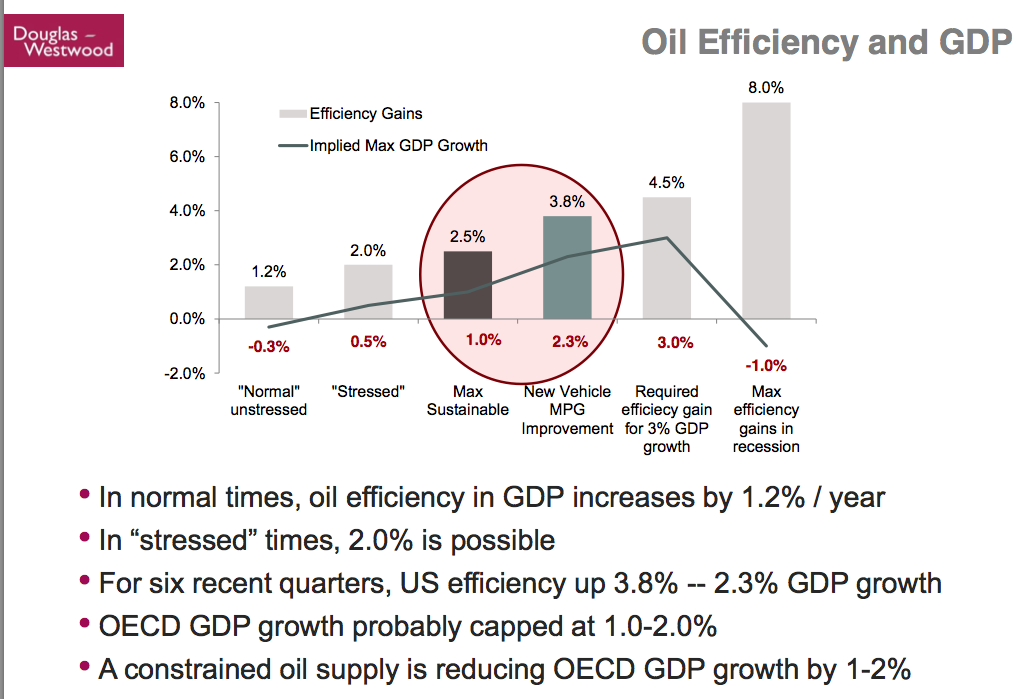
Kopits offers his view of how much efficiency can be gained in a given year, in the slide below:
Koptis 54 Oil Efficiency and GDP GrowthIn his view, the maximum sustainable increase in efficiency is 2.5% in non-recessions, but a more normal increase is 1% per year. At current oil supply growth levels, OECD GDP growth is capped at 1% to 2%. The effect of constrained oil supply is reducing OECD GDP growth by 1% to 2%.
Conclusions
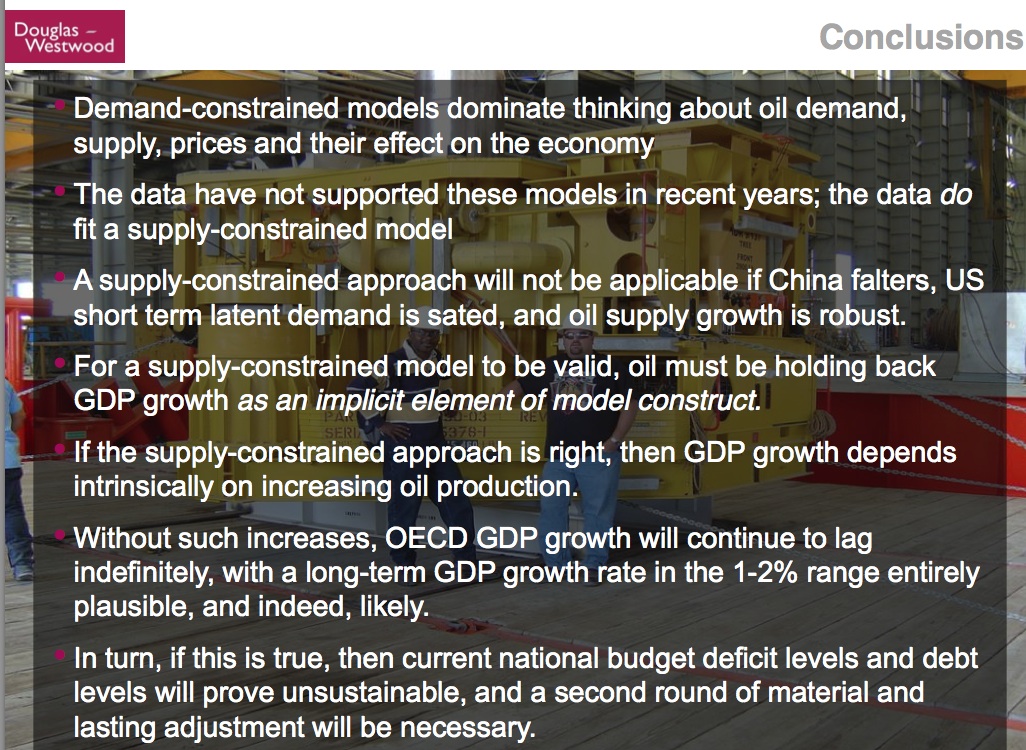
Kopits 59 ConclusionsWhile demand constrained models dominate thinking, in fact, a supply constrained model is more appropriate in recent years.
We seem to be short of oil. Whenever there is extra oil on the market, it is quickly soaked up. Oil prices have not collapsed. No one is nervous about a price collapse.
China recently has been putting little price pressure on the market–its demand is recently less high. Kopits thinks China will eventually return to the market, and put price pressure on oil prices. Thus, oil price pressures are likely to return at some point.
Gail’s Observations
An obvious point, which I thought I heard when I listened to the presentation the first time, but didn’t hear the second time is, “Who will buy all of these assets on the market, and at what price?” China would seem to be a likely buyer, if one is to be found. But when several companies want to sell assets at the same time, a person wonders what prices will be available.
The new strategy is, in effect, maintaining dividends by returning part of capital. It is clearly not a very sustainable strategy.
It will take a while for these cut-backs in Capex expenditures to find their way through to oil output, but it could very well start in a year or two. This is disturbing.
What we are seeing now is a cutback in what companies consider “economically extractable oil”–something that isn’t exactly reported by companies. I expect that what is being sold off is mostly not “proven reserves.”
In this talk, it looks like lack of sufficient investment is poised to bring the system down.  That is basically the expected limit under Limits to Growth.
In theory, if an expansion of China’s oil demand does bring oil prices up again, it could in theory encourage an increase in drilling activity. But it is doubtful that economies could withstand the high prices–they are already having problems at current price levels, considering the continued need for Quantitative Easing to keep interest rates low.
A recent news item was titled, G20 Finance Ministers Agree to Lift Global Growth Target. According to that article,
Mr Hockey said reaching the goal would require increasing investment but that it could create “tens of millions of new jobs”.
The cutback in investment by oil companies is working precisely in the wrong direction. If these cutbacks act to cut future oil extraction, it will bring down growth further.

Labels: , , ,

Tuesday, September 17, 2013

Dude, Where's my car?


I'm on a highway to hell
-AC/DC

This is not my beautiful car
-Talking Heads

Greetings 

         The fun thing  (?) about peak oil is that every few years the frame changes.  You have to look at it in a different way.  This is because things change all the time - as different feed backs come into play.

      Hubbert and Campbel were focused on crude - so that was something look at - but then along came unconventional oil, natural gas liquids, and bio fuels.  they muddied the waters.     

     Meanwhile while everyone was arguing about "peak production" trying to put a label on "oil" and pick a date  - look out behind you!     Take a look at price!  Holy moly   Its gone up 10 times!    So much that even fracking pays off!  

     So,  now, production is inching along, and price seems to have stabilized - are we in the clear?   Time to re-frame.    Take a look at affordability.     

     Because what really matters is not the oil production numbers, and not even the price ,  but can we afford to buy the stuff?      If we can't - for whatever reasons, it doesn't matter if there huge pools of the stuff, or even what the price is.  All prices are relative - to the ability to pay.  What matter is whether oil is "cheap" or not. .   

    So, is oil still cheap?   No

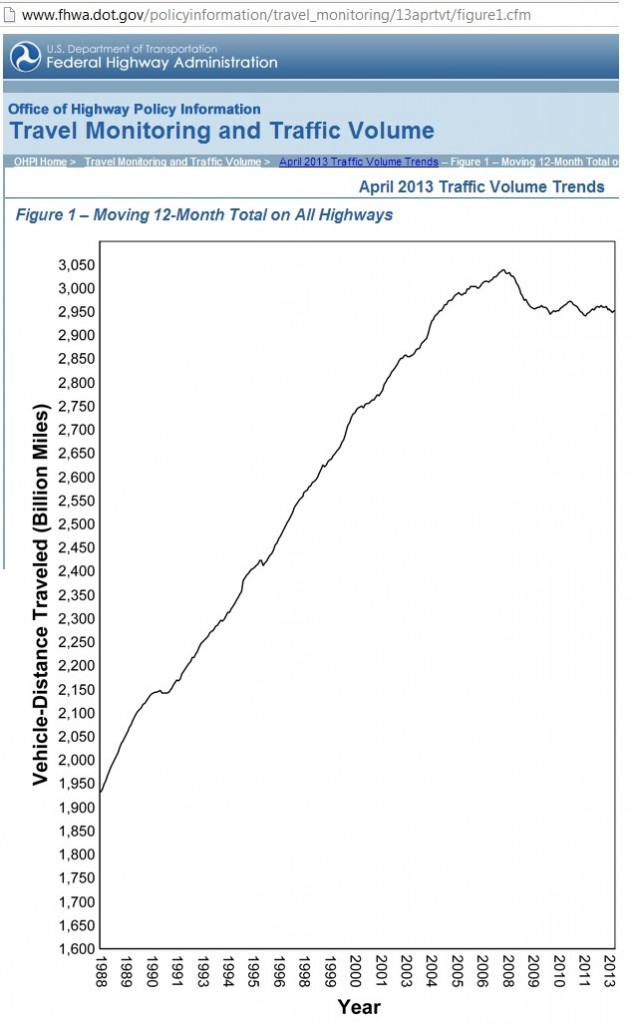
       A quick look at the VMT (vehicle mile driven) numbers tells the story.    When oil is cheap - people drive more.  If its expensive they don't.

     The picture says it all.    Peak affordability


      So here's yet another way to say it:

"Peak oil does not occur when we run out of oil.  Peak oil occurs when the marginal consumer is no longer willing to pay the cost of extracting and processing the marginal barrel of oil.  "  Steven Kopits of Douglas Westwood (more below)

    Now we all know that Federal Reserve is striving mighty to urn things around.     But can printing money make oil cheaper?  Well it can't make it cost less, but arguably if you made people richer, oil would be more affordable.    I wonder how much it would take?     We've only tried a few trillion.   How's it working?

      I think you know the answer: see here

"Back in 2007, median household income was $55,438. That's declined to $51,404 in February 2013. Those numbers are pretax and adjusted for inflation and seasonal factors."

median income

             
        Oil will continue to be  "un-affordable" to the marginal consumer until, either the price comes down, or the consumer's income rises.


      What are the prospects?   Well, judging by their willingness to invest, the oil companies don't seem to optimistic.  They are beginning to recognize that there is no profit in going after high cost projects, if the they can't raise prices.   And that the price is unlikely to rise,  because  the marginal consumer is dropping  out of the market. Kopits again


       "What we’re seeing is that the majors are looking at these high-cost projects, and they are beginning to take a more critical eye. This is very much in line with what our model says, which is that oil prices can’t rise much faster than GDP and inflation, plus or minus. And in fact geological costs, as you come down the back side of Hubbert’s peak, will increase and will do so at an accelerating rate. I think we are beginning to see that process now.

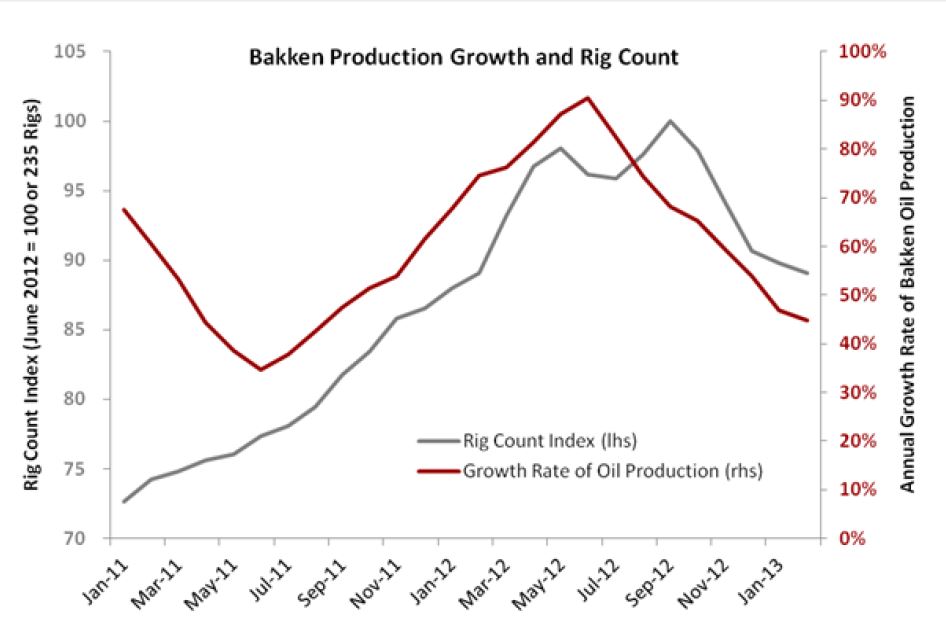
Even when we look at the “good-news” shale / tight oil, some investment is slowing. In the Bakken, for example, the rig count actually peaked in September of 2012, and the year-over-year production growth rate peaked at 90% three months earlier in June. Today the growth rate, while still impressive, is down to about 40%. If that trend continues, we could see single-digit growth in the Bakken much sooner than most think.

So how does this play out?    At some point we still hit "peak oil" - its not so much a "geological" event, but a point at which it just doesn't make economic sense to pay the costs of expensive oil.  

Q: So the shale oils won’t be the ever-growing cavalry that everyone expects them to be?
Kopits: If you take the plain vanilla interpretation of this, unless the shales start picking up rapidly from non-exploited plays—not the Permian and the Eagle Ford and the Bakken, but places like the Utica and Monterey, where results have been disappointing, or some other plays or even abroad—you are looking at a world in which the marginal consumer is beginning to reject the marginal barrel. And if you run this out for a period of time, you will peak out the oil supply. I think the peak occurs in a finite time frame—not 2030, not 2020. Maybe 2014 or 2016—I’m not exactly sure, but sometime pretty soon, unless shale oil really takes off in new plays.
Q: So the story line getting a ton of ink of late—peak oil is dead….it isn’t actually quite dead yet?
Kopits: No. But importantly, we’re going to peak out production not because we’re “running out of oil,” but because the marginal consumer is not willing to pay for the marginal barrel. We seem to be pretty much at that level today.


=====

Commentary: Interview with Steve Kopits

by Steve Andrews, originally published by ASPO-USA  | APR 30, 2013
Q: You’re dialed in right now on the issue of compression of capital expenditures—or capex compression—in the oil industry. Can you give us a quick definition of what that is?
Kopits: Capex compression is a term we use to describe the reduction of upstream spending by the oil companies when their exploration and production costs are rising faster than their oil revenues. That’s what’s happening today. Hess is divesting oil producing properties to increase profits; BP has shelved the deepwater Mad Dog Phase 2 project in the Gulf of Mexico. This is occurring because oil prices haven’t been increasing, and costs have. So oil companies are looking at their portfolio of projects and deciding to postpone or cancel some of them. Were the oil supply rising quickly and oil prices falling, this sort of capital restraint would be normal—the usual boom-bust cycle of the industry. But oil is still in short supply, and very few of the large oil companies have been able to hold oil production over the last few years—even as they were investing massively in oil exploration and production. Now, they are actually reducing investment in upstream projects, even in the face of historically high oil prices and falling production. That’s capex compression.
Q: And here I thought investments in exploration and development were still on their way up. What’s changed?
Kopits: In aggregate, upstream spend is still rising, but at a decreasing pace.
If we look at the issue more broadly though, there are some things happening in the oil business that are beginning to validate views that we, and analysts like Chris SkrebowKopits:ski, have held regarding economic peak oil.
Peak oil does not occur when we run out of oil. Peak oil occurs when the marginal consumer is no longer willing to pay the cost of extracting and processing the marginal barrel of oil. And we can actually calculate what the related numbers are.
Q: How do we do that?
Kopits: To begin with, we refer to the price a nation’s oil consumers are willing to pay as its “carrying capacity.” For the US, carrying capacity is about $95-100 Brent [per-barrel oil price in London]. If the oil price is above this level, oil consumption will decline—which is exactly what we see and what we predicted four years ago. But carrying capacity is not a static number. It changes over time, specifically, with three things: GDP growth, efficiency gains in the use of oil, and dollar inflation. So if GDP goes up, efficiency goes up and the CPI goes up, then the amount that consumers are willing to pay for oil will increase. For China, by the way, we estimate the carrying capacity at around $115-120 / barrel Brent. So oil consumption will increase in China at $115 Brent, but fall in the advanced economies—exactly the pattern we’ve seen in the last few years.
On the supply side, the global oil supply and related costs are determined primarily by two factors: geology and technology. Geology is driving costs by forcing us to frontier areas like ultra deepwater and the Arctic. Technology, on the other hand, is allowing us to access new resources like shale gas and shale / tight oil. So, for any given oil price, depletion will always drive us to more difficult geologies and thus higher costs. Technology, on the other hand, can move us back to easier geologies and lower costs. Hydrofracking of shale oil and gas wells, for example, has done just that.
Also, if you are so inclined, you can add above-ground constraints—Saudi policy or Venezuelan policy or Alaskan tax and royalty rates, for example. But assuming these latter factors are relatively constant, geology and technology will determine supply for any given oil price.
So, to sum all this up: we hit peak production when the marginal consumer is no longer willing to buy the marginal barrel.
Q: I think I’ve read in your work elsewhere that you believe the consumer is already there.
Kopits: The marginal consumer banged into the price of the marginal barrel, on a static basis, somewhere in 2011 at about $110-115 Brent. And then, oil prices essentially stopped rising. Those of us who use supply-constrained forecasting weren’t surprised. It’s entirely consistent with the historical record. But I think many in the oil business still thought, somehow, that oil prices would continue to rise as they had done in the 2000s. After all, the oil supply is widely acknowledged as constrained, even by those who are not necessarily believers in peak oil. So why wouldn’t prices continue to rise if we’re supply short? Well, because there was a price at which the marginal global consumer would rather reduce oil consumption than pay more. And that price is around $110-115 Brent, and from here on in, we should expect that number to rise only with the purchasing power of the marginal consumer.
On the other hand, the cost of extraction development has continued to increase. Last year costs increased somewhere between 10% and 13%, depending on who you talk to. Exxon’s costs rose about 7% in excess of its increase in revenues, which were also falling. And Petrobras’ costs were rising 10% to 13% faster than its revenues. So what we can see is that in the contest between technology and geology, in recent times geology has been winning. Oil has become more expensive to extract.
Q: But when costs increase to a certain level, production should fall; yet we haven’t seen that.
Kopits: In fact, oil production is falling at most the of the oil majors. It was even down at 2% at Petrobras last year. But on a global scale, you’re right. Oil production hasn’t fallen—for three reasons. First, much of what passes for increased “oil” production is actually natural gas production. This includes natural gas liquids from “wet” natural gas wells; LNG [liquefied natural gas] from gas wells; and gas-to-liquids diesel made from natural gas. That’s about half of global oil supply growth in the last six years right there. Check out any investor presentation from the majors. LNG features prominently.
Second, we started throwing massive amounts of upstream spend into this business. Upstream expenditures essentially went from $250 billion around 2005 to about $650 billion this year. In essence, by really jacking up how much money we were putting into the system, we were able to increase production…a little bit. To that we can add some changes in above-ground constraints, primarily in Iraq, which is a very important part of supply growth.
Finally, we made some important technological advances with hydrofracking technology. US tight oil production and Canadian oil sands growth represent just about 100% of net oil supply growth in the last two years.
But leaving these aside, the system hit a wall in 2005—Ken Deffeyes was really spot on with his prediction—and the way we maintained and only slightly grew production after that was essentially by throwing money at it.
This was facilitated by dramatic oil prices jumps, from $25 in 2002 to $112 in 2012. But since 2011, depending on rapidly rising oil prices is no longer a viable strategy. The global economy has said, “this is how much we’ll pay and no more.” At the same time, geology just kept marching along right down the back half of Hubbert’s peak, and costs have continued to rise.
That’s where we are today: price resistance from the consumer and E and P costs that just continue rising. Despite the very high oil price environment, the upstream financial performance at most of the oil majors, including Exxon and Petrobras, has deteriorated. True, Petrobras’ performance is distorted by government interference, but Exxon is arguably the most disciplined investor in the world. But both of them face deteriorating upstream performance for oil.
Q: Given that emerging reality, how are these companies responding?
Kopits: Well, if you look at their capex plans then you see that Shell, BP, Total, Exxon and Hess are all cutting their upstream spend in their 2013-2017 plans going forward. Only Chevron is raising theirs, and only modestly. So in a world where we are struggling to increase global oil supply and the price itself remains high, the major oil companies are in fact beginning to carve back on their exploration and production investments. It’s capex compression.
Q: Why are they going that route?
Kopits: It’s because they’re not getting the bang for their buck. Their megaprojects—ultra deepwater and LNG—are often not able to hold the line on costs. The growing hit-list here includes Australia’s Browse, a $45 billion LNG project that was just cancelled. It includes the Arctic, specifically Alaska, where Shell is sitting out the coming season, in part because they ran their drilling rig aground. But Statoil has said they won’t proceed in Alaska until Shell has shown some progress. ConocoPhillips has just cancelled a jack-up rig order that was intended for the Alaskan market. Total pulled out of Canadian oil sands at a loss. Then we see just last week that BP pulled the plug on Mad Dog Phase 2, which would have been one of the major developments in the Gulf of Mexico—a $10 billion megaproject—and that cancellation was a surprise.
What we’re seeing is that the majors are looking at these high-cost projects, and they are beginning to take a more critical eye. This is very much in line with what our model says, which is that oil prices can’t rise much faster than GDP and inflation, plus or minus. And in fact geological costs, as you come down the back side of Hubbert’s peak, will increase and will do so at an accelerating rate. I think we are beginning to see that process now.
Even when we look at the “good-news” shale / tight oil, some investment is slowing. In the Bakken, for example, the rig count actually peaked in September of 2012, and the year-over-year production growth rate peaked at 90% three months earlier in June. Today the growth rate, while still impressive, is down to about 40%. If that trend continues, we could see single-digit growth in the Bakken much sooner than most think.
Q: So the shale oils won’t be the ever-growing cavalry that everyone expects them to be?
Kopits: If you take the plain vanilla interpretation of this, unless the shales start picking up rapidly from non-exploited plays—not the Permian and the Eagle Ford and the Bakken, but places like the Utica and Monterey, where results have been disappointing, or some other plays or even abroad—you are looking at a world in which the marginal consumer is beginning to reject the marginal barrel. And if you run this out for a period of time, you will peak out the oil supply. I think the peak occurs in a finite time frame—not 2030, not 2020. Maybe 2014 or 2016—I’m not exactly sure, but sometime pretty soon, unless shale oil really takes off in new plays.
Q: So the story line getting a ton of ink of late—peak oil is dead….it isn’t actually quite dead yet?
Kopits: No. But importantly, we’re going to peak out production not because we’re “running out of oil,” but because the marginal consumer is not willing to pay for the marginal barrel. We seem to be pretty much at that level today.
We need to understand these dynamics better. What are the combined effects of flat oil prices and rising production costs, that’s where I think the challenge is and where our professional work is focusing on the macro side…to better understand what these trends are, what they mean, and how companies in the industry should respond to it.
I’ll give you an example. Normally, if you look at an oil production system, it tends to be symmetrical around the peak. The rate at which you approach the peak is the rate at which you depart from the peak. We haven’t done that. What we’ve done is that we’ve approached the peak and we’ve leveled out production, the so-called “undulating plateau”. But we’ve maintained that plateau by turning to non-oil liquids, by dramatic increases in upstream spend, and also by technological innovation related to hydrofracking. All of these, as of today, look to be running their course. Even shale oil. Yes, it will grow for the next few years from the three majors plays in the US, but the peak of production growth is already behind us in the Bakken, for example. On current trends, Bakken production will be increasing by single digits within two years. Not a tragedy by any means, but not enough to move the global oil supply at that time, either.
Of course, we have one more arrow in the quiver after that: government take. Governments typically take 60-90% of revenues of oil production. There’s nothing wrong with that, as in most cases the oil belongs to the respective government. But if the cost of production is increasing, then the value of reserves is falling. Put another way, current levels of government take, whether production or profit sharing, royalties, lease payments or taxes of any sort, are likely unsustainable. Oil companies will need tax relief in one form or another. Far from being able to raise taxes on oil companies, the sober reality is that governments are going to have to get used to getting less. Expect this theme to come front and center in the next couple of years. If government take is reduced quickly, then oil production levels could be sustained for a few more years.
But what then? What’s the outlook for oil production globally? Will production at the high cost producers just ease off gently, or will global production rejoin the anticipated trend line from a 2005 peak sharply and quickly? Will the major oil companies invest just a bit less, or do they start culling their new project list aggressively and without material replacement?
I don’t know what the answer to that is. But that’s what we’re trying to find out. That’s the focus of our macro thinking today.
Steven, thanks for your time and your thoughts.
Steven Kopits has been Managing Director for the New York office of energy business advisors Douglas-Westwood since 2008. He is solely responsible for the views expressed.
Labels: , , ,