Tuesday, August 20, 2013

Egypt as a window into to the near future - a post peak Gulf


Greetings


 Here's  a pretty good article from the Atlantic showing some of the underlying factors in the current Egyptian unrest .  (and the future unrest in other MENA states)    It seems that people will put up with a military government for a long time, as long as food is cheap.  !!   ( And the experts have put a number on it - 210) 

  "According to the New England Complex Systems Institute, if food prices go over a threshold of 210 on the FAO Food Price Index, the probability of civil unrest is greatly magnified."

    Of course, governments can assure cheap food by subsidizing prices.  As long as they can afford it.  It helps to have a reliable source of revenue.  Like, for instance ,  the export of oil.

    But, a country can only export oil as long as production remains above domestic consumption.

"Since 2010, oil consumption--currently at 755,000 bpd--has outpaced production. It is no coincidence that the following year, Hosni Mubarak was toppled."

NB: For a quick review of the MENA net export situation here is a glance from Robert Hirsch's blog

---

Underlying growing instability is the Egyptian state's increasing inability to contain the devastating social impacts of interconnected energy, water and food crises over the last few decades. Those crises, already afflicting other regional states like Yemen and Syria, will unravel prevailing political orders with devastating consequences--unless urgent structural transformation to address those crises becomes a priority. The upshot is that Egypt's meltdown represents the culmination of long-standing trends that, without a change of course, can only escalate with permanent repercussions across the Middle East and North Africa (MENA), and beyond.
A major turning point for Egypt arrived in 1996, when Egypt's domestic oil production peaked at about 935,000 barrels per day (bpd), dropping since then to about 720,000 bpd in 2012. Yet Egypt's domestic oil consumption has increased steadily over the past decade by about 3 percent a year. Since 2010, oil consumption--currently at 755,000 bpd--has outpaced production. It is no coincidence that the following year, Hosni Mubarak was toppled.

.....

The impact on Egypt's state revenues has been dramatic. Energy subsidies amount to $15 billion a year, about a quarter of the entire budget, driven largely by expanding consumption needs for a growing domestic population. Over the last decade, Egypt's gas use has almost doubled, nearly matching production, further limiting the country's exporting capacity and, thus, hard currency revenues , reserves of which have more than halved in two years. Around another $3 billion a year goes to food. In total, 10 percent of its GDP is spent on subsidies.
With state revenues declining, how had Egypt sustained levels of growth of around 7 percent in the two years preceding the 2008 global banking crisis--even winning praise from the World Bank, which described the government as a "top reformer"?
The answer is simple: Egypt had financed increasing expenditures through one core mechanism: borrowing. Over the last decade, government debt has averaged about 85.5 percent of GDP. In 2011, Egypt registered a balance of payments deficit of $18.3 billion . The situation has become unsustainable as the state is increasingly unable to service myriad debts, has desperately attempted to identify viable sources of new oil and gas imports, but cannot muster the capital to secure them.

----

As energy accounts for over a third of the costs of grain production (pdf), high food prices are generally underpinned by high oil prices. Since 2005, world oil production has remained on an undulating plateau that has kept prices high, contributing to surging global food prices. According to the New England Complex Systems Institute, if food prices go over a threshold of 210 on the FAO Food Price Index, the probability of civil unrest is greatly magnified.

Global wheat prices doubled (pdf) from $157/metric tonnes ($173/ton) in June 2010 to $326/metric tonne ($359/ton) in February 201 (the same month Mubarak fell) while half the population was dependent on food rations. That year, the FAO Index averaged about 228, the highest since FAO started measuring international food prices in 1990. The second highest average occurred in 2008--the same year Egypt experienced violent clashes over government-subsidized bread in different cities, leading to 15 people being killed and 300 arrests.
Since then, the index has hovered consistently above 210, and in May 2013 before Tahrir Square was flooded by millions of Egyptians, it was at 213. Although currently at 205, the Worldwatch Institute warns that food prices willtrend higher and be more volatile in coming years and decades. This is consistent with the last decade, over which the World Bank global food price index has increased 104.5 percent, at an average annual rate of 6.5 percent.
fao
Perhaps the biggest driver of rocketing food prices in 2011, however, was the unprecedented impact of climate change in the world's major food basket regions, pushing up global cereal prices to record levels.
Droughts and heat-waves in the U.S., Russia, and China since 2010 led to a sharp drop in wheat yields, on which Egypt is heavily dependent.
That same year, Egypt's water shortages sparked tens of thousands of people to take to the streets in different parts of the country, primarily farmers protesting the growing inability to irrigate their farms--making tens of thousands of hectares of farmland impossible to cultivate. Egyptians in the 1960s enjoyed a water share per capita of 2,800 cubic meters (98,881 cubic feet) for all purposes. The current share has dropped to 660 cubic meters (23,307 cubic feet)--well below the international standard defining water poverty at 1,000 cubic meters (35,314 cubic feet).

-----

But another major worry is oil production. New evidence suggests that the Gulf powers face the prospect of imminent production peaks. Leaked State Department cables show that the US government privately believes that Saudi Arabia's oil reserves may have been overstated by as much as 300 billion barrels--nearly 40 percent. By around 2020, Saudi Arabia will be unable to increase production , confronting instead a future of decline--indeed, its oil exports have already begun falling as it increasingly uses up production for domestic needs.
That in turn would mean a catastrophic loss of state revenues, not just for Saudi Arabia, but for the other Gulf powers which have much smaller reserves. The post-peak Gulf would not only usher in a world of extreme energy volatility--oil prices remain closely tied to production from the region--it would render these kingdoms highly vulnerable to the converging crises already at play in countries like Egypt, Syria and Yemen.
The implication is stark. If business-as-usual continues, Egypt today is very much a window into a near-future that would make dystopian science fiction look like high fantasy.

Labels: , , , ,

Tuesday, April 30, 2013

Peak Oil is so last year


Greetings


           The "peak oil is dead "meme, is growing like wildfire.  There is a big article in the Atlantic, provocatively entitled "What if we never run out of oil?"     The article is mainly about methane hydrates, and how recent Japanese efforts to harvest them mark the beginning of a new era..  Kurt Cobb does an excellent job of dealing with that claim, as well as other  "high stock , but low flow" resources - like tar sands,  deep water oil and  Arctic oil,  in his piece. The only true metric of energy abundance: the rate of flow

Withe respect to tight oil and gas, he notes:

"Charles Mann, the author of the piece, has missed the two most crucial points about the future supply of oil and natural gas. First, new unconventional sources of these hydrocarbons are more difficult and costly to extract than conventional ones. In addition, the unconventional well flows exhibit very steep declines in their rate of production--so steep that in the tight oil fields of Texas and North Dakota drillers must replace about 40 percent of their production PER YEAR just to maintain current output. The decline rates for shale gas are no more encouraging: 79 to 95 percent after three years according to a comprehensive survey of 65,000 oil and gas wells in 31 shale plays. Shale natural gas and tight oil drillers face a task similar to climbing up a down escalator. Each must replace enormous fractions of their current production frequently just to keep production flat. A path to persistently rising global production of oil and gas far into the future cannot be built on production from such fields.


. .  Then  I  saw a piece in the New York Times Sunday, dealing with the perils of  US energy Independence  !  Amazing stuff.    The author accepts, without analysis   the premise that the US will 

    "..overtake Saudi Arabia as the world's largest oil producer as early as 2017, start exporting more oil and gas than it exports by 2025, and achieve full energy self-sufficiency by 2030....oil could fall to just $50 a barrel within the next two years."    (Interestingly the net version of this story omits some of these claims) 

            
To which I can only reply :  "GIGO!"
But Chris Nelder offers a more serious response, in an interview in in the Washington Post, noting in part :

In 2005, we reached 73 million barrels per day. Then, to increase production beyond that, the world had to double spending on oil production. In 2012, we’re now spending $600 billion. The price of oil has tripled. And yet, for all that additional expenditure, we’ve only raised production 3 percent to 75 million barrels per day [since 2005].


.......
 Mature OPEC fields are now declining at 5 to 6 percent per year, and non-OPEC fields are declining at 8 to 9 percent per year. Unconventional oil can’t compensate for that decline rate for very long.

......

And we’re replacing it with tight oil wells in the U.S. that decline 40 percent in the first year, where the production cost is over $70 per barrel. Or deepwater wells, which deplete at 20 percent per year. Or tar sands, which is expensive. Anticipated production growth for tar sands has consistently failed to meet expectations, year after year after year. Ten years ago, tar sands production today was expected to be twice what it actually is.

These are just low-quality oil resources, and we’re relying on them to compensate for the decline in cheap, high-quality stuff.
But, let's face it, peak oil isn't the issue.  The issue is the price of oil.  If peak oil had no effect on price, who would care? 

      But we do care about price.  Over the past 10 years the price of oil has doubled twice.  In the last 5 years oil usage in the US has dropped by 5%.  Mainly because (some of us)  can't afford the price.  That's peak affordable oil.

   Here's an interview with Steve Kopits of Douglas Westwood.   He has an interesting interpretation of what has happened since 2000, and what is likely in the future   

  A round 2000., it became clear that supply was not growing as fast as demand, and the price rose.  A rising price justified further investment by the oil companies into more and more expensive alternatives - deep oil, tar sands etc.   It was all good.   But then the price stopped rising.   Consumers rebelled.  Kopits notes: 


 "But since 2011, depending on rapidly rising oil prices is no longer a viable strategy. The global economy has said, “this is how much we’ll pay and no more.” At the same time, geology just kept marching along right down the back half of Hubbert’s peak, and costs have continued to rise   

The price  stopped rising because people and businesses couldn't pay it.  It's called "demand destruction"   Kopits calls the number that triggers demand destruction, a country's "carrying capacity" .  When the price goes above that-  people just drop out of the market.  Oil use drops.    That number is lower in the US than it is in China, so the US uses less, while use in China continues to grow.  Until the price hits  China's  carrying capacity".
   

"To begin with, we refer to the price a nation’s oil consumers are willing to pay as its “carrying capacity.” For the US, carrying capacity is about $95-100 Brent [per-barrel oil price in London]. If the oil price is above this level, oil consumption will decline—which is exactly what we see and what we predicted four years ago. ..... For China, by the way, we estimate the carrying capacity at around $115-120 / barrel Brent. So oil consumption will increase in China at $115 Brent, but fall in the advanced economies—exactly the pattern we’ve seen in the last few years.


Here's the interesting part.  The price stopped rising, but costs did not.  The cost of producing the marginal barrel continues to climb.  But,   how will the oil companies recover their costs, if the consumer  can't afford it?   Will the oil company continue to invest in this high cost oil?  Evidently not.

"Well, if you look at their capex plans then you see that Shell, BP, Total, Exxon and Hess are all cutting their upstream spend in their 2013-2017 plans going forward. Only Chevron is raising theirs, and only modestly. So in a world where we are struggling to increase global oil supply and the price itself remains high, the major oil companies are in fact beginning to carve back on their exploration and production investments. It’s capex compression."

...
"The growing hit-list here includes Australia’s Browse, a $45 billion LNG project that was just cancelled. It includes the Arctic, specifically Alaska, where Shell is sitting out the coming season, in part because they ran their drilling rig aground. But Statoil has said they won’t proceed in Alaska until Shell has shown some progress. ConocoPhillips has just cancelled a jack-up rig order that was intended for the Alaskan market. Total pulled out of Canadian oil sands at a loss. Then we see just last week that BP pulled the plug on Mad Dog Phase 2, which would have been one of the major developments in the Gulf of Mexico—a $10 billion megaproject—and that cancellation was a surprise.
What we’re seeing is that the majors are looking at these high-cost projects, and they are beginning to take a more critical eye. This is very much in line with what our model says, which is that oil prices can’t rise much faster than GDP and inflation, plus or minus. And in fact geological costs, as you come down the back side of Hubbert’s peak, will increase and will do so at an accelerating rate. I think we are beginning to see that process now.

So how's it play out in future?

"If you take the plain vanilla interpretation of this, unless the shales start picking up rapidly from non-exploited plays—not the Permian and the Eagle Ford and the Bakken, but places like the Utica and Monterey, where results have been disappointing, or some other plays or even abroad—you are looking at a world in which the marginal consumer is beginning to reject the marginal barrel. And if you run this out for a period of time, you will peak out the oil supply. I think the peak occurs in a finite time frame—not 2030, not 2020. Maybe 2014 or 2016—I’m not exactly sure, but sometime pretty soon, unless shale oil really takes off in new plays.

...
"..we’re going to peak out production not because we’re “running out of oil,” but because the marginal consumer is not willing to pay for the marginal barrel. We seem to be pretty much at that level today.


------

Commentary: Interview with Steve Kopits

by Steve Andrews, originally published by ASPO-USA  | TODAY
Q: You’re dialed in right now on the issue of compression of capital expenditures—or capex compression—in the oil industry. Can you give us a quick definition of what that is?
Kopits: Capex compression is a term we use to describe the reduction of upstream spending by the oil companies when their exploration and production costs are rising faster than their oil revenues. That’s what’s happening today. Hess is divesting oil producing properties to increase profits; BP has shelved the deepwater Mad Dog Phase 2 project in the Gulf of Mexico. This is occurring because oil prices haven’t been increasing, and costs have. So oil companies are looking at their portfolio of projects and deciding to postpone or cancel some of them. Were the oil supply rising quickly and oil prices falling, this sort of capital restraint would be normal—the usual boom-bust cycle of the industry. But oil is still in short supply, and very few of the large oil companies have been able to hold oil production over the last few years—even as they were investing massively in oil exploration and production. Now, they are actually reducing investment in upstream projects, even in the face of historically high oil prices and falling production. That’s capex compression.
Q: And here I thought investments in exploration and development were still on their way up. What’s changed?
Kopits: In aggregate, upstream spend is still rising, but at a decreasing pace.
If we look at the issue more broadly though, there are some things happening in the oil business that are beginning to validate views that we, and analysts like Chris SkrebowKopits:ski, have held regarding economic peak oil.
Peak oil does not occur when we run out of oil. Peak oil occurs when the marginal consumer is no longer willing to pay the cost of extracting and processing the marginal barrel of oil. And we can actually calculate what the related numbers are.
Q: How do we do that?
Kopits: To begin with, we refer to the price a nation’s oil consumers are willing to pay as its “carrying capacity.” For the US, carrying capacity is about $95-100 Brent [per-barrel oil price in London]. If the oil price is above this level, oil consumption will decline—which is exactly what we see and what we predicted four years ago. But carrying capacity is not a static number. It changes over time, specifically, with three things: GDP growth, efficiency gains in the use of oil, and dollar inflation. So if GDP goes up, efficiency goes up and the CPI goes up, then the amount that consumers are willing to pay for oil will increase. For China, by the way, we estimate the carrying capacity at around $115-120 / barrel Brent. So oil consumption will increase in China at $115 Brent, but fall in the advanced economies—exactly the pattern we’ve seen in the last few years.
On the supply side, the global oil supply and related costs are determined primarily by two factors: geology and technology. Geology is driving costs by forcing us to frontier areas like ultra deepwater and the Arctic. Technology, on the other hand, is allowing us to access new resources like shale gas and shale / tight oil. So, for any given oil price, depletion will always drive us to more difficult geologies and thus higher costs. Technology, on the other hand, can move us back to easier geologies and lower costs. Hydrofracking of shale oil and gas wells, for example, has done just that.
Also, if you are so inclined, you can add above-ground constraints—Saudi policy or Venezuelan policy or Alaskan tax and royalty rates, for example. But assuming these latter factors are relatively constant, geology and technology will determine supply for any given oil price.
So, to sum all this up: we hit peak production when the marginal consumer is no longer willing to buy the marginal barrel.
Q: I think I’ve read in your work elsewhere that you believe the consumer is already there.
Kopits: The marginal consumer banged into the price of the marginal barrel, on a static basis, somewhere in 2011 at about $110-115 Brent. And then, oil prices essentially stopped rising. Those of us who use supply-constrained forecasting weren’t surprised. It’s entirely consistent with the historical record. But I think many in the oil business still thought, somehow, that oil prices would continue to rise as they had done in the 2000s. After all, the oil supply is widely acknowledged as constrained, even by those who are not necessarily believers in peak oil. So why wouldn’t prices continue to rise if we’re supply short? Well, because there was a price at which the marginal global consumer would rather reduce oil consumption than pay more. And that price is around $110-115 Brent, and from here on in, we should expect that number to rise only with the purchasing power of the marginal consumer.
On the other hand, the cost of extraction development has continued to increase. Last year costs increased somewhere between 10% and 13%, depending on who you talk to. Exxon’s costs rose about 7% in excess of its increase in revenues, which were also falling. And Petrobras’ costs were rising 10% to 13% faster than its revenues. So what we can see is that in the contest between technology and geology, in recent times geology has been winning. Oil has become more expensive to extract.
Q: But when costs increase to a certain level, production should fall; yet we haven’t seen that.
Kopits: In fact, oil production is falling at most the of the oil majors. It was even down at 2% at Petrobras last year. But on a global scale, you’re right. Oil production hasn’t fallen—for three reasons. First, much of what passes for increased “oil” production is actually natural gas production. This includes natural gas liquids from “wet” natural gas wells; LNG [liquefied natural gas] from gas wells; and gas-to-liquids diesel made from natural gas. That’s about half of global oil supply growth in the last six years right there. Check out any investor presentation from the majors. LNG features prominently.
Second, we started throwing massive amounts of upstream spend into this business. Upstream expenditures essentially went from $250 billion around 2005 to about $650 billion this year. In essence, by really jacking up how much money we were putting into the system, we were able to increase production…a little bit. To that we can add some changes in above-ground constraints, primarily in Iraq, which is a very important part of supply growth.
Finally, we made some important technological advances with hydrofracking technology. US tight oil production and Canadian oil sands growth represent just about 100% of net oil supply growth in the last two years.
But leaving these aside, the system hit a wall in 2005—Ken Deffeyes was really spot on with his prediction—and the way we maintained and only slightly grew production after that was essentially by throwing money at it.
This was facilitated by dramatic oil prices jumps, from $25 in 2002 to $112 in 2012. But since 2011, depending on rapidly rising oil prices is no longer a viable strategy. The global economy has said, “this is how much we’ll pay and no more.” At the same time, geology just kept marching along right down the back half of Hubbert’s peak, and costs have continued to rise.
That’s where we are today: price resistance from the consumer and E and P costs that just continue rising. Despite the very high oil price environment, the upstream financial performance at most of the oil majors, including Exxon and Petrobras, has deteriorated. True, Petrobras’ performance is distorted by government interference, but Exxon is arguably the most disciplined investor in the world. But both of them face deteriorating upstream performance for oil.
Q: Given that emerging reality, how are these companies responding?
Kopits: Well, if you look at their capex plans then you see that Shell, BP, Total, Exxon and Hess are all cutting their upstream spend in their 2013-2017 plans going forward. Only Chevron is raising theirs, and only modestly. So in a world where we are struggling to increase global oil supply and the price itself remains high, the major oil companies are in fact beginning to carve back on their exploration and production investments. It’s capex compression.
Q: Why are they going that route?
Kopits: It’s because they’re not getting the bang for their buck. Their megaprojects—ultra deepwater and LNG—are often not able to hold the line on costs. The growing hit-list here includes Australia’s Browse, a $45 billion LNG project that was just cancelled. It includes the Arctic, specifically Alaska, where Shell is sitting out the coming season, in part because they ran their drilling rig aground. But Statoil has said they won’t proceed in Alaska until Shell has shown some progress. ConocoPhillips has just cancelled a jack-up rig order that was intended for the Alaskan market. Total pulled out of Canadian oil sands at a loss. Then we see just last week that BP pulled the plug on Mad Dog Phase 2, which would have been one of the major developments in the Gulf of Mexico—a $10 billion megaproject—and that cancellation was a surprise.
What we’re seeing is that the majors are looking at these high-cost projects, and they are beginning to take a more critical eye. This is very much in line with what our model says, which is that oil prices can’t rise much faster than GDP and inflation, plus or minus. And in fact geological costs, as you come down the back side of Hubbert’s peak, will increase and will do so at an accelerating rate. I think we are beginning to see that process now.
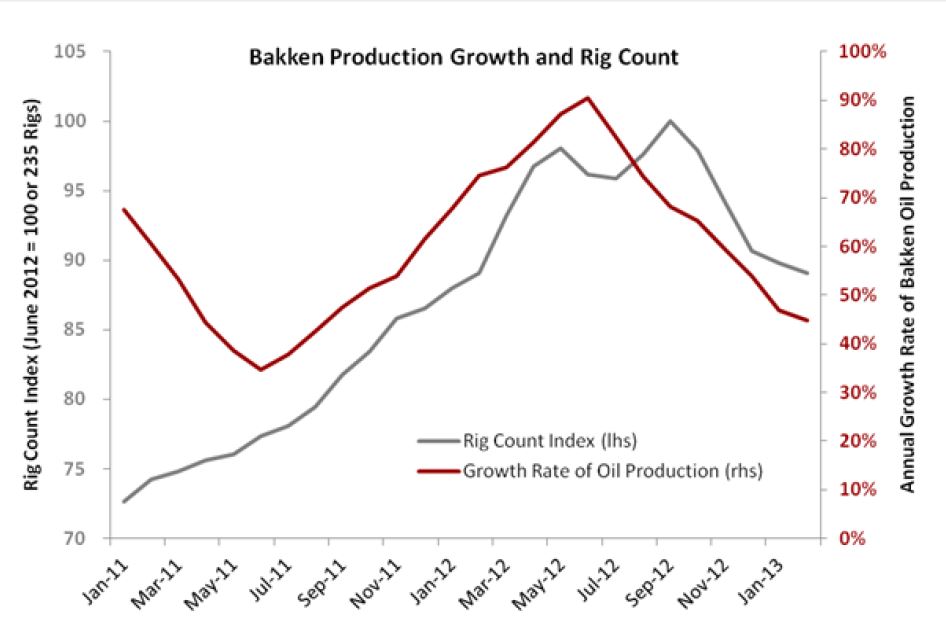
Even when we look at the “good-news” shale / tight oil, some investment is slowing. In the Bakken, for example, the rig count actually peaked in September of 2012, and the year-over-year production growth rate peaked at 90% three months earlier in June. Today the growth rate, while still impressive, is down to about 40%. If that trend continues, we could see single-digit growth in the Bakken much sooner than most think.
Q: So the shale oils won’t be the ever-growing cavalry that everyone expects them to be?
Kopits: If you take the plain vanilla interpretation of this, unless the shales start picking up rapidly from non-exploited plays—not the Permian and the Eagle Ford and the Bakken, but places like the Utica and Monterey, where results have been disappointing, or some other plays or even abroad—you are looking at a world in which the marginal consumer is beginning to reject the marginal barrel. And if you run this out for a period of time, you will peak out the oil supply. I think the peak occurs in a finite time frame—not 2030, not 2020. Maybe 2014 or 2016—I’m not exactly sure, but sometime pretty soon, unless shale oil really takes off in new plays.
Q: So the story line getting a ton of ink of late—peak oil is dead….it isn’t actually quite dead yet?
Kopits: No. But importantly, we’re going to peak out production not because we’re “running out of oil,” but because the marginal consumer is not willing to pay for the marginal barrel. We seem to be pretty much at that level today.
We need to understand these dynamics better. What are the combined effects of flat oil prices and rising production costs, that’s where I think the challenge is and where our professional work is focusing on the macro side…to better understand what these trends are, what they mean, and how companies in the industry should respond to it.
I’ll give you an example. Normally, if you look at an oil production system, it tends to be symmetrical around the peak. The rate at which you approach the peak is the rate at which you depart from the peak. We haven’t done that. What we’ve done is that we’ve approached the peak and we’ve leveled out production, the so-called “undulating plateau”. But we’ve maintained that plateau by turning to non-oil liquids, by dramatic increases in upstream spend, and also by technological innovation related to hydrofracking. All of these, as of today, look to be running their course. Even shale oil. Yes, it will grow for the next few years from the three majors plays in the US, but the peak of production growth is already behind us in the Bakken, for example. On current trends, Bakken production will be increasing by single digits within two years. Not a tragedy by any means, but not enough to move the global oil supply at that time, either.
Of course, we have one more arrow in the quiver after that: government take. Governments typically take 60-90% of revenues of oil production. There’s nothing wrong with that, as in most cases the oil belongs to the respective government. But if the cost of production is increasing, then the value of reserves is falling. Put another way, current levels of government take, whether production or profit sharing, royalties, lease payments or taxes of any sort, are likely unsustainable. Oil companies will need tax relief in one form or another. Far from being able to raise taxes on oil companies, the sober reality is that governments are going to have to get used to getting less. Expect this theme to come front and center in the next couple of years. If government take is reduced quickly, then oil production levels could be sustained for a few more years.
But what then? What’s the outlook for oil production globally? Will production at the high cost producers just ease off gently, or will global production rejoin the anticipated trend line from a 2005 peak sharply and quickly? Will the major oil companies invest just a bit less, or do they start culling their new project list aggressively and without material replacement?
I don’t know what the answer to that is. But that’s what we’re trying to find out. That’s the focus of our macro thinking today.
Steven, thanks for your time and your thoughts.
Steven Kopits has been Managing Director for the New York office of energy business advisors Douglas-Westwood since 2008. He is solely responsible for the views expressed.

Labels: , , , , , , , , ,