Wednesday, August 3, 2016


They didn't see the stop sign
took a turn for the worse
  -The Eagles (Life in the Fats Lane)
Don't you think you'd better stop?
Well maybe
    -Pearl Jam  (All Those Yesterdays)
Greetings
       Here's hoping you are having a "resilient"  summer.  Hopefully you've had a chance "put up" some of your bounty.  Hard to believe, but it's time to start planting those fall crops.    And maybe finish chopping that firewood.  Yikes!   The days are getting shorter! 
      Richard Heinberg has a nice succinct analysis of our current situation in his latest piece "You Can't Handle the Truth".   Where he provides a nice sketch of the truth we'd rather avoid looking at.

"But here’s the real deal: a few generations ago we started using fossil fuels for energy; the result was an explosion of production and consumption, which (as a byproduct) enabled enormous and rapid increase in human population. Burning all that coal, oil, and natural gas made a few people very rich and enabled a lot more people to enjoy middle-class lifestyles. But it also polluted air, water, and soil, and released so much carbon dioxide that the planet’s climate is now going haywire. Due to large-scale industrial agriculture, topsoil is disappearing at a rate of 25 billion tons a year; at the same time, expanded population and land use is driving thousands, maybe millions of species of plants and animals to extinction.
 We extracted non-renewable fossil fuels using the low-hanging fruit principle, so that just about all the affordable petroleum (which is the basis for nearly all transport) has already been found and most of has already been burned. Since we can’t afford most of the oil that’s left (either in terms of the required financial investment or the energy required to extract and refine it), the petroleum industry is in the process of going bankrupt. There are alternative energy sources, but transitioning to them will require not just building an enormous number of wind turbines and solar panels, but replacing most of the world’s energy-using infrastructure.
 We have overshot human population levels that are supportable long-term. Yet we have come to rely on continual expansion of population and consumption in order to generate economic growth—which we see as the solution to all problems. Our medicine is our poison.

And most recently, as a way of keeping the party roaring, we have run up history’s biggest debt bubble—and we doubled down on it in response to the 2008 global financial crisis.
       Its no secret that climate -wise,   the chickens are coming home to roost. See e.g. Scorching global temps astound climate scientists; 1000 year flood in Maryland;  Alaska highway melting    Anthrax spewing zombie deer ? 

"Conditions that are melting Arctic permafrost there recently thawed the carcasses of deer felled by anthrax some 75 years ago, when World War II raged. Warmer temperatures then reactivated the infectious disease, which can survive in hibernation for decades. More than three dozen people have been hospitalised, half of them children, though with no confirmed cases. Making matters worse, a heatwave combined with the anthrax outbreak may have killed more than 1200 deer. New ones.
As apocalyptic as this development may seem, it's perhaps the least worrisome byproduct of warming near the top of the Earth, which is heating up the fastest. Retreating ice and softening permafrost both in the Arctic and elsewhere have already begun to yield other curiosities and dangers, some of which can do a lot more damage than a pile of dead deer:
        We've no option but to adapt, so it's probably a good idea to look at this analysis by the World Resource Institute, which points out how rainfall is movinging away from the equator and towards the poles

" Now a new study in the journal Nature provides some of the first evidence that this widely-predicted phenomenon – the movement of clouds and rainfall from the mid-latitudes towards the North and South poles -- is already taking place. Just like the retreat of glaciers and polar sea ice, now clouds and rain are retreating poleward.
 This will have huge implications for agricultural production, industrial and energy output, and municipal water provisioning. Many irrigated agricultural areas are already facing water stress. The climate-driven shift of clouds and rain – known as Hadley Cell expansion – will put those areas under even greater stress in the future. Rain-fed agriculture, which many poor people depend upon, will also suffer as a result of reduced rainfall in the mid-latitude regions.
         And of course this is likely to inspire migrants to make their way north.   This is most obvious in North Africa, and Europe, but here is an interesting report from the University of Portland,  suggesting that Oregon would do well do plan for a surge of migrants  - before they come.   

On the resources side, it is widely recognized that we are seeing the end of cheap oil.  There are many theories about this and its likely effects.  Here is a particularity interesting one from an economist with the IMF   see study here.   Although this is likely to result in higher prices over the longer term   (see The Coming Moonshot in Oil Prices), over the shorter term,  prices are fluctuating wildly.   Currently oil process are quite low.  Too low for many US producers to turn a a profit.    In this article Art Berman provides a useful overview of the oil situation in historical context.     Based on his review, one might divide the last 75 years into three categories:  The Golden Age, the age of debt, and the age of consequences
 "The United States experienced a golden age of economic growth and prosperity during the 25 years following World War II. This period forms the basis for U.S. and indeed global expectations that growth is the norm and that recessions and slow growth are aberrations that result from mis-management of the economy. This is the America that today’s populists want to return to.
The Golden Age, however, was a singular phenomenon that is unlikely to recur. After 1945, the economies and militaries of Europe and Japan were in ruins. The U.S. was the only major power that survived the war intact.  Having no competition is a huge competitive advantage.
The U.S. was the first country to fully convert to petroleum, another competitive advantage. A barrel of oil contains about the same amount of energy as a human would expend in calories in 11 years of manual labor.  Crude oil contains more than twice as much energy as coal and two-and-a-half times more than wood. And it’s a liquid that can be moved easily around the world and put in vehicles for transport.
 In 1950, the U.S. produced 52% of the crude oil in the world and was largely self-sufficient. Texas was the largest U.S. producing state and the Texas Railroad Commission (TXRRC) controlled the world price of oil through a system of allowable production that also ensured spare capacity.
      
     The age of debt started after the oil shocks in the 1970's
   "The U.S. put economic growth on a credit card that it never planned to pay off. Public debt increased almost 6-fold from the beginning of Reagan’s administration ($1 trillion) in 1981 to the end of Clinton’s ($6 trillion) in 2000 (Figure 5). By the end of Bush’s presidency in 2008, debt had reached $10 trillion. It is now more than $18 trillion.
 The 1990s were the longest period of economic growth in American history. There are, of course, limits to growth based on debt but the new economy seemed to be working as long as oil prices stayed low. 
It seems that the economy can grow given either a) low oil prices or b) the ability to absorb more debt.  Now  debt is astronomical, and even low oil prices cannot seem to do their magic.   We still feeling the effects of the recent surge in prices

"The oil-price collapse that began in July 2014 followed the longest period of unaffordable oil prices in history. Monthly oil prices (in 2016 dollars) were above $90 per barrel for 48 months from November 2010 through September 2014 ."
Berman puts it simply ; The economy is exhausted.  This intuition is confirmed by the fact that between 2005 and 2014, incomes were either stagnant or fell for 65-70% of the population in developed countries .   This was a big change, as in the periods before 2005, the figure was 2%. see here
Heinberg suggest the real underlying cause - we have just reached the limits to growth:
" In reality, these are all symptoms of an entirely foreseeable systemic crisis. The basic outlines of that crisis were traced over 40 years ago in a book titled The Limits to Growth. Today we are hitting the limits of net energy, environmental pollution, and debt, and the experience is uncomfortable for just about everyone. The solution that’s being proposed by our political leaders? Find someone to blame.

He suggest that neither party is willing to recognize this, and therefore they offer nothing to adress it
"The Republicans really do seem to get the apocalyptic tenor of the moment: their convention was all about dread, doom, and rage. But they don’t have the foggiest understanding of the actual causes and dynamics of what’s making them angry, and just about everything they propose doing will make matters worse. Call them the party of fear and fury.
 The Democrats are more idealistic: if we just distribute wealth more fairly, rein in the greedy banks, and respect everyone’s differences, we can all return to the 1990s when the economy was humming and there were jobs for everyone. No, we can do even better than that, with universal health care and free college tuition. Call the Democrats the party of hope.
In the end, Heinberg suggests that the most effective response is to work locally - on our own, and on our community's resilience
 "Given the absence of helpful leadership at the national level, our main opportunity for effective preparation and response to the wolf at our doorstep appears to lie in local community resilience building.
 It’s the truth. Can you handle it?

So, what to do?  Here's an interesting idea Conviviality

Labels: , , , ,

Monday, July 4, 2016

The Good Old Days (These Are)

You can't always get what you want
     -The Rolling Stones

Everything
All the time
     - The Eagles (Life in the fast lane)

Greetings and Happy Independence Day
        The fourth of July is a great day for political speeches.  Clinton, Sanders and Trump are promising that they can turn back the clock, and return the country to the good old days.  For interesting take on the politics of nostalgia see here  The good old days of high wage jobs, of high consumption.   But they fail to note what made that possible - cheap oil.     And the days of cheap oil are going fast.
       Art Berman has an interesting article in Oilprice:   Why we can expect crippling higher oil prices in the near future  .    .  Berman dryly notes:
"Those who want to make America great again recall the economic prosperity of 1987 to 1999 (Reagan-Bush-Clinton years) when real oil prices averaged only $33 per barrel."
       Today the price is $48, but over the longer term, its actually been much higher.   
"Since 2009, oil has never been more expensive. The average price in real May 2016 dollars is $83 per barrel, the highest in history (Figure 10). This average includes the year of low oil prices in 2009 after The Financial Crisis and the two years since the mid-2014 oil-price collapse.
"Even during the period of the oil shocks from 1974 to 1986, real oil prices were far lower, averaging $68 per barrel.
      (But even with these historically high prices, oil companies are having difficulty breaking even.  See  Oil bankruptcies spike 379%  (CNN)   One third of oil companies could go bankrupt this year (Fortune))
        Berman concludes we have arrived at "peak cheap oil", This is the peak that has real significance to our "normal" way of life.
"Those who believe that Peak Oil is a failed observation do not understand that it was never about running out of oil. Peak Oil was always about running out of cheap oil. That is an indisputable fact."
         In this environment, the producers take on debt waiting for the price to rise, while consumers take on debt waiting for it to fall.
 
"Like a disease, the high cost of energy and debt, its corollary, have drained the life from our global economy over the last several decades. The economic benefits anticipated from lower oil prices after the price collapse did not materialize because prices never stayed low enough for long enough.

"The economic problems that lead up to the 2008 Financial Collapse included high oil prices from 2000 through 2008. The massive new debt that was incurred to remedy that crisis as well as even higher oil prices have thwarted a recovery.
See also this article;  Oil - Interest Rates and Debt

Will higher prices bring on another oil glut?  Berman doesn;t think so He says:

"Many talk hopefully about renewed drilling now that oil prices are near $50 per barrel. I doubt that prices will stay at $50 but will, instead, follow the 2015-2016 pattern of cyclicity. Prices should trend higher but I don’t expect a major shift to new drilling or a return to the peak production rates of 2014 and early 2015. The industry is wounded and will not heal for many years if ever.
Tight oil may have bought us a few years of abundance but the resulting over-supply, debt and prolonged period of prices below the cost of production have exacted a terrible cost. Under-investment, a damaged service sector, weak oil company balance sheets and a decimated work force practically ensure cripplingly higher prices a few years in the future.
        Berman is not alone.  Wood Macenzie, notes that oil companies are spending less, and that last year there discoveries lagged, only replacing 75% of the inventory sold.  see here
       So where do we go from here?    The result so far anemic growth in the economy,  or if GNP growth is adjusted for inflation, we are already in a recession.   see here    
      Richard Heinberg and David Fridley have put out a useful book Our Renewable Future, which addresses  this situation as well as a number of others.  It is worth a look.   (Happily the book is available in an online format)  They note that part of the solution for the end of cheap oil will be found in electric vehicles, but only part.   Electric car sales have been growing rapidly, and could conceivably replace ICE vehicles in that sector.
"There are currently roughly 750,000 road-legal electric vehicles (EVs) globally, and the rate of growth in the market is a spectacular 76 percent annually.[5] The United States has seen a growth rate of 69 percent annually, with about 300,000 vehicles now running on batteries.[6] At this growth rate (roughly a doubling every year), the EV market in the United States could grow to equal the size of the current auto fleet in just a decade—though almost no one expects that to happen, as about half the gasoline-powered cars now in service will still be operational in ten years, and the vast majority of automobiles still being sold have conventional combustion engines."
But, so far consumers seems to be going in the opposite direction,  see this:     American Drivers Regain Appetite for Gas Guzzlers (NYT)
"The single most effective action that most Americans can take to help reduce the dangerous emissions that cause climate change? Buy a more fuel-efficient car.
But consumers are heading in the opposite direction. They have rekindled their love of bigger cars, pickup trucks and sport utility vehicles, favoring them over small cars, hybrids and electric vehicles, which are considered crucial to helping slow global warming.
So far this year, nearly 75 percent of the people who have traded in a hybrid or electric car to a dealer have replaced it with an all-gas car, an 18 percent jump from 2015, according to Edmunds.com, a car shopping and research site.
Trucking is a more serious problem.  Heinberg and Fridley point out that
"While a large majority of vehicles on the road are used to move people, 99.9 percent of the total weight being transported on US roads (not counting the vehicles themselves) is goods that we consume.[12] But large, heavy vehicles such as trucks, tractors, and cargo ships require batteries too heavy to be practical in most instances, particularly if they are traveling long distances. "
You may have seen that Nickolas Motors is taking pre orders on its "soon to be released" battery powered semi, which some have suggested "proves" that an electric long haul trucks are in our future
But at this point, no one knows whether this idea can really be built as advertised
Here is one analysis from the Institute of Electrical and Electronics Engineers:

“As you might expect from a startup, all of this stuff sounds pretty great. But we’re obligated to point out that there are a lot of grand plans but little in the way of execution. Furthermore, this level of hype always makes us vaguely suspicious, especially when the one number that we can actually fact check, the preorder amount, is at best confusing and at worst deceptive. That “$2.3 billion in presales” refers to 7,000(ish) deposits to reserve a truck worth approximately $375,000. But each deposit is a fully refundable $1,500—not the full $375,000—meaning that Nikola Motors has received slightly over $10 million. It’s a significant amount of money, but that $2.3 billion isn’t really meaningful at this point. Nikola Motors says that it will unveil the Nikola One prototype on 2 December in Salt Lake City, Utah. And if it’s everything Nikola Motors says it is (or even mostly everything), we’ll certainly be impressed. Technology like this could be an enormous benefit for the trucking industry. However, as with all things that seem just a little bit too good, we’ll be reserving our judgement and excitement until Nikola manages to deliver on its promises.”

      For a reflection on the importance of trucking see When Trucks Stop Running
         As most people know most of the remaining "cheap oil" is located in the Middle East.  So as you watch "the bombs bursting in air"  and the flyovers of the Blue Angels, you might want to reflect on what happened after the last oil crisis. see here   
"...the 1980 Carter doctrine, which states “the overwhelming dependence of the Western democracies on oil supplies from the Middle East…[any] attempt by an outside force to gain control of the Persian Gulf region will be regarded as an assault on the vital interests of the United States of America, and such an assault will be repelled by any means necessary, including military force.”

Since then we’ve invaded, occupied, or bombed Iran (1980, 1987–1988); Libya (1981, 1986, 1989, 2011); Lebanon (1983); Kuwait (1991); Iraq (1991–2011, 2014–present); Somalia (1992–1993, 2007-present); Saudi Arabia (1991, 1996); Afghanistan (1998, 2001–present); Sudan (1998); Yemen (2000; 2002-present); Pakistan (2004-present); and now Syria.
Have a safe holiday.

Labels: , , , , , , , ,

Tuesday, May 17, 2016

I am waiting
      -Rolling stones
Like desperados
waiting for a train
      - Townes Van Zandt

Greetings

Bonus Feature:   A new Nate Hagens video.  A Guide to Being Human in the 21st Century  (This one is about ten times better than the others - he got an editor )

     OK  So perhaps we have come to fork in the road..   

     On the one hand we have, the opportunity to reduce consumption .  This is the most straight forward way to reduce carbon emissions.  And reducing consumption by the 20% that are responsible for 80% of the emissions would not have a significant effect on our quality of life.    Here is an article:   The historical ecological footprint : From over population to over consumption    , which makes very interesting reading.  One of the conclusions our move to overshoot in the 70's was caused by over consumption, not increased population. Interestingly they also assert that  if we had the continued the consumption pattern of the 50's we would still be using only one earth, despite the increase in population during the last 60 years!    Here are some hints on how to do that:   http://www.plancurtail.org

     In the Hagens video, you will see that he takes the position that reduced consumption is unavoidable.  As he points out for 95 percent of us, growth is over - as measured by income.   He suggests, we will go through some turmoil and re-set at a less complex society, one that uses 1/4 to 1/3 the energy.

      Nevertheless, this seems  we are not likely to take this road voluntarily.  Why?  Because,  as Hagens explains we are are "programmed, by natural selection",  to want to accumulate stuff in order to improve our status, to get more power influence,  (and opportunities for mating. !).   While some people can break free of that conditioning, especially when "all the cool kids" are still doing it.   see e.g. Evolutionary psychology and consumer behavior
    
 Another option is accelerated construction of renewable facilities, DC lines, and storage, as well as new electric based  transport options.    Some version of this will , no doubt, be what H. Clinton will be suggesting.  see here This seems to be physically possible.   Dave Roberts,:  "Here's what it would take for the US to run on 100% renewable energy   (based on this study)    and Ugo Bardi:   How much for the sustainable energy transition. (based on this study  A Net Energy-based Analysis for a Climate-constrained Sustainable Energy Transition. )  

       But its not free
"We said that we need to increase the installation rate of about a factor of 8 in energy terms. Assuming that the cost of renewable energy won't radically change in the future, monetary investments should of about the same factor. It means that we need to go from the present value of about 300 billion dollars per year to some 2 trillion dollars/year. This is a lot of money, but not an unthinkable: amount. If we sum up what we are investing for fossils (about $1 trillion/year), for renewables ($300 billions/year) and nuclear (perhaps around $200 billions/year) we see that we are not far from there, as we can see in the image below. The total amount yearly invested in the world for energy supply is about 2% of the Gross World Product, today totaling about US$78 trillion".

       Relying on the market will probably not do the trick.   Its interesting to note that while we continue to see headlines about how wind and solar are so cheap, and how they will naturally conquer the world,  investment in renewable energy (which had had been rising dramatically )  has plateaued  since 2011 at the 300 billion dollar level.  see here  Another issue is the cost of retrofitting or junking the current equipment which does not run on electricity.  Hagens estimates that 80% of our energy use uses such equipment, and would cost $100 trillion to replace

        So, whats left  ?   .Straight ahead, I suppose.  BAU - continued growth of consumption and the economy, as long as possible, ,  based mainly on fossil energy, with renewable power slowly added in to address growing demand, and to replace existing facilities as they decay.  ( i.e. Boardman).  Carbon emissions stay pretty steady, and the price of energy rises and the EROI declines. 

            So, how does BAU play out?    Hall and Murphy sketched out one model in their 2011 paper,    "Adjusting the economy to the new energy realities of the second half of the age of oil".  
     (1) economic growth increases oil demand, (2) higher oil demand increases oil production from lower EROI resources, (3) increasing extraction costs leads to higher oil prices, (4) higher oil prices stall economic growth or cause economic contractions, (5) economic contraction leads to lower oil demand, and (6) lower oil demand leads to lower oil prices which spur another short bout of economic growth until this cycle repeats itself
       
 We have seen this play out in recent years.  The economy crashed in 2008, lower demand, and  oil prices, then as demand increased, (thanks to record breaking debt), oil companies invested in high cost  and high EROI projects, (fracking and oil sands).  The resulting over supply crashed the price.  

         And many companies have also crashed.  Bloomberg reports
“Three bankruptcies this week shows that $45 a barrel oil isn’t enough to rescue energy companies on the verge of collapse…
…Since the start of 2015, 130 North American oil and as producers and service companies have filed for bankruptcy owing almost $44 billion, according to law firm Haynes & Boone. The tally doesn’t include Chaparral Energy Inc., Penn Virginia Corp. and Linn Energy LLC, which filed for bankruptcy this week owing more than $11 billion combined.”
   
Here's some interesting speculation about how this might develop.  (from a longish article here  
Jason Schenker, president and chief economist at Prestige Economics, says: “Oil prices simply aren’t going to rise fast enough to keep oil and energy companies from defaulting. Then there is a real contagion risk to financial companies and from there to the rest of the economy.”
Schenker has been ranked by Bloomberg News as one of the most accurate financial forecasters in the world since 2010. The US economy, he forecasts, will dip into recession at the end of 2016 or early 2017.
Mark Harrington, an oil industry consultant, goes further. He believes the resulting economic crisis from cascading debt defaults in the industry could make the 2007-8 financial crash look like a cakewalk. “Oil and gas companies borrowed heavily when oil prices were soaring above $70 a barrel,” he wrote on CNBC in January.
“But in the past 24 months, they’ve seen their values and cash flows erode ferociously as oil prices plunge—and that’s made it hard for some to pay back that debt. This could lead to a massive credit crunch like the one we saw in 2008. With our economy just getting back on its feet from the global 2008 financial crisis, timing could not be worse.”
Ratings agency Standard & Poor (S&P) reported this week that 46 companies have defaulted on their debt this year—the highest levels since the depths of the financial crisis in 2009. The total quantity in defaults so far is $50 billion.


An environment where prices are continually gyrating is not conducive to investment.  And without investment discoveries decline   IHS reports that conventional oil discoveries continue to decline from about 30 bbl in 2910 to about 3 in 2015.  They note that while high prices can stimulate prompt response in short term projects like fracking, the lead times for conventional projects are much longer.  But tight oil cannot fill the gap as it much smaller.
"North American tight oil alone cannot cover future supply gap—exploration will need to resume
According to IHS Energy Conventional Exploration and Discovery Trends analysis from our Upstream Industry Future Service, conventional oil and gas discoveries made outside onshore North America continued their multi-year decline trend last year, based on initial 2015 results. And the drop is dramatic:  Oil and gas volumes discovered in 2015 were the lowest since 1952, with oil finds setting a record low since the significant ramp-up of oil and gas exploration began following World War II. As anticipated, exploration and appraisal (E&A) drilling fell sharply in 2015, exacerbating the annual drop in resources found."
        
This comes as no surprise to Art Berman, an oil geologist  who, while the rest of the media was trumpeting the "Shale Revolution, pointed out,  in 2012,  that it was not a revolution but a "Retirement Party".  

"Oil companies have to make a big deal about shale plays because that is all that is left in the world. Let's face it: these are truly awful reservoir rocks and that is why we waited until all more attractive opportunities were exhausted before developing them. It is completely unreasonable to expect better performance from bad reservoirs than from better reservoirs."  from here 

    .  Berman also noted that it was clear from the public filings of the companies involved, that they wren't making money, even at $100 a barrel. But that thanks to cheap debt they still  make the payments, and keep the stock price up.

      So, what does Berman say now?  He says the price will not stay low, but will rise soon.  That in all likelihood it will rise sharply, and that thanks to years of little of no investment, it will stay high.  from here

   "Here’s what I see: I look at this chart and I talk about this in talks and I say “Hey look from 2005 to 2012 the world spent about three trillion dollars on upstream oil and gas exploration and production and basically got the same amount of crude and condensate out of ground for its trouble," right? We doubled our investment on a yearly basis from $300 to $600 billion and basically held production flat. I can only imagine what happens to production once you take a trillion in spend off of the top of that."

"And so if we get to a point— and we will, we almost certainly will—where suddenly everybody wakes up and says “Oh my God we don’t have enough oil." We’re now half a million barrels a day low, and what happens? The price shoots up, okay? That’s the way commodity markets work. And everybody says “Whoopee, let’s get back to drilling big time." Well there’s a big lag. There’s a huge time lag between when the price responds and people actually get around to drilling and they actually start bringing the oil onto the market and it becomes available as supply, because they’ve been asleep at the wheel for  how many months or years. You don’t just turn a valve and all of a sudden everything is okay again. 


  Are consumers preparing for a likely jump in oil prices?   Consumers not worried about energy.  See Gallup poll    In this low price environment, consumers tend to ignore MPG.  See here; and here
 "The overwhelming popularity of SUVs trumps just about any other trend in today's market," says Caldwell. "SUV sales are up 22 percent in the last five years, and almost every other segment has suffered as a result. It's especially true for hybrids and EVs, which generally don't offer the size that today's shoppers crave."
...
 "In fact, Edmunds found that a hybrid or electric trade-in is more likely to go toward the purchase of a SUV (33.8 percent) than another hybrid or EV. The trend is even more apparent when looking only at EV trade-ins — 25.7 percent of EV trade-ins went toward the purchase of a SUV, compared to just 4.8 percent that went toward another EV.

         So, what's Hagens' recommendation?    Not guns and gold.  But more of a mental attitude.  Reject the "consensus trance" (what the cool kids are doing.  Choose your own tribe wisely - people who won't try to draw you back in to the trance.  Go on an internet/electricity holiday.  Spend time in woods.  Work on your "meta cognition"  watching the thoughts and feelings that arise.  Which ones are useful?
     And above all, in the words of Bill and Ted  "Be excellent to one another!"

Labels: , , ,

Monday, March 9, 2015

Watch out for the Kool Aid


He was trying to create the next world war
He found a promoter who nearly fell off the floor
He said "I've never engaged In the kind of thing before
But yes, it can be easily done"
   
    - Bob Dylan

And it's one, two, three
What are we fighting for?
    - Country Joe

Greetings

       Anyone who watches the nightly news is familiar with the "good looking natural  gas gal".  She walks around refineries explaining how great the US's energy situation is.   The US is sitting pretty.   We're kicking Saudi Arabia's butt !   We're number ONE!   Yeah Baby. 
  
      This really appeals to red blooded male Americans and makes them feel pretty good.   Those of you know a little about the energy situation, though might give her speech  a slightly different reading.   Here's one possibility.  The price of natural gas in the US is too low,  much lower than it is in the rest of the world.  Its hard to make money at that price.  The gas companies would prefer to sell the gas a higher price.  Either here, or elsewhere. (Current price in US - $3; in Eu $8, and in Japan $16 - here ) So, they want to build export terminals.   But first they have to convince the American public, that we've got so much gas we can meet our own needs and sell to Europe, to Ukraine, and to Asia.  

      You might contrast this with a nice presentation from Art Berman, which is quite funny, and very informative.    Here are the slides   And he succeeds in putting  the pretty gal's rhetoric in perspective.  Yes, the US is producing more than SA.  But we are not "oil independent " by any stretch.  We still import 44% of the oil we consume.   And even according to the EIA,  we will probably never be "oil independent" -   Starting in 2016 when shale oil peaks, we will import a greater and greater percentage each year.  Forever..   Yes we are producing oil faster than SA, but doesn't mean we have more to produce.  In terms of reserves, we are not number one.....or number two.  We are number 10.  

      The gas story, is not quite as bad, but it's has the same idea.  We produce enough to meet our own needs,  but not for long.  (Although the EIA says we have 100 years of supply , or maybe 40 - Little known fact - the EIA has no geologists on staff)  According to independent studies by geologists such as the University of Texas study, and a  study by David Hughes  (Drilling Deeper), US gas production  will peak in the early 2020's .     Or perhaps sooner, if we start shutting down coal plants?   see Flurry of Coal Power Shutdowns Expected by 2016

     Now, as it turns out most of our political leaders, and opinion makers, are in fact red blooded American males.   And they prefer the story that the pretty natural gas lady is telling.   Perhaps that explains the fact that they are beating the drums of war with Russia.     And the media, ever vigilant, is constantly  letting us know just how bad the Russians really are.   But see here, for a different view, (from a Pulitzer Prize nominated investigative reporter).   I just hope we don't have another "Gulf of Tonkin"  event  (or non -event)
   
         The energy angle is, of course natural gas. Russia supplies  a good portion of Europe's natural gas consumption.   If those shipments were interrupted, could the US step in?    Don't count on it.    Below Richard Heinberg suggests that if we are relying on "surplus" US natural gas to bail out the Europeans, we may have a surprise coming.

      Berman has an interesting spin on the oil business.  He looks at the public filings of  the shale drillers.  Cumulatively they have $17 trillion in debt,  and they expect to pay it with negative cash flow.  In the first 3/4 of 2014  (before the price crashed)  they lost $14 billion. In 2013 they lost $13 billion.    They spend $1.20 and make a $1.00.  This is not a model than can work for long.   These companies were in trouble when oil was selling at $95.  How high will it need to go for them dig out of this hole?  

      But it is working now, because the companies can continually roll over the debt, and the lenders are "betting on the come".  They are convinced that there is lots of oil in the ground, to the loan is secured by a "real asset".  The company may go broke, but the asset remains.  But the asset has to really be there, and the price of that asset has stay high enough to make money.  Right now, it isn't.


---------------

Is the US Overplaying Its Energy Hand?


In the grand poker game of geopolitics, energy is often the wild card. That’s why the Middle East is such a mess: Great Powers (first Britain, more recently the United States) have been installing, propping up, toppling, threatening, or bribing regimes in that region — almost always to the detriment of indigenous populations — ever since the first oil discovery there prior to World War I.
Oil and natural gas interests are clearly implicated in current turmoil in or around Libya, Iraq, Syria, and Iran—and also Ukraine. In each instance it requires some historical context to understand the peculiarities of the situation; let’s focus for a moment on the last of these countries.
Ukraine has long been a transit route for Russian gas destined for Europe. The fact that Russia is an energy superpower is frustrating to Anglo-American geopolitical strategists, who see Eurasia as the key square on the “grand chessboard” (to use Zbigniew Brzezinski’s phrase) for maintaining global dominance. Hence their strategy of hemming Russia’s western flank with NATO bases, and their more recent tactic of subverting the constitutional (although thoroughly corrupt) Ukrainian government of Viktor Yanukovych (via injections of CIA cash to foment violent demonstrations) and immediately legitimizing the coup that overthrew him. Washington evidently would like either to control or to destabilize and weaken Russia; this, after all, is the way the West has dealt for decades with energy exporters in the Middle East. If Moscow won’t be the next Riyadh or Kuwait City, then let it become the next Tehran. This strategy makes many people in Europe nervous: they don’t much like dependency on Russia for energy imports, but they positively dread the prospect of being somehow cut off from needed supplies of natural gas.
 
This is clearly a dangerous game. Russia still has a formidable nuclear arsenal, and Europe’s economy is too important to toy with. However, American geopolitical strategists evidently think they have grounds for strategic boldness. In the last few years, the United States has begun hinting broadly that Europeans have nothing to fear from joining enthusiastically in an anti-Russia campaign: if push comes to shove, America could fill pipelines extending all the way from Bulgaria to Ireland with natural gas originating in the fracked shales of Pennsylvania, Texas, Oklahoma, and Louisiana. Indeed, there’s supposedly so much of the stuff that customers in Japan and South Korea might as well start preparing to luxuriate in liquefied natural gas (LNG) from the good ol’ USA, too. Some boosters of the American domestic energy industry even suggest the country might become such a significant oil exporter that it supplants the global roles of OPEC and Russia. (Here’s Jeb Bush, exhibiting his family’s famously elegant syntax in a Chicago speech last week: “As we grow our presence by growing our ability to produce oil and gas, we also make it possible to lessen the dependency that Russia now has on top of Europe.”)
 
There’s just one flaw in this plan: there probably isn’t and won’t be enough natural gas to enable US exports of any significant magnitude. And certainly not enough oil.
 
USS Montebello, a U.S. oil tanker sunk by the Japanese in 1941. Source: NOAA
USS Montebello, a U.S. oil tanker sunk by the Japanese in 1941. Source: NOAA
 
On the surface, there seems to be evidence to support the claim of resource abundance. According to projections from The Energy Information Administration (EIA), the statistical arm of the United States Department of Energy, shale gas production in 2040 will be 40 percent higher than it is currently, while tight oil production will declined only moderately from its current 4 million barrels per day to 3.2 million barrels per day.
 
However, these projections are disputed by many veteran analysts, notably including a prestigious team of geoscientists from the University of Texas,  independent petroleum geologist Art Berman, and David Hughes, who is associated with my organization, Post Carbon Institute, and has spent most of his career studying the energy resources of Canada. These skeptics point out that shale gas and tight oil wells typically decline rapidly (with production dropping roughly 70 percent in the first year), and that production tends to be profitable only within core areas (“sweet spots”) within much larger fuel-bearing geological formations. As these sweet spots are drilled out, each “play” will enter production decline (as has already occurred in the Haynesville and Barnett shale gas regions).
 
Further, horizontal drilling and hydrofracturing—techniques used to wring oil and gas from shale and tight reservoirs—are expensive, so oil and gas prices need to be at historically high levels to justify them. During the last decade, the depletion of conventional oil and gas in North America and elsewhere around the world forced oil and gas prices up to economy-crushing levels. With a barrel of crude selling for $100 or so, the application of extreme extraction technologies to produce oil from low-quality reservoirs began to make sense. But the business also entailed a lot of risk and required staggering levels of debt. Historically rock-bottom-low interest rates plus boatloads of hype made it possible for small, risk-friendly companies to raise the needed capital.
 
One of the biggest risks of this business model was that oil prices would fall, which is exactly what has happened during the past six months. Despite all the recent talk of “cheap oil,” current prices (at about $50 a barrel) actually align with the long-term inflation-adjusted historic average—but that’s too low a price to make fracking for tight oil profitable, and drilling rigs are falling idle.
 
The oil price collapse has also wrecked prospects for profits from American LNG exports. In much of the world, natural gas prices are tied to oil prices. When oil prices were stratospheric, gas prices in Europe and Asia were so high, relative to North American prices, that spending money on building export terminals and tankers, and on cooling and pressurizing trillions of cubic feet of methane, seemed to make economic sense. Now that world oil prices have fallen by half, the difference between US and rest-of-world gas prices is not large enough to justify such investments.
 
The skeptics say the EIA has not taken these problems seriously and doesn’t integrate them properly into its forecasts. In his landmark report Drilling Deeper, Hughes notes that “The EIA, which is viewed as perhaps the most authoritative source of US energy production forecasts, has consistently overestimated future production.” (Others have made the same observation.) He continues:
“The EIA’s forecast strains credibility, given the known decline rates, well quality by area, available drilling locations, and the number of wells that would need to be drilled to make that [forecast rate of production] happen.”
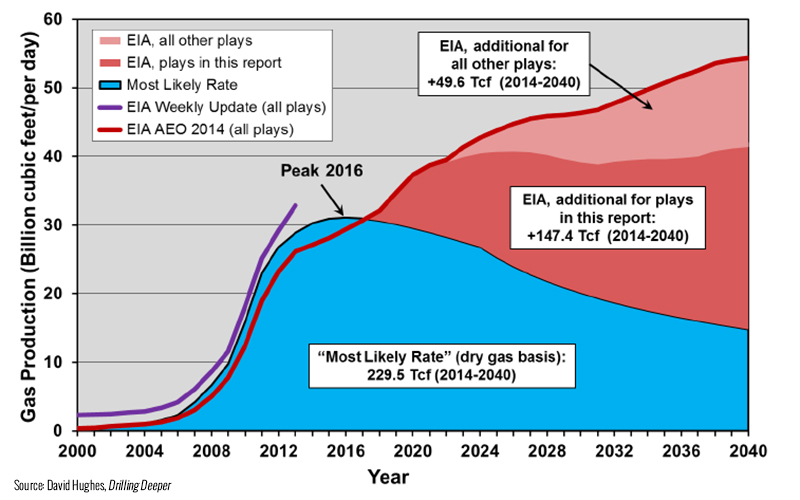
Most Likely Drilling Rate Gas Production from Major Shale Plays through 2040 compared to EIA Shale Gas Forecast. Source: Drilling Deeper
 
While the EIA sees US shale gas production growing through 2040, Hughes forecasts: “Production from these plays peaks in 2016 at nearly 34 Bcf/d and declines to below 16 Bcf/d by 2040, or [by] more than 50%.” This is an enormous difference: if the EIA estimate is accurate, there is indeed the possibility of gas exports—though that would require the oil/gas price differential to increase; and even then there would not be nearly enough gas to supply all of Europe’s needs, in addition to those of American customers. But if Hughes is right, natural gas exports are laughably unlikely and the United States is probably headed into a gas supply crisis in the next decade.
 
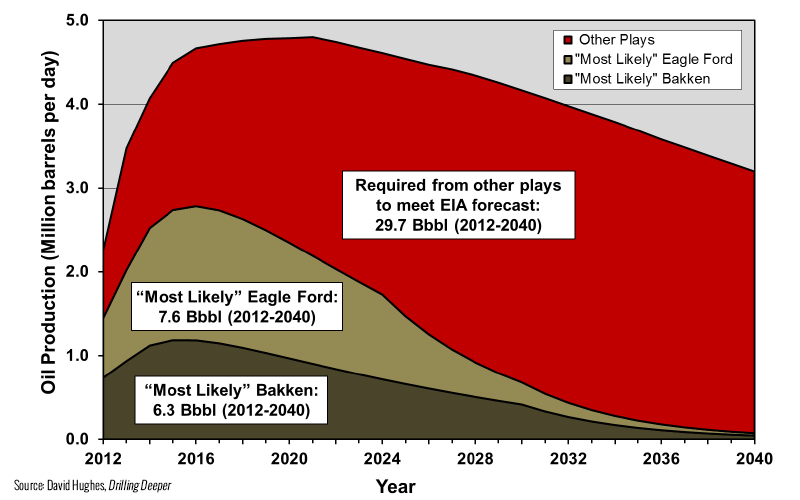
Hughes sees US tight oil production rates topping out around the same time as those of shale gas (i.e., before 2020), and declining much further and faster than the EIA estimates.
 
Most Likely scenario projections of oil production for the Bakken and Eagle Ford plays with the remaining amount of production that would be required from other plays to meet the EIA’s total reference case forecast. Source: Drilling Deeper
 
Why should we believe David Hughes rather than the EIA? Read his report for yourself: it’s thorough, transparent, and logical—something that cannot be said for the forecasts in the EIA’s latest Annual Energy Outlook.  And while EIA has been wrong in its production forecasts more often than it has been right, Hughes is building an impressive track record. In 2011, the EIA published a report estimating the size of the oil reserves in California’s Monterey shale basin at over 15 billion barrels; surely high rates of production would soon boost the Golden State’s economy. With help from PCI, Hughes prepared a thorough geological review of the basin and concluded that the EIA estimate was dramatically overstated. The EIA subsequently downgraded its estimate by 96 percent, to 0.6 billion barrels.  And the promised Monterey shale production boom has not materialized.
 
Even normally insightful energy commentator Michael Klare seems to have bought into to the new narrative of US resource abundance. In a recent article he critiques Republican plans to create “a North American power bloc capable of aggressively taking on Russia, China, and other foreign challengers,” and implicitly accepts that it is physically possible for such plans to work. It would have been useful to his argument against US energy imperialism and continued fossil-fuel energy dominance to point to evidence that North America simply doesn’t have sufficient resources to support oil or gas exports, but nowhere does he hint at this.
 
Commentators and politicians believe the EIA because they assume it is the highest authority on the matter. That’s understandable. But do the current policy makers in Washington — in the State Department, Pentagon, and CIA — also privately stand behind official production forecasts? Or is all the talk about the US using oil and gas exports to neutralize Russia’s influence just a bluff?
 
If they do believe their own talking points, they have embarked on a game they cannot win by making promises they probably cannot even begin to fulfill.
If they don’t believe the hype — that is, if this is all a bluff — then it is a deeply cynical strategy (in the very worst sense of the word). Instead of helping prepare America, Europe, and the rest of the world for an inevitable post-hydrocarbon future, these policy makers are using exaggerated resource estimates merely to score points in a game, while the global arena in which that game is being played is about to be engulfed by economic and ecological catastrophe.
 
My guess is that the Washington power brokers really believe what they are saying. The level of energy literacy among policy makers is abysmal. And with the EIA feeding them misinformation, what else are they to do but try to use it to their advantage? After all, the message of resource abundance is what they want to hear and believe.
 
This is how empires crash: the folks in charge pay their information ministries to come up with only good news; rulers act on the basis of unrealistic assumptions; reality bites; and when it does, no one is prepared.
 
The evidence suggests the United States is playing energy poker with a pair of jacks in its hand, but betting as if it had four aces. Washington can only hope the rest of the world is populated with terrible and unlucky poker players; otherwise, this game could end in bitter feelings at best, gunfire at worst.

Labels: , , , ,